Rajasthan Government to Table Landmark Disturbed Areas Bill in Assembly
The Rajasthan government is poised to introduce a significant legislative proposal titled the "Rajasthan Prohibition of Transfer of Immovable Property and Provision for Protection of Tenants from Eviction from Premises in Disturbed Areas Bill, 2026" during the upcoming assembly session this Friday. This comprehensive bill aims to empower the state administration to designate specific localities as "disturbed areas," thereby imposing stringent regulations on property transactions within these zones.
Key Provisions and Regulatory Framework
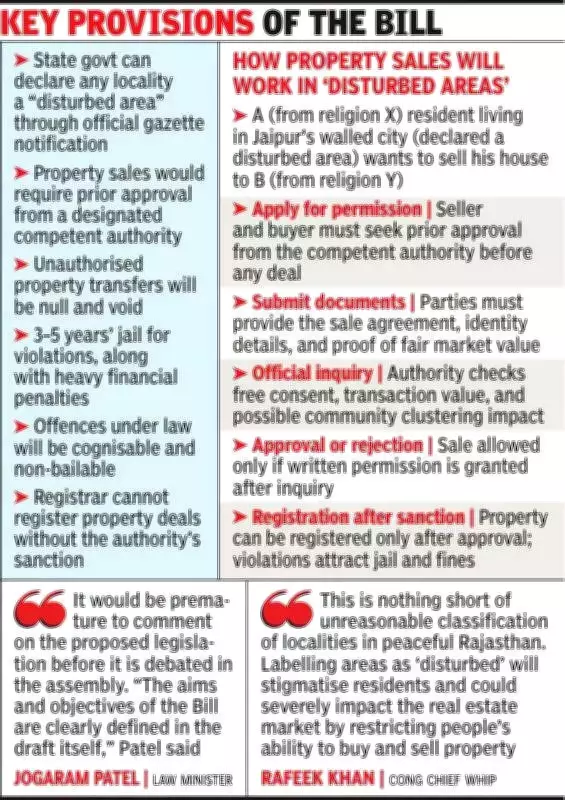
Modeled after existing legislation in Gujarat that was enacted in 1991, the proposed bill enables the government to declare any area as disturbed based on factors such as the intensity and duration of riots, mob violence, or other serious threats to public order. This designation will be formalized through an official gazette notification, providing a legal basis for enhanced oversight.
One of the central features of this legislation is the requirement for prior permission from a designated competent authority for any sale or transfer of property within disturbed areas. This provision effectively makes unregulated property transactions nearly impossible, ensuring that all deals undergo thorough scrutiny before approval.
Impact on Localities and Designation Process
Areas with mixed populations and frequent property dealings, such as Jaipur's historic walled city, are expected to be significantly impacted by these new regulations. The process for designating an area as disturbed will involve a detailed analysis of past disturbances, including their severity and duration, as well as any underlying demographic tensions that could threaten local peace and stability.
Once an area is notified as disturbed, this classification can remain in effect for up to three years. The bill includes provisions for both extension and withdrawal of this status based on improvements in local conditions, allowing for flexibility in response to changing circumstances.
Application and Investigation Procedures
Individuals wishing to sell property within a disturbed area must submit an application to the competent authority. This authority will then conduct a comprehensive investigation, examining multiple factors to ensure compliance with the law's objectives.
- Consent of both parties involved in the transaction
- Fair market pricing of the property
- Potential for demographic imbalance resulting from the sale
The bill explicitly states that "the competent authority shall examine whether the proposed transfer may result in improper clustering of persons of one community affecting demographic equilibrium." This clause underscores the legislation's focus on maintaining social harmony and preventing segregated living patterns.
Penalties and Legal Implications
The legislation outlines severe penalties for violations, with offences being cognisable and non-bailable. Convictions could result in prison sentences ranging from three to five years, accompanied by substantial fines. These fines are set at a minimum of Rs 1 lakh or 10% of the property's value, whichever is higher, serving as a strong deterrent against non-compliance.
Political Support and Legal Challenges
While some members of the Bharatiya Janata Party (BJP) argue that such a law is essential to prevent the migration of Hindu residents from mixed neighbourhoods, legal experts caution that the bill may face significant judicial challenges. Advocate-on-Record Ajay Singh has raised concerns about potential infringements on constitutional rights.
"Such provisions may raise questions about fundamental rights, including equality and the freedom to reside and settle anywhere in India under Article 19," Singh warns, highlighting the delicate balance between maintaining public order and upholding individual liberties.
The introduction of this bill represents a proactive approach by the Rajasthan government to address communal tensions and demographic shifts through regulatory measures, sparking important discussions about property rights, social cohesion, and legal boundaries in sensitive urban areas.