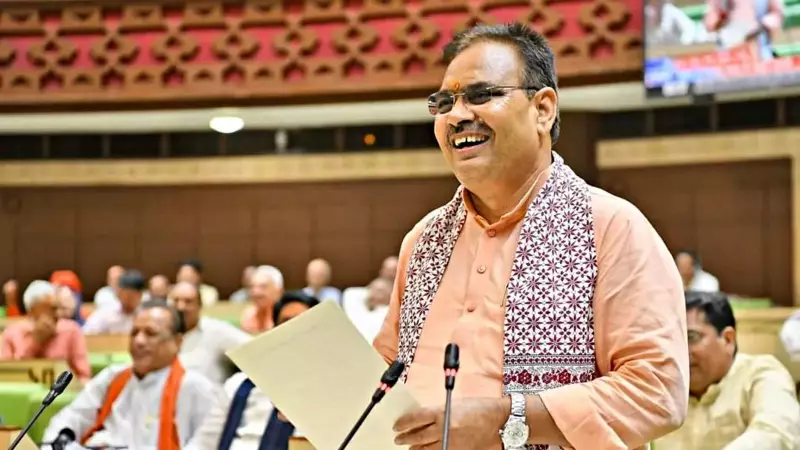
In a significant move towards environmental sustainability and technological governance, the Rajasthan Cabinet, chaired by Chief Minister Bhajan Lal Sharma, has given its nod to two pivotal policies and received an update on a major infrastructure project. The decisions, taken on Tuesday, December 31, 2025, encompass the Rajasthan Vehicle Scrapping Policy-2025 (RVSP) and a dedicated Artificial Intelligence – Machine Learning (AI ML) Policy. Furthermore, the cabinet was informed that the long-awaited Barmer refinery is likely to be inaugurated by Prime Minister Narendra Modi in January.
Rajasthan Vehicle Scrapping Policy-2025: A Green Push
The newly approved Rajasthan Vehicle Scrapping Policy-2025 (RVSP) aims to systematically remove unfit and polluting vehicles from the state's roads. Deputy Chief Minister Prem Chand Bairwa and Public Health Engineering Minister Kanhaiya Lal stated that the policy mandates the phasing out and destruction of such vehicles using scientific, safe, and environment-friendly methods.
Under this framework, several categories of vehicles will be eligible for scrapping. These include government vehicles older than 15 years, vehicles without valid fitness or registration certificates, those damaged in accidents, scrap vehicles purchased at auction, unusable vehicles, and vehicles voluntarily donated to the Rajasthan Vehicle Scrapping Facility (RVSF).
A key incentive for vehicle owners is a motor vehicle tax rebate of up to 50 percent, capped at a maximum of Rs 1 lakh, on the purchase of a new vehicle. To avail this benefit, owners will receive a Certificate of Deposit (COD) and a Certificate of Vehicle Scrapping (CVS) from an authorised scrap centre, which can be digitally uploaded to the national Vahan portal.
The policy also promotes the establishment of RVSFs across the state. The entire scrapping process will be integrated with the Vahan portal, ensuring complete transparency, digital tracking, and eliminating the possibility of scrapped vehicles being used illegally.
AI ML Policy: Ethical and Responsible Use
In a parallel decision, the cabinet approved the state's Artificial Intelligence – Machine Learning (AI ML) Policy. Deputy CM Bairwa explained that the policy's core objective is to leverage AI and ML for faster, more transparent, and citizen-centric public service delivery. It also seeks to enhance administrative efficiency and foster innovation-driven economic growth.
The policy places a strong emphasis on the ethical and secure deployment of these technologies. It mandates that AI systems developed or used by the state must be transparent, accountable, fair, and designed to protect citizen privacy. A major focus will be on reducing bias in AI algorithms, ensuring robust data protection, and maintaining clarity in AI-assisted decision-making processes.
Barmer Refinery Nears Completion, Inauguration Expected
In other major news, Cabinet Minister Jogaram Patel announced that the nearly Rs 80,000 crore refinery and petrochemical complex in Barmer's Pachpadra is likely to be inaugurated by Prime Minister Narendra Modi in January, barring any last-minute hurdles.
Patel noted that work on the 9 million metric tonne per annum capacity project has accelerated under the current state government and is nearing completion. The project's cost has seen revisions over time. Initially estimated at Rs 43,129 crore with a completion deadline of October 31, 2022, the cost had escalated to Rs 72,937 crore by June 2, 2023, during the previous government's tenure.
The cabinet has now approved a second revised cost proposal from HPCL Rajasthan Refinery Ltd. (HRRL), setting the new project cost at Rs 79,459 crore—an increase of Rs 6,522 crore. The debt-equity ratio remains at 2:1. The Rajasthan government's equity share stands at 26 percent, amounting to Rs 6,886 crore, and it will contribute an additional Rs 565.24 crore as equity due to the cost escalation.
Reacting to the development, former Chief Minister Ashok Gehlot credited the Congress-led UPA government for securing the project for Rajasthan. He stated that the foundation stone was laid in 2013 with the intervention of then-PM Manmohan Singh and UPA chairperson Sonia Gandhi. Gehlot alleged that the project was stalled for five years after the BJP came to power in the state in 2013, leading to cost overruns, and expressed hope that the current government would expedite its inauguration.
These cabinet decisions mark a multi-pronged approach by the Rajasthan government, addressing critical areas of environmental conservation, technological ethics, and industrial development, setting a roadmap for the state's future growth.