

SAD Levels Serious Allegations Against Punjab Government's Land Acquisition Policy
In a significant development in Mohali, the Shiromani Akali Dal (SAD) has launched a scathing attack on the Punjab government's land pooling scheme, alleging widespread misuse and exploitation of farmers. The political party claims that under the guise of development, fertile agricultural land is being systematically acquired and transferred at rates far below market value, threatening the livelihoods of local agricultural communities.
Political Unusual: Congress Mayor Joins SAD-Led Protest
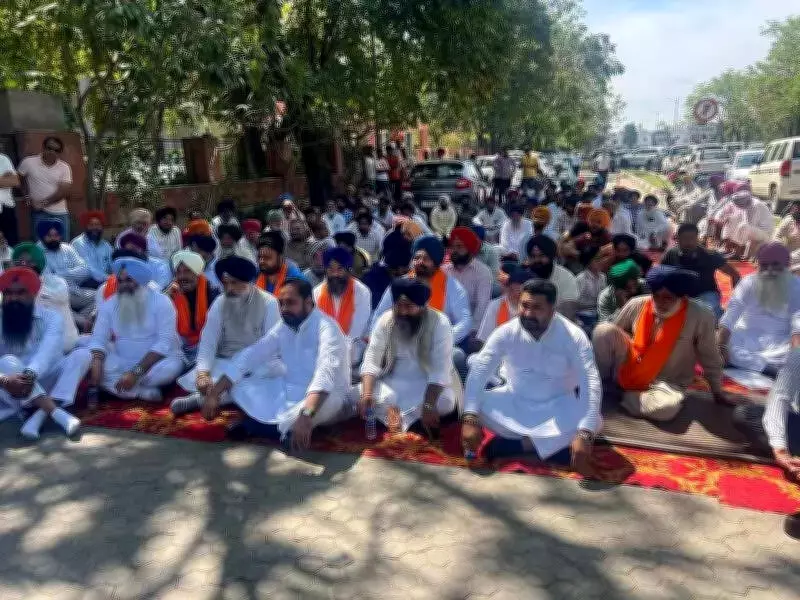
Adding an intriguing political dimension to the controversy, Congress mayor Amarjit Singh Sidhu was observed participating in the SAD-organized rally in Mohali. His presence signaled cross-party support for the protesting farmers and demonstrated opposition to the Aam Aadmi Party (AAP)-led state government's handling of the land acquisition issue.
Farmers Launch Sustained Agitation Against Land Acquisition
The protest movement has gained substantial momentum, with farmers from approximately 24 villages actively demonstrating against the proposed land acquisitions. The agitation has taken various forms, including a relay hunger strike initiated by seven farmers, highlighting the depth of their opposition to the government's policies.

Addressing the gathering of protesting farmers outside the PUDA Bhawan in Phase 8, Mohali, SAD district president Parvinder Singh Sohana delivered a powerful critique of the land pooling scheme. "What is being projected as a farmer-friendly initiative is actually causing significant harm to agricultural interests," Sohana asserted during his speech.
Allegations of Financial Irregularities and Incomplete Development
Sohana raised serious concerns about potential financial irregularities within the implementation of the land pooling policy. He alleged that the scheme is facilitating the sale of valuable agricultural land at artificially low prices, suggesting possible corruption or mismanagement in the valuation and transfer processes.
The SAD leader further criticized the government's development track record, pointing out that basic infrastructure remains incomplete in numerous already-acquired areas. "Roads, water supply systems, and sewerage networks are still lacking in a large number of developed sectors and colonies," Sohana emphasized, questioning the government's priorities and implementation capabilities.
Long-Term Consequences and Farmer Resistance
Sohana warned about the potential long-term consequences of continued agricultural land acquisition, suggesting it could disrupt the region's socio-economic and geographical balance. He stressed that farmers are unlikely to accept policies they perceive as directly threatening their traditional livelihoods and economic security.
Several prominent farmer representatives and local leaders have thrown their weight behind the protest movement. Notable figures including Karamjit Singh Mauli, Gurkripal Singh Sidhu, and Shamsher Singh Purkhalvi were present at the protest site, demonstrating broad-based support for the ongoing agitation against the land pooling scheme.
Demands for Policy Review and Stakeholder Consultation
The protesting farmers have presented clear demands to the state government, calling for an immediate reconsideration of the land pooling policy. They insist that proper consultations with all stakeholders, particularly affected farmers and agricultural communities, must occur before any further implementation of the scheme.
Sohana concluded his address with a sharp critique of the government's priorities, alleging that instead of focusing on genuine public welfare, the administration appears to be acting in ways that primarily benefit private interests. The controversy continues to escalate as farmers maintain their protest, seeking meaningful dialogue and policy adjustments from the AAP-led Punjab government.






