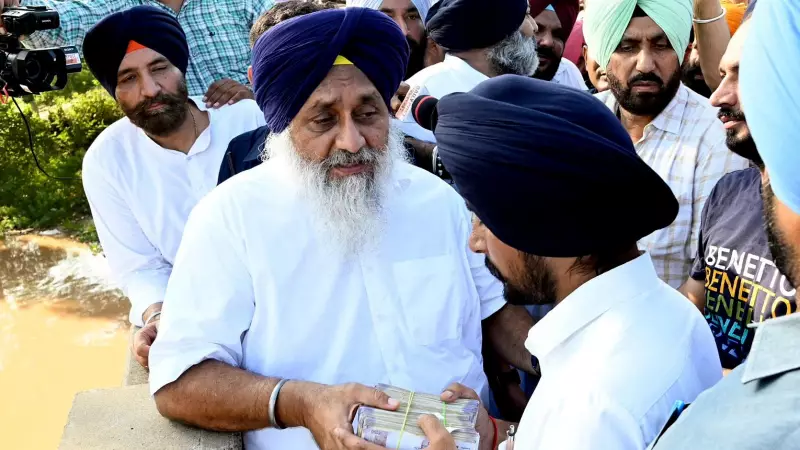
Shiromani Akali Dal (SAD) president Sukhbir Singh Badal has launched a sharp critique against the central government's newly enacted rural employment law, demanding its immediate withdrawal. The former Punjab deputy chief minister argues that the Viksit Bharat Guarantee for Rozgar and Ajeevika Mission (Gramin) Act, or VB-G RAM G Act, will adversely affect the poor and impose an unfair financial load on state governments.
Call to Restore the Old MGNREGA Framework
Addressing journalists in Amritsar, Badal emphasized the virtues of the previous scheme, the Mahatma Gandhi National Rural Employment Guarantee Act (MGNREGA). He highlighted that MGNREGA guaranteed 100 days of wage employment for rural households and was entirely funded by the central government. "The government should withdraw its decision as it will directly impact the lives of the poor," Badal stated, referring to the new VB-G RAM G Act.
His demand for a rollback came just a day after President Droupadi Murmu gave her assent to the VB-G RAM G Bill, which effectively replaces MGNREGA. The new legislation increases the guaranteed wage employment from 100 to 125 days for rural workers.

Financial Burden and Symbolic Erasure
Badal pinpointed a major flaw in the new act's design: the cost-sharing model. He revealed that under the VB-G RAM G Act, state governments are required to bear 40 per cent of the scheme's expenses. This, he asserted, would place a significant additional financial burden on states, many of which are already grappling with strained budgets.
Beyond the fiscal argument, the SAD leader also took issue with the removal of Mahatma Gandhi's name from the landmark rural employment law. "Mahatma Gandhi ji was that person who fought for the country's freedom. If any scheme is run in his name, it should not be changed," Badal remarked, criticizing the symbolic shift.
The Core Conflict: Central vs. State Responsibility
The controversy underscores a growing tension between the Centre and states regarding the funding of welfare schemes. Badal's opposition frames the VB-G RAM G Act not as an upgrade but as a problematic policy that dilutes central responsibility and risks the welfare of India's rural poor. His call to action is clear: scrap the new law and fully restore the centrally-funded MGNREGA to protect vulnerable populations and state finances.
As the political debate intensifies, the implementation of the VB-G RAM G Act and its impact on rural employment will be closely watched, especially in agrarian states like Punjab.