

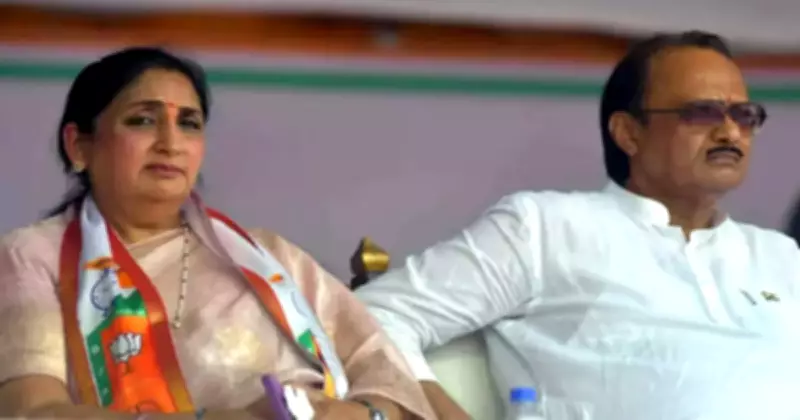
Sunetra Pawar's Historic Rise to NCP Leadership
The elevation of Sunetra Pawar as the national president of the Nationalist Congress Party represents a defining moment in the organization's history. Her promotion comes during what is arguably the NCP's most severe crisis yet—the tragic demise of her husband and the party's then-chief, Ajit Pawar, in a private plane crash in January.
A Political Novice Takes the Helm
Despite being a complete political newcomer, Sunetra Pawar now occupies all three crucial positions that Ajit Pawar held at the time of his passing. She serves as Maharashtra's deputy chief minister, NCP president, and leader of its legislature party simultaneously. The party moved with remarkable speed to fill these key vacancies, a strategic decision aimed at preventing any leadership vacuum during this turbulent period.
The tragedy struck at a particularly sensitive moment, when both NCP factions were reportedly close to formal reunification. This raises the critical question: with a new leader now firmly established, does this development permanently close the door on a potential merger between the divided factions?

The Swift Leadership Transition
The NCP's rapid filling of vacant posts drew considerable attention and some criticism from political observers. On January 31, merely three days after Ajit Pawar's death, Sunetra Pawar assumed two of the three roles he had occupied. Then, on February 26, just two days before the one-month anniversary of the fatal crash, she was unanimously elected to the third and most significant position—NCP chief.
According to political analysts, this accelerated leadership transition was driven by concerns within certain party sections that Sharad Pawar, the family patriarch who co-founded the NCP in 1999 and led it for nearly a quarter-century, might attempt to reassert his influence following any potential merger. The fact that the veteran leader was reportedly not consulted about the decision—as he himself revealed publicly—suggests there may have been deliberate strategic calculations behind the party's hurried move to establish new leadership.
NCP Reunion Now Off the Table
The appointment of the NCP's new president, combined with the war of words that erupted after Ajit's passing and subsequent statements from both camps, all point toward the same conclusion: the much-discussed merger is definitively off the table.
Since assuming leadership, Sunetra Pawar has actively sought to establish her authority, frequently speaking about her late husband and emphasizing her commitment to fulfilling the vision he had for Maharashtra's development. "The lifelong commitment of Ajit Pawar saheb to the development of Maharashtra and his tireless work for the people will always guide me," she declared after taking over as NCP boss.
The Sharad Pawar faction, officially known as NCP (Sharadchandra Pawar), has been even more explicit in ruling out any reunion. Key family members including Ajit's cousin Supriya Sule and nephew Rohit Pawar have stated unequivocally that the merger discussion ended with his passing, declaring the matter closed and not worth further debate.
With the leadership question now settled and reunion prospects eliminated—at least for the foreseeable future—the NCP has two fewer critical issues to navigate during this transitional phase.
The Merger That Never Materialized and Electoral Setbacks
That the NCP factions were approaching reunification, as revealed following the Baramati tragedy, came as little surprise to political observers. Several developments had already signaled this possibility. Despite the political split, the Pawar family had maintained visible unity, with members frequently appearing together at family gatherings. More significantly, ahead of recent municipal elections in Maharashtra, the two groups collaborated to jointly contest several municipal corporations, with Ajit Pawar and Sunetra themselves addressing a press conference to announce the partnership.

However, this electoral alliance failed to deliver substantial results. Of the total 2,869 seats contested across 893 wards and 29 municipal corporations, the NCP secured only 167 seats while the NCP (SP) managed just 36. These disappointing numbers indicated a clear decline in the electoral influence traditionally wielded by the Pawar political dynasty.
Historical Context: How the NCP Split Occurred
Ajit Pawar's July 2023 rebellion marked his second major political insurrection, but unlike his previous attempt, this one proved successful. His first significant rebellion occurred in November 2019, following the breakdown of the BJP-Shiv Sena alliance over the latter's demand for the chief minister's position. In a dramatic early-morning move, Ajit took oath as deputy chief minister alongside BJP's Devendra Fadnavis, who was sworn in as chief minister.
That government lasted a mere 80 hours as senior Pawar—the seasoned former Maharashtra chief minister—ensured all defectors returned to the party fold. Left with no alternative, the nephew also returned and subsequently became deputy chief minister for a fourth term, this time within the Maha Vikas Aghadi government comprising Shiv Sena, Congress, and NCP.
Over two years later, nearly a year after the MVA government's collapse in June 2022, Ajit revolted again, this time joining the coalition led by the BJP and the Shiv Sena faction headed by Eknath Shinde, which was then governing Maharashtra. He was appointed deputy chief minister for a fifth term, and this time, the split proved permanent. The Election Commission of India later recognized Ajit Pawar's faction as the legitimate NCP, while the other faction became known as NCP (SP). He returned for a sixth and final term following the alliance's landslide victory in the November 2024 state assembly elections.
What Lies Ahead for the NCP
With leadership uncertainty resolved and reunion prospects eliminated, Sunetra Pawar can now concentrate on settling into her new roles. She faces the dual challenge of learning political intricacies from senior NCP leaders while gradually carving out her own distinct space within the party organization.
Currently serving as a Rajya Sabha MP, she has approximately six months to secure election as a Maharashtra MLA or MLC to continue as deputy chief minister. This election is widely expected to be largely procedural, as she is likely to contest from Ajit's Baramati assembly constituency and is anticipated to win by a substantial margin.
Her most significant challenge will involve strengthening the NCP electorally, particularly given its disappointing performance in recent civic body elections. Even in Pune—a traditional Pawar stronghold where the family holds considerable influence—the party managed only 37 seats in the 165-member civic body, while the NCP (SP) performed even worse with just three seats. In the 128-member Pimpri-Chinchwad Municipal Corporation, another former Pawar bastion, the NCP won 37 seats while the NCP (SP) failed to secure any representation.
Sunetra Pawar now shoulders the formidable responsibility of upholding both her family's political legacy and her late husband's substantial contributions. She must balance the considerable weight of the Pawar name while establishing her own unique identity within the NCP and Maharashtra's complex political landscape.





