

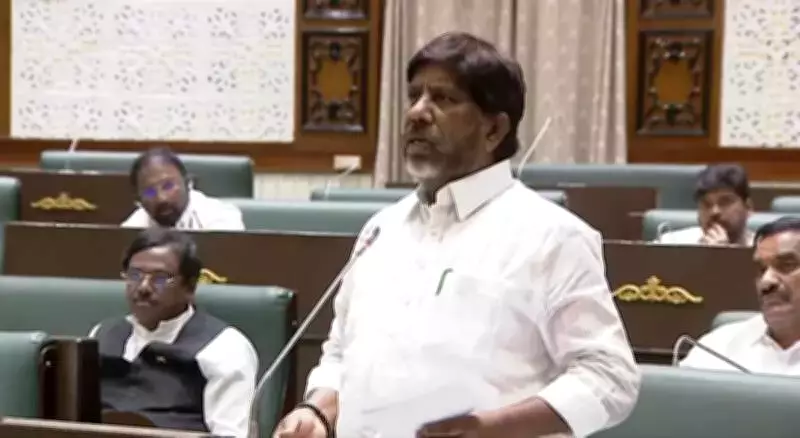
Telangana Deputy CM Outlines PRC Timeline and Employee Welfare Initiatives
In a detailed address during the assembly question hour on Monday, Deputy Chief Minister Bhatti Vikramarka provided clarity on the Pay Revision Commission (PRC) and outlined the state government's efforts to address employee welfare issues. Responding to queries from BRS MLA T Harish Rao and others, Bhatti emphasized the Congress government's commitment to resolving long-standing concerns of government employees and pensioners.
PRC Term and Implementation Plans
Bhatti Vikramarka confirmed that the term of the Pay Revision Commission is valid until March 31, 2026. He assured the assembly that the state government will make a decision to implement new pay scales for government employees once the commission submits its report. This announcement comes amid ongoing discussions about the timeline for PRC implementation, which has been a key point of contention.
Addressing Pending DAs and Arrears
The deputy CM highlighted that the Congress government has already cleared three Dearness Allowances (DAs) that were left pending by the previous BRS administration. Four more DAs remain outstanding, and the government plans to implement them in a phased manner. Bhatti detailed the financial challenges inherited from the BRS government, noting that arrears totaling 40,150 crore were left behind, with 4,575 crore specifically related to employee bills.

To tackle this burden, the government has been regularly paying 700 crore every month to clear pending employee dues. Bhatti revealed that a policy decision is under consideration to increase this monthly payment to 1,000 crore, aiming to expedite the clearance of arrears. Since assuming power, the Congress government has cleared approximately 6,146 crore related to government employees.
Retirement Age Changes and Benefits
Bhatti criticized the previous BRS government for increasing the retirement age from 58 to 61 years for general employees and from 60 to 65 years for Class IV employees. He argued that this move was intended to avoid payment of retirement benefits, shifting the burden of 17,000 employees' benefits onto the Congress government. A white paper released in the assembly documented these financial issues, underscoring the scale of the challenge.
Employee Welfare Measures
The deputy CM outlined several initiatives aimed at improving employee welfare:
- Cashless Medical Treatment Cards: The cabinet has introduced these cards for employees, addressing a demand that unions had struggled with for nearly a decade during the BRS tenure.
- Accident Insurance Scheme: The government is implementing a 1.25 crore accident insurance plan for employees, providing financial support to families in the event of accidental death.
- Freedom for Union Leaders: Leaders of employee unions have been granted complete freedom to meet the CM, deputy CM, and ministers at any time, removing restrictions imposed by the previous government.
Salary Payments and Financial Management
Bhatti contrasted the current administration's practices with those of the BRS government, stating that salaries are now credited on the 1st of every month without delay, compared to payments after the 15th under the previous regime. He accused the BRS government of creating financial destruction and weakening systems, making it difficult to even pay employee salaries. The Congress government, he asserted, is committed to prioritizing employee welfare and restoring financial stability.
Opposition Queries and Responses
During the question hour, BRS MLA T Harish Rao raised several pointed questions, accusing Bhatti of evading answers. Harish Rao questioned the delay in implementing the pending five DAs and the PRC, noting that Congress had promised a new PRC within three months of assuming power in its election manifesto. With two and a half years having passed, he urged the government to clarify when the PRC would be implemented or if another extension was planned.

Harish Rao also asked about increasing Interim Relief (IR) for employees, as done previously under the KCR government, and highlighted the hardships faced by retired employees awaiting their benefits. He challenged the government's allocation of funds for projects like Future City and Musi, questioning why money was unavailable for PRC and DA arrears. Bhatti's responses focused on the ongoing efforts to address these issues systematically, emphasizing the humane approach and financial constraints inherited from the previous administration.
This assembly session underscored the ongoing political debate over employee welfare in Telangana, with the Congress government defending its record and the opposition pressing for faster action on key promises.





