

Telangana Land Survey Exposes Deep Caste-Based Economic Disparities
The recently released SEEEPC Survey-2024 has unveiled a compelling narrative about land ownership patterns in Telangana, revealing that economic power is unevenly distributed across castes in ways that transcend simple population statistics. The data indicates that several communities with relatively smaller populations command a disproportionately higher share of land, while others continue to remain significantly land-poor despite their larger numbers.
Stark Examples of Disproportionate Land Ownership
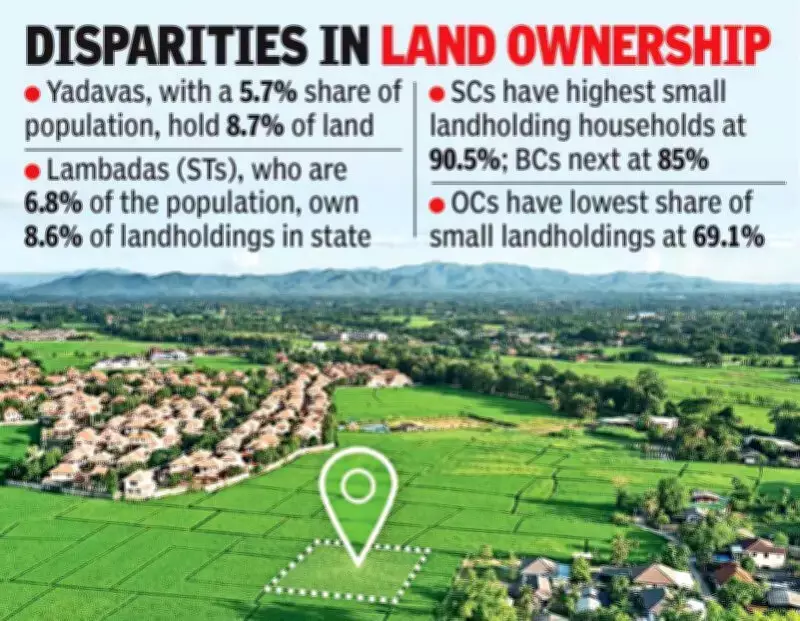
Among the most striking findings is the case of Reddys, classified as Other Castes (OCs), who own approximately 13.5% of the state's land despite accounting for just 4.8% of the population. Similarly, Yadavas from the Backward Classes (BCs) category, with a 5.7% population share, hold 8.7% of land. Lambadas, belonging to Scheduled Tribes (STs) and constituting 6.8% of the population, own 8.6% of landholdings. The survey also identified Velamas (OCs) and Koyas (STs) as communities enjoying relatively higher land ownership compared to their population size.
Communities Facing Historical Exclusion
In stark contrast, communities such as SC Bedas and OC Muslims have significantly lower land ownership relative to their population, highlighting their historical exclusion from land assets. The report emphasizes that seven specific castes—Reddy, Yadav, Lambada, Mudiraj, Munnuru Kapu, Kuruma, and Koya—collectively make up 32% of Telangana's population but control a staggering 51% of its land. This concentration underscores how land continues to be a critical factor shaping economic strength and social standing in the region.

"Land ownership is especially significant because it offers not only a source of income through agriculture or rental but also social status, economic security, and bargaining power," the report stated. It further classified landholdings into categories: lands below five acres are considered small, 5 to 20 acres as medium, and above 20 acres as large landholdings.
Independent Analysis Reveals Nuanced Insights
An independent experts group that analyzed the SEEEPC report noted that there is no direct link between land ownership and the overall backwardness of castes. The analysis highlighted three key points:
- First, the disparities in land ownership between OCs and marginalized groups are not as pronounced as in other parameters like education, occupation, and living conditions.
- Second, STs, by virtue of owning large tracts of dry or fallow land, score better than BCs and SCs in this specific parameter.
- Third, mere ownership of land or being less backward in the land parameter does not automatically translate into reducing overall backwardness.
Complexities in Backwardness and Land Ownership
The report also pointed out that some BC castes, such as goldsmiths or BC Christians, own limited land yet are less backward overall due to better performance in education and occupations. Conversely, castes like Kuruma, where many own land—often in small parcels—continue to face higher levels of backwardness. This suggests that land ownership alone is not a silver bullet for socio-economic advancement.
Distribution of Landholding Sizes Across Castes
The survey further reveals that SCs have the highest proportion of small landholding households at 90.5%, followed by BCs at 85%. This indicates a heavy dependence on fragmented and often unviable plots, which can hinder agricultural productivity and economic stability. In contrast, OCs have the lowest share of small landholdings at 69.1%, indicating greater access to medium and large land parcels. These larger holdings typically offer stronger economic stability and better agricultural returns, perpetuating the cycle of inequality.
The SEEEPC Survey-2024 serves as a critical document for understanding the deep-rooted economic disparities in Telangana, emphasizing the need for targeted policies to address land distribution and promote inclusive growth across all caste groups.






