

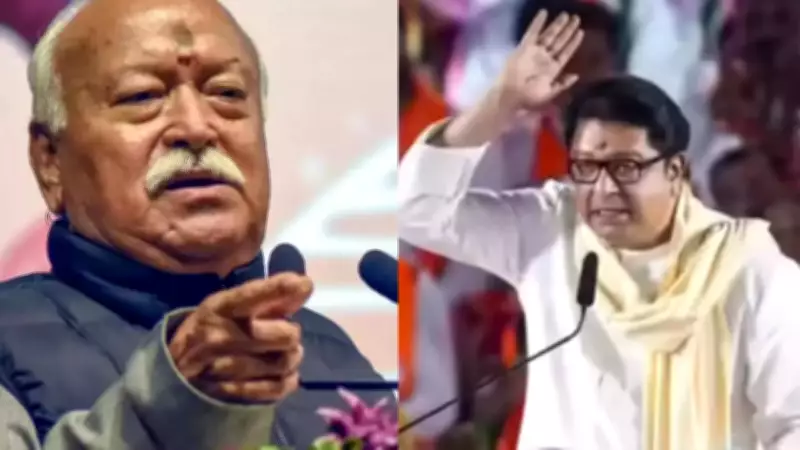
MNS Chief Raj Thackeray Launches Scathing Attack on RSS Chief Mohan Bhagwat Over Linguistic Remarks
MUMBAI: In a strongly worded statement issued on Sunday, Maharashtra Navnirman Sena (MNS) chief Raj Thackeray launched a sharp critique of Rashtriya Swayamsevak Sangh (RSS) chief Mohan Bhagwat. Thackeray took issue with Bhagwat's recent characterization of linguistic assertion and agitations as a "kind of disease," calling the statement dismissive of India's federal structure and linguistic diversity.
Defense of Linguistic Pride Across Indian States
Reacting to Bhagwat's comments made at an event in Mumbai on February 8, Thackeray argued that love for one's language and region cannot be trivialized as a disorder. He emphasized that strong linguistic and provincial identities exist throughout the country. "If love for one's language is a disease, then this disease has spread across most Indian states," Thackeray declared in his statement.
The MNS leader cited historical examples from Karnataka, Tamil Nadu, West Bengal, Punjab, and Gujarat to underline that linguistic pride and regional identity are not unique to Maharashtra. He pointed to the historical reorganization of states on linguistic lines as evidence of this reality.

Questioning RSS Event Attendance and Political Neutrality
Thackeray questioned the presence of several prominent personalities at the RSS event, suggesting their attendance stemmed not from admiration for Bhagwat but from fear of the Narendra Modi-led government. "Otherwise, why did nobody attend such dull and boring sermons earlier?" he asked, urging the RSS chief to "come out of this misconception."
While asserting respect for the Sangh's work, Thackeray said it should refrain from taking indirect political positions. He questioned why the RSS, which claims to be a non-political organization, was involving itself in such issues, particularly referencing remarks made by RSS leader Bhaiyyaji Joshi before elections suggesting that Mumbai's language was not limited to Marathi.
Migration Issues and Regional Tensions
The MNS chief pointed to tensions arising when large groups of migrants move to other states, allegedly disregard local culture and language, and attempt to build political vote banks. Such behavior, he said, naturally leads to resentment among locals. "You call this a disease?" Thackeray asked, adding that similar incidents had occurred in Gujarat when migrants from Uttar Pradesh and Bihar were driven out. "Why didn't you go there to preach harmony?" he challenged Bhagwat.
Criticism of Government Language Policies
Thackeray further challenged Bhagwat to first criticize the government for what he described as the imposition of Hindi across the country, noting that Hindi is not India's national language. He warned against what he called the "force-fitting" of Hindutva into linguistic debates.
MNS's Stance on Various Issues
Reiterating the MNS's past actions, Thackeray said the party had taken stands against communal riots, loudspeakers at religious places, and noise pollution during festivals, irrespective of religion. "What is wrong is wrong — we say it plainly," he stated.
He accused the RSS chief of remaining silent on what he described as chaos unfolding in the name of Hindutva across the country, citing incidents during Kanwar Yatras, rising beef exports, and politicization of cow slaughter as examples. Thackeray questioned when the RSS would hold the government and traders accountable on these issues.
Marathi Identity as Supreme Priority
Concluding his statement, Thackeray emphasized that the Marathi language and the Marathi people remain the MNS's supreme priority. "Linguistic and regional identities will continue to exist in this country and in Maharashtra," he asserted, warning that such sentiments form the party's very reason for existence. "Whenever such situations arise, Maharashtra will rise with fury."
Accusing the ruling establishment in Maharashtra of weakness, Thackeray said Bhagwat would not dare make such statements in other states where linguistic pride is equally strong and vocal.






