

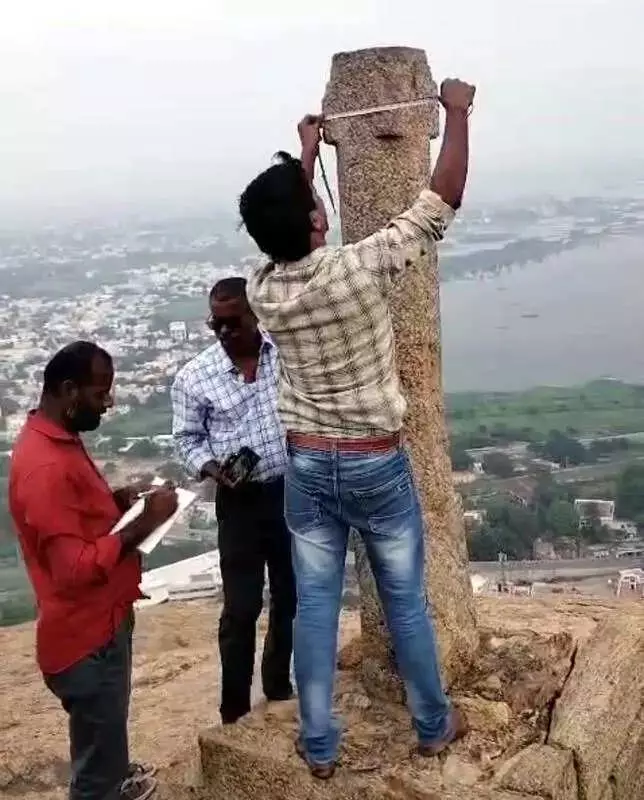
The Tamil Nadu government has informed the Madras High Court that it has not formed any opinion regarding the stone pillar atop the Thiruparankundram hill in Madurai district. The state's stance is due to a lack of empirical data to prove whether the structure was a Deepam post or when it was erected.
State's Position in Court
Advocate-General P S Raman conveyed the government's position to a division bench comprising Justice G Jayachandran and Justice K K Ramakrishnan on Thursday. The state explicitly stated that no deepam (traditional lamp) has ever been lit at the site so far. Raman emphasized that the government is refraining from taking a definitive stand because it is unsure of the pillar's nature.
"There is no material or proof available regarding the origin and purpose of the structure," the Advocate-General told the court. The bench was hearing a series of appeals challenging a single judge's order. That order had directed the management of the Subramaniya Swamy temple to light the Karthigai Deepam at the stone lamp pillar on the hill.

Historical Context and Ongoing Study
Raman provided historical context, noting that a judge who ruled on a civil suit in 1920 had inspected the area. That judge concluded that the only religious structure on the hill's summit was the dargah and its adjuncts.
Furthermore, the Advocate-General revealed that long before the current legal issue arose, the state's survey and revenue departments had initiated proceedings. These proceedings aim to verify the significance of stone pillars in Madurai and Tirunelveli districts. An official Government Order (GO) has been issued for this study, and a report is awaited.
"When it is done, it would throw some light on the origin and purpose of the stone pillar," Raman submitted, indicating that the government is awaiting factual findings before forming a conclusion.
Legal Arguments and Procedural Issues
The court also heard arguments about the proper legal channel for deciding such matters. Raman pointed out that the temple's executive officer (EO) had previously responded to a petitioner's representation. The EO's order stated that an existing custom would be continued to ensure a harmonious festival.
However, the Advocate-General argued that the EO lacked the authority to decide on customs, a power vested in the Board of Trustees. "Wrong question was asked to the wrong person," he remarked.
Raman asserted that the correct legal remedy for the petitioners is under Section 63(e) of the Tamil Nadu Hindu Religious and Charitable Endowments Act, 1959. This section grants the HR and CE department authorities the power to decide on such disputes.
Counsel for the petitioners presented counter-arguments. One senior counsel expressed reluctance to approach authorities under Section 63(e), as they had already given an opinion. Another counsel contended that lighting the Deepam atop the hill was not a new custom.
After hearing arguments for five days, the division bench reserved its orders on the matter.






