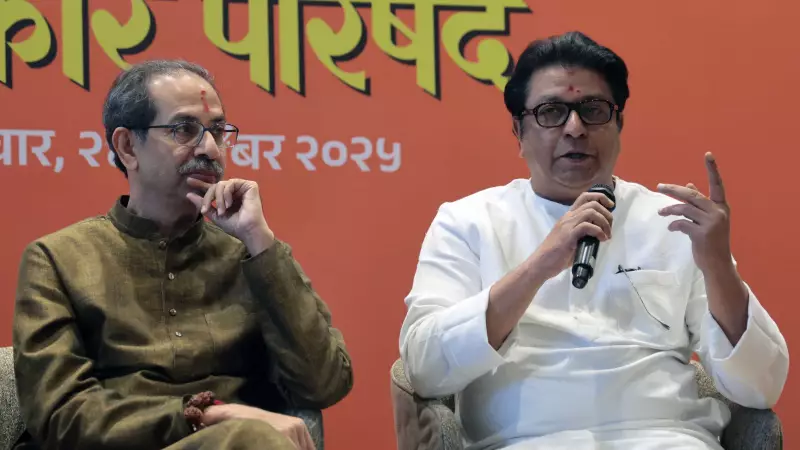
The recent formal alliance between Uddhav Thackeray's Shiv Sena (UBT) and Raj Thackeray's Maharashtra Navnirman Sena (MNS) for the upcoming Brihanmumbai Municipal Corporation (BMC) polls is not merely a political reunion. It is a strategic necessity dictated by two decades of electoral data from India's richest civic body. A deep dive into the last four BMC elections reveals a persistent pattern: no political party has managed to secure more than 30% of the total vote share since 2002. This inherent fragmentation of the electorate forces parties into alliances, seat-sharing pacts, and tactical coordination, making outright popular mandates a rarity in the city.
The Fractured Mandate: Mumbai's Consistent Split Verdict
Unlike state or national elections, BMC polls are fought ward-by-ward in a metropolis where voter preferences are sharply divided along lines of language, income, locality, and occupation. The city rarely rallies behind a single party uniformly. The data underscores this split personality.
In the 2002 BMC election, the Shiv Sena emerged as the largest party with 28.10% of the vote, barely ahead of the Congress at 26.48%. Fifteen years later, in 2017, the scenario was strikingly similar. Despite significant political upheavals in the intervening period, the winning party's vote share remained capped below the 30% threshold. This dispersion means control of the 227-member corporation hinges less on a sweeping wave of support and more on a party's ability to manage vote division and convert narrow leads into seat victories.

The Alliance Arithmetic: From Dominance to Dependence
For years, the Shiv Sena was the dominant force in the BMC, yet its vote share tells a story of a stagnant base rather than expanding dominance. In 2002, it polled 28.10%, and in 2017, it was nearly identical at 28.29%. In the 2007 and 2012 elections, its share even dipped to around 22%. Despite this, the party won a large number of seats—97 in 2002 and 84 in 2017—primarily because the anti-Sena vote was splintered among multiple opponents, and it long benefited from an alliance with the BJP.
The 2017 election marked a pivotal break when the BJP and Shiv Sena decided to contest independently. The BJP's vote share skyrocketed from below 9% in previous polls to 27.32% in 2017, and it won 82 seats. However, even this dramatic rise could not breach the 30% ceiling or dislodge the Sena as the single-largest party. This outcome underscores why, despite its strength, the BJP now sees an alliance with the Eknath Shinde-led Shiv Sena as crucial for power.
The case of the MNS is particularly instructive. In 2012, the party secured a substantial 20.67% vote share but won only 28 seats, dramatically altering outcomes by cutting into the Sena's base. By 2017, its share collapsed to 7.73%. In the current landscape, with the Shiv Sena itself split and traditional vote banks fractured, the Uddhav Thackeray-led faction views an alliance with the MNS not as a guaranteed victory lap but as a vital move to prevent further erosion of its core vote.
The Unbreakable Ceiling and the Path to Power
The lesson from twenty years of BMC elections is unequivocal. Mumbai has never given a single party the simple majority needed to govern the corporation alone. Elections are ultimately decided by coalition-building and managing micro-level ward arithmetic rather than by overarching popularity.
For the Thackeray cousins, their pact aims to consolidate a specific voter segment and improve chances in tightly contested wards. However, the 30% vote share ceiling remains a formidable barrier for any single entity. As the city approaches its next civic poll, the historical data makes one reality clear: in the complex calculus of Mumbai's civic politics, alliances are not a choice but the most reliable, and often the only, route to power.