Abdulla Aboobacker Bounces Back from Injury Setbacks, Sets Sights on 2026 Glory
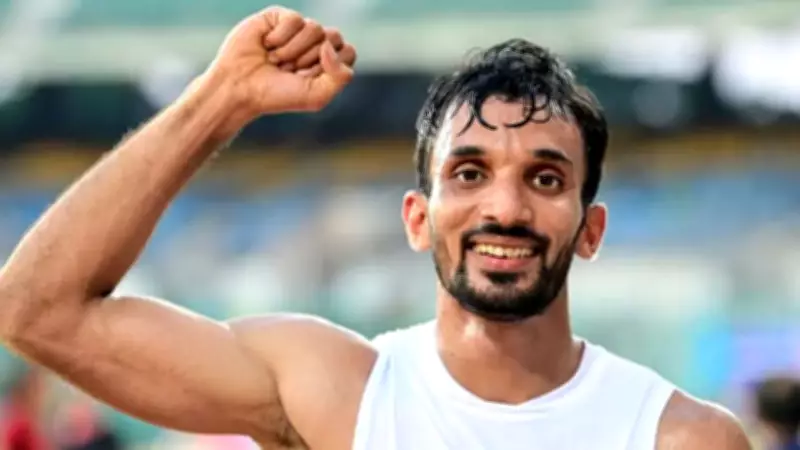
After a challenging 2025 season marred by injuries and inconsistent form, India's premier triple jumper, Abdulla Aboobacker, is steadily regaining his competitive edge. The 30-year-old athlete from Kerala is demonstrating enhanced consistency through a series of solid performances, positioning himself strongly ahead of a demanding 2026 athletics calendar filled with major international competitions.
Overcoming Physical Hurdles and Regaining Momentum
Last year proved particularly difficult for Aboobacker, as he grappled with persistent back and ankle pain that significantly disrupted his training and competition schedule. These physical issues forced him to withdraw from several tournaments and culminated in a disappointing performance at the World Athletics meet in Tokyo. There, he finished a distant 10th in Group A with a modest jump of 16.33 meters, failing to advance to the final round.
In response to these setbacks, Aboobacker made the strategic decision to take an extended break of nearly two months. This period was dedicated entirely to focused recovery and meticulous injury management, allowing his body to heal and rebuild strength.

Strong Return and Key Qualification Achieved
His return to competition has been marked by immediate success. In March, at the Indian Open Jumps competition held in Bengaluru, Aboobacker claimed the gold medal with an impressive leap of 16.83 meters. This performance was notable as it saw him defeat national record holder Praveen Chithravel, signaling a significant return to form.
Furthermore, Aboobacker successfully cleared the qualification mark of 16.28 meters, securing his spot for the upcoming Asian Games in Aichi-Nagoya, Japan. "The qualification is a significant milestone," Aboobacker stated in a recent interview. "Returning to competition with a mark of 16.83m represents clear technical progression from the 16.63m achieved at the last Asian Games. This provides a strong foundation for the Commonwealth Games qualifiers and the inter-state meet."
Ambitious Targets and a Shift in Mindset
The athlete has set ambitious goals for himself, aiming to consistently jump in the range of 17.20 to 17.40 meters. "Aiming for the 17.20m to 17.40m range is a necessary objective for me," he explained. "Performing at that level not only closes the gap with the current podium standards of 17.12m but positions a jumper to actively contend for a medal rather than just a place in the final. The emphasis now shifts to maintaining this momentum."
Aboobacker's career has been a mix of triumph and near-misses. He clinched a silver medal at the 2022 Birmingham Commonwealth Games with a best effort of 17.02 meters. However, he narrowly missed the podium at the Hangzhou Asian Games, finishing in a frustrating fourth place.
Reflecting on that experience, he admitted, "I was nervous in Hangzhou. I was the 2023 Asian champion at the time, and the pressure of 'Will I get a medal or not' got to me. It was a fierce competition between me, Praveen, and two Chinese athletes who were hitting 17.20m. Finishing fourth felt like I was just there for participation value." He added, "But that was years ago. I've matured now. The tension is gone because the past is the past."
This maturity has fostered a new, resolute mindset. "My mindset has transitioned into a 'do or die' approach, where the primary objective is a podium finish rather than a specific distance," Aboobacker revealed. "Having missed the gold at the previous CWG by a margin of only 1cm with a 17.02m jump and following a fourth-place finish at the Asiad, my focus is now entirely on upgrading those results." He has been honing this focus through training at the Inspire Institute of Sport (IIS) in Bellary since 2022.
Data-Driven Training and Recovery Focus
Aboobacker also detailed his evolved training regimen, which is now meticulously structured into specific phases across the off-season and mid-season. A strategic shift occurs during the peak competitive period to maximize performance.

"Last year, we transitioned to single-session workouts that prioritise high intensity coupled with an even greater emphasis on recovery," he said. "With a workload of 40 to 50 training units, recovery has become the most critical factor in sustaining elite performance. We employ a data-driven approach, utilising regular blood tests to monitor inflammation levels and overall physiological readiness. I have found that when recovery is managed effectively, optimal performance follows as a natural result."
As Abdulla Aboobacker continues his disciplined preparation, the Indian athletics community watches with anticipation, hopeful that his renewed physical health and fortified mental approach will translate into golden success on the world stage in 2026.