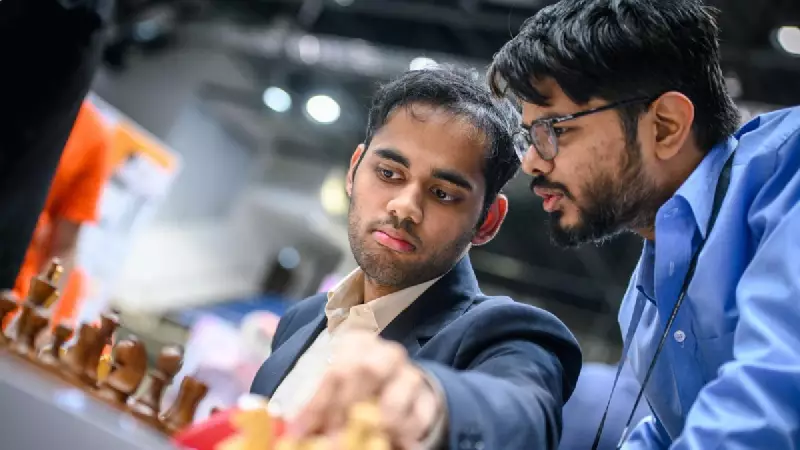
Arjun Erigaisi's remarkable performance at the 2025 World Rapid & Blitz Chess Championships in Doha has potentially rewritten a long-standing narrative about Indian chess. By securing bronze medals in both the Rapid and Blitz events, the young grandmaster not only ended India's podium drought in these formats but also challenged the perception that the country's new generation of prodigies struggles with the intuitive play required in faster time controls.
Breaking the Anand Era Drought
Since the legendary Viswanathan Anand won his last rapid gold in 2017, no Indian male player had stood on the podium at the World Rapid and Blitz Championships. This fact reinforced a view, notably echoed by world champion Magnus Carlsen, that while Indian players are exceptional calculators ideal for classical chess, they often falter in rapid and blitz due to weaker intuitive skills. Arjun Erigaisi's double bronze in Doha has directly confronted this notion.
His campaign was a masterclass in resilience and skill. In the Rapid section, he deployed impeccable defensive play to hold Magnus Carlsen to a draw, stopping the Norwegian's winning streak on the first day. After some setbacks, he fought back with crucial wins to finish tied for second place, only missing the silver medal due to a slight tiebreak advantage for Russia's Vladislav Artemiev.

A Dominant Display and a Coach's Perspective
In the Blitz event, Arjun was even more dominant during the Swiss round-robin stage. He showcased a masterful command of fast time controls, achieving a stunning victory over the eight-time World Blitz Champion, Magnus Carlsen. The game was so intense it reportedly led to a frustrated Carlsen smashing the table after losing on time. Arjun topped the leaderboard with 15 points from 19 rounds before an unfortunate semi-final loss to Uzbekistan's Nodirbek Abdusattorov ended his title bid.
Despite this historic feat, Arjun's former trainer, N. Srinath, viewed the double bronze as a slightly disappointing end. Srinath believes that Arjun, who is the top-ranked Indian across all three formats (Classical, Rapid, and Blitz), is capable of winning medals of a better colour—gold or silver—if given more opportunities.
"Yes, he played Tata Steel and Norway Chess… two top-tier closed events this year, but compared to his peers, he competed in fewer tournaments than players at his level typically do across the year," Srinath stated. He emphasized that Arjun lacks sufficient exposure to the absolute elite, the 2750+ Elo rating group, which is crucial for development at the highest level.
The Invitation Conundrum and Visibility Factor
Srinath, a key figure behind the Chennai Grandmaster tournament, also explained why Arjun often misses out on elite invitational events compared to compatriots like D Gukesh and R Praggnanandhaa. He attributes this to the "visibility factor" for organisers.
"Naturally, having a world champion in your tournament significantly boosts media coverage compared to having a non-world champion. From an organisational standpoint, Gukesh is certainly a great player to have," Srinath argued. He added that Praggnanandhaa commands substantial viewership, and globally, names like Carlsen and Hikaru Nakamura are the biggest draws.
Furthermore, Srinath pointed out that Arjun's nationality works against him in a field crowded with Indian talent. He believes Arjun is on par with players like Germany's Vincent Keymer and Uzbekistan's Nodirbek Abdusattorov, but organisers seeking geographical diversity often choose the latter two.
Arjun himself has acknowledged this challenge. "The best thing would be to be part of closed events (invitationals). But given the circumstances, I had to take some risks (by playing Open events)," he told The Indian Express in 2024.
Srinath concludes that regular competition against the ultra-elite is non-negotiable for Arjun's growth. Facing players like China's Wei Yi or America's Wesley So, who punish even minor errors, provides invaluable practice that is currently missing from his schedule. With more such opportunities, India's new chess star could well turn bronze into gold and permanently alter the perception of Indian prowess in rapid chess.