From Medical School to Marathon Glory: The Kartik Karkera Story
Until January 2025, Kartik Karkera had never attempted a full marathon. The 28-year-old orthopaedic surgeon from Nashik, Maharashtra, had focused primarily on middle-distance running, particularly the 1,500-meter race. His decision to participate in the MVP Marathon in Nashik stemmed from both necessity and opportunity. His medical institution offered him leave to train for the National Games in Uttarakhand if he could win the marathon. This proposition set in motion an extraordinary athletic journey.
A Remarkable Debut and Record-Breaking Performance
"The decision to sign up for a full marathon was completely spontaneous," recalls Karkera, reflecting on his first marathon attempt. Not only did he win his debut marathon, but he also set a new course record of 2 hours and 20 minutes. While some dismissed this achievement as beginner's luck, Karkera proved them wrong with an even more impressive performance a year later.
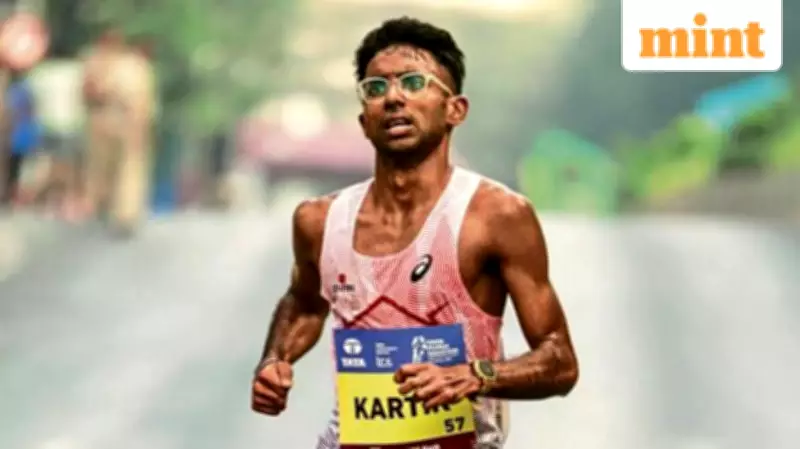
At the prestigious Tata Mumbai Marathon on January 18 this year, Karkera achieved what many considered impossible. He surged past defending champion Anish Thapa and two-time winner Srinu Bugatha to claim victory in the Indian elite category, finishing 10th overall. For most of the race, he was on pace to break the course record, but humidity and cramps in the final kilometers slowed his progress slightly. Nevertheless, he crossed the finish line in 2 hours, 19 minutes, and 55 seconds—a personal best that solidified his status as a rising star in Indian marathon running.

The Doctor-Athlete Balancing Act
What makes Karkera's story particularly compelling is his dual identity as a practicing orthopaedic surgeon and elite athlete. Known affectionately as "Doctorsaab" within running circles, he has mastered the challenging balance between medical responsibilities and athletic training. "I go by that name with all the athletes I train alongside, even my coach. I'm quite used to it now," he says with a laugh.
Karkera attributes his racing success to a combination of rigorous training and mental fortitude. "I trust the training and thrive on my competitive nature. I don't get stressed going into a race because I have nothing to lose and a lot to gain," he explains. This mindset proved crucial during his Tata Mumbai Marathon victory, where he executed a perfectly timed surge after the pacemaker dropped out at the 29.5-kilometer mark.
An Unexpected Journey into Competitive Running
Karkera's relationship with running began unexpectedly a decade ago while he was studying medicine in Russia. Initially participating in polyathons—multi-discipline events that included running—he discovered a natural talent for endurance sports. His only previous running experience had come from playing hockey during his school days at St. Francis D'Assisi in Mumbai.
The early days of competitive running presented significant challenges. Karkera recalls his first official race representing Tambov State Medical University in the 3,000-meter event, where he finished second to last. "It was a tough race. I got to know what competitive running is all about," he remembers. Despite this modest beginning, he remained determined to improve.
Overcoming Personal and Professional Challenges
Balancing medical studies with increasingly demanding training schedules proved emotionally and physically taxing. Karkera would begin his days at 5 AM on the track, often completing his stretching routine in the shower before rushing to university. The strain became so intense that he considered abandoning his medical career until his father, Jayraj—an aspiring runner in his youth who had to give up his athletic dreams—convinced him to persevere.
"I would often be in tears because I wasn't able to manage things. Those days were really difficult, both physically and emotionally," Karkera admits. He completed his MBBS in 2021 and subsequently specialized in orthopaedics and trauma in Moscow, a field he chose specifically because of his running background.

Training Excellence and Strategic Career Moves
During his time in Russia, Karkera had the extraordinary opportunity to train under Olympic champion Yuriy Borzakovskiy, the 800-meter gold medalist from the 2004 Athens Games. This elite coaching helped him become university champion in the 1,500-meter event for consecutive years in 2021 and 2022, and win his first half marathon in Moscow in 2023.
Karkera credits his medical knowledge with enhancing his athletic performance. "My medicine degree helped me become more productive and remain injury-free in training. After a long, hard session, I knew the things that would help me recover faster and get me back on the track," he explains.
Despite promising medical career prospects in Russia, Karkera decided to return to India to be closer to family. After passing the Foreign Medical Graduates Exam and completing a year-long internship, he settled in Nashik specifically for its athletic infrastructure and coaching opportunities. "I looked for a place that had professional infrastructure that would allow me to train alongside work. And I had heard of Vijendra Singh from Nashik who has coached some of the top athletes in the country," he says.
Record-Breaking Achievements and Future Aspirations
Middle-distance running remains Karkera's first love—he holds state gold medals in the 800-meter, 1,500-meter, and 5,000-meter events. In a remarkable achievement last year, he broke the 29-year-old Maharashtra state record in the 1,500-meter at a meet in Kochi.
His marathon success has opened new competitive horizons. "Once I realized endurance was my thing, I thought of working towards making the cut for the Asian Games in 2026," Karkera reveals. He views his Tata Mumbai Marathon victory as an important fitness test ahead of the New Delhi Marathon on February 22, where the top two finishers will qualify for the Asian Games.
Inspiring the Next Generation
Karkera describes himself as "a working-class runner" who remains connected to everyday athletes. "I'm not completely into athletics, you can call me a working class runner. I try to engage with people and if I inspire one person to take up a sport, I feel like I've played my part," he says.
This philosophy came full circle after his Tata Mumbai Marathon victory when a parent approached him with a heartfelt message. She told Karkera that his achievement inspired her to continue encouraging her child to pursue sports alongside education. For the doctor-athlete, this moment proved as satisfying as winning the biggest race of his life.
Kartik Karkera's journey demonstrates that passion, perseverance, and proper balance can lead to extraordinary achievements in multiple fields. His story continues to inspire both the medical and athletic communities across India.