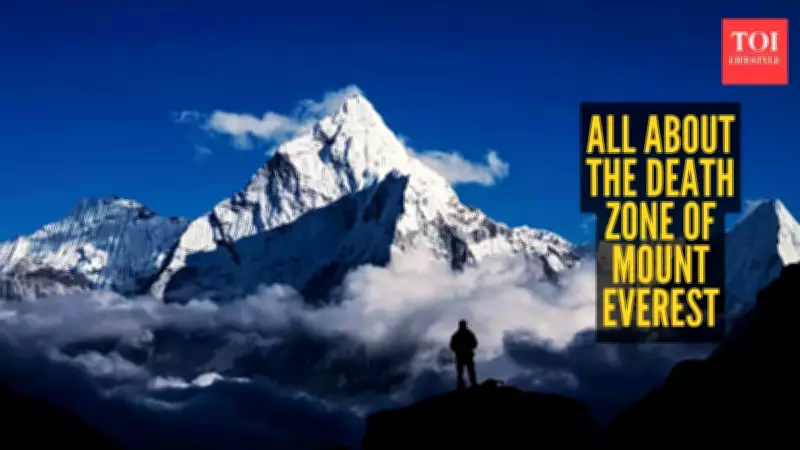
The Everest Death Zone: Where Human Survival Meets Its Absolute Limit
If you have ever viewed photographs of mountaineers near the summit of Mount Everest, you have likely encountered the ominous term "Death Zone." While it may sound like dramatic hyperbole, this designation is starkly literal. The Death Zone refers to altitudes exceeding 8,000 meters (26,247 feet), where the human body cannot sustain itself for extended periods. No degree of physical fitness or mental fortitude can override the fundamental physics of the perilously thin air at such extreme heights.
Defining the Lethal Altitude Threshold
Mountaineers use "Death Zone" to describe elevations above 8,000 meters on the planet's highest peaks. Everest features an extensive section within this range, stretching from approximately the South Col at 7,900–8,000 meters up to the summit at 8,848.86 meters, the officially measured height as of 2020. Upon entering this zone, the body operates on borrowed time, initiating a countdown to severe physiological decline.
At sea level, atmospheric pressure ensures oxygen-rich air flows efficiently into the lungs and bloodstream. At 8,000 meters, however, atmospheric pressure plummets to about one-third of sea level. Consequently, each breath delivers significantly less oxygen to the blood, leaving cells starved of the essential element needed to maintain organ function. This results in a state of gradual suffocation, even while actively breathing.

The Biological Impossibility of Prolonged Survival
Above 8,000 meters, the human body confronts an insurmountable biological barrier. Oxygen availability drops to roughly 33% of sea level, and the body cannot fully acclimatize to this deficit. Despite weeks of gradual ascent, tissues remain oxygen-deprived. Metabolism undergoes drastic changes, breaking down muscle for survival, leading to rapid and unavoidable weight loss. Sleep quality deteriorates severely, and healing processes slow to a crawl.
Medical experts and high-altitude physiologists unanimously agree that no human can remain healthy in the Death Zone. Even elite climbers experience rapid deterioration. It is not a question of if the body will weaken, but how swiftly it will happen. This reality dictates the strict protocols of Everest expeditions, where climbers spend weeks acclimatizing at lower camps before making a brief, final ascent into the Death Zone, aiming to descend as quickly as possible.
Immediate and Severe Physical Effects
The impacts of the Death Zone are neither subtle nor slow to manifest. They accumulate rapidly, presenting grave dangers:

- Oxygen Starvation (Hypoxia): The brain and muscles receive insufficient oxygen, causing slowed and fuzzy thinking, impaired decision-making, and reduced reaction times. This cognitive impairment frequently contributes to accidents near the summit.
- Extreme Fatigue: Each step feels like a sprint, with climbers often taking one step, pausing for 5–10 breaths, then taking another. Even with supplemental oxygen, the body endures immense strain.
- Loss of Coordination and Judgment: Fine motor skills deteriorate first, making tasks like managing buckles, ropes, and carabiners dangerously difficult on exposed ridges.
- High-Altitude Cerebral Edema (HACE): Brain swelling due to altitude causes severe headaches, confusion, loss of balance, hallucinations, and potentially coma. Without rapid descent, it is often fatal.
- High-Altitude Pulmonary Edema (HAPE): Fluid accumulation in the lungs creates a sensation of drowning while awake, accompanied by coughing, breathing struggles, and bluish lips. Descent is the only effective treatment.
- Skyrocketing Frostbite Risk: Temperatures can plunge below -30°C with wind chill. Poor blood flow from hypoxia increases vulnerability, leading many survivors to lose fingers or toes.
The Critical Role of Supplemental Oxygen
Most climbers above 8,000 meters rely on bottled oxygen. While it does not render the Death Zone safe, it mitigates risks by improving blood oxygen levels, enhancing mental clarity, boosting muscle function, and reducing—though not eliminating—the likelihood of HACE and HAPE. Without supplemental oxygen, the body faces maximum stress, with each minute exacting a heavier toll and increasing error probability. It is crucial to emphasize that even with oxygen, the Death Zone remains deadly; it merely extends the brief window of survivability.
Strict Time Limits and Turnaround Protocols
There is no fixed timer for survival in the Death Zone, but clear limits exist. Most summit pushes aim to confine exposure to 12–20 hours total for ascent and descent. Prolonged stays above 8,000 meters induce severe physical breakdown, including muscle wasting, mental confusion, and organ stress. Expeditions enforce strict "turnaround times"; if climbers fail to reach the summit by a designated hour, they must abort the attempt. Overstaying risks depleting strength and oxygen reserves for the descent, a common factor in fatal accidents.
Primary Causes of Mortality
Deaths near Everest's summit typically stem from a combination of factors: hypoxia impairing thought and movement, exhaustion preventing descent, altitude sickness like HACE or HAPE, falls on narrow ridges, extreme cold, frostbite, and sudden weather shifts. A grim reality is that rescue operations are nearly impossible in the Death Zone due to steep terrain, air too thin for effective helicopter use, and climbers lacking the strength to assist others. Carrying an incapacitated adult at 8,500 meters exceeds human capability, explaining harrowing accounts of climbers passing motionless but alive individuals.
Unique Dangers of the Summit Area
The final approach to Everest's summit involves exposed ridges and steep steps with minimal maneuvering space, often requiring climbers to clip into fixed ropes. On favorable weather days, traffic jams can form, forcing individuals to stand idle in the Death Zone, burning precious oxygen and energy while awaiting their turn. Remaining stationary heightens risks by accelerating heat loss, oxygen consumption, and bodily deterioration, making every extra minute critical.
The Limits of Acclimatization
Acclimatization enhances the body's ability to cope with thinner air at lower high altitudes by increasing red blood cell count and optimizing oxygen utilization. However, this adaptation has a ceiling; above 8,000 meters, no amount of acclimatization can fully compensate for the deficient oxygen pressure. Thus, climbers undertake multiple ascents and descents before a summit push, preparing their bodies to endure the Death Zone briefly, not to reside there.
A Global Phenomenon Beyond Everest
While Everest is the most renowned example, the Death Zone exists on all 14 peaks worldwide exceeding 8,000 meters, located in the Himalayas and Karakoram ranges. Everest's Death Zone is particularly notable for its length and congestion due to the mountain's height and popularity. This zone is not a myth or mere dramatic label; it is a tangible, measurable physiological boundary where air lacks sufficient oxygen pressure to sustain human life, leading to gradual organ shutdown, fading strength, impaired judgment, and near-impossible rescue scenarios.
Ultimately, climbers treat the summit push as a sprint, not a stroll: ascend, touch the top, and evacuate swiftly. The mountain remains indifferent to experience; in the Death Zone, physics and biology dictate the unforgiving rules of survival.