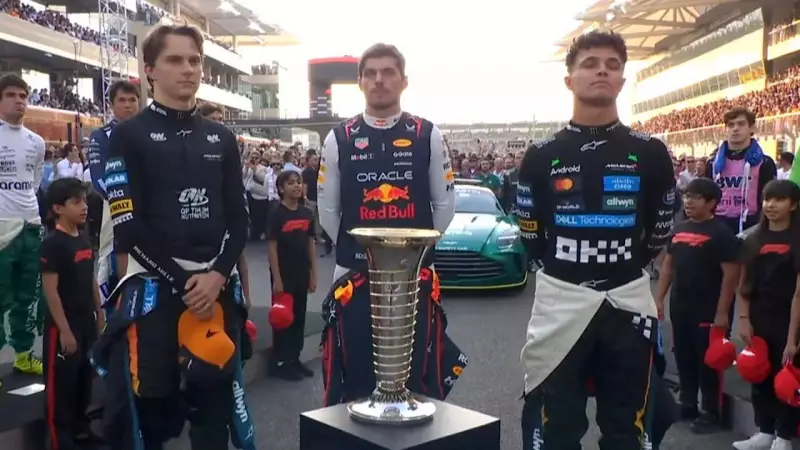
The world of Formula 1 is bracing for a significant financial shift as drivers prepare for the 2026 season. Beyond adapting to sweeping new technical regulations, competitors are facing a substantial bill from the sport's governing body, the FIA, for their essential super licenses. The fee structure, directly tied to previous season's performance, means reigning world champion Lando Norris is set for the heftiest invoice.
How the FIA Super License Fee is Calculated
The financial requirement to race in Formula 1 has two components. Every driver must pay a base fee of €11,842 (approximately $13,888). On top of this, an additional charge of €2,392 (about $2,805) is levied for every championship point scored in the previous season. This performance-based model creates a vast disparity in what drivers pay to secure their racing credentials for the year.
For newcomers and those who didn't score points in 2025, the cost remains minimal. Racing Bulls rookie Arvid Lindblad, along with experienced hands like Cadillac's Valtteri Bottas and Sergio Perez, will only need to cover the base amount. Alpine's Franco Colapinto, who also failed to register a point, joins this group.

The Million-Dollar Club: Top Drivers' Hefty Bills
At the opposite end of the spectrum, the top points-scorers face fees running into millions. After a dominant 2025 season where he amassed 423 points, McLaren's Lando Norris faces a super license bill of approximately $1.2 million. His closest rival, Red Bull's Max Verstappen, who finished just two points behind, will pay a slightly lower sum of $1,194,986.
The other top payers include McLaren's Oscar Piastri at $1,164,126 and Mercedes' George Russell at $908,829. Ferrari drivers also feature prominently, with Charles Leclerc set to pay $692,809 and his new teammate, Lewis Hamilton, facing a fee of $451,540. Mercedes rookie Kimi Antonelli rounds out this high-paying group with a bill of $434,707.
New Era Begins with Pre-Season Testing
The 2026 season marks the start of a new technical era for Formula 1, with major FIA regulation changes set to debut at the Australian Grand Prix in March. These rules are anticipated to dramatically alter car performance and racing dynamics. To help teams and drivers adapt, three pre-season test sessions have been scheduled.
The on-track action for the new cars will commence with the first test at the Circuit de Barcelona-Catalunya in the final week of January. This will be followed by two back-to-back test sessions in Bahrain during February, providing crucial data before the competitive season kicks off in Melbourne.
This combination of a major financial outlay for drivers and a complete technical overhaul sets the stage for a fascinating and unpredictable 2026 Formula 1 championship, where adapting to change will be the key to success both on and off the track.