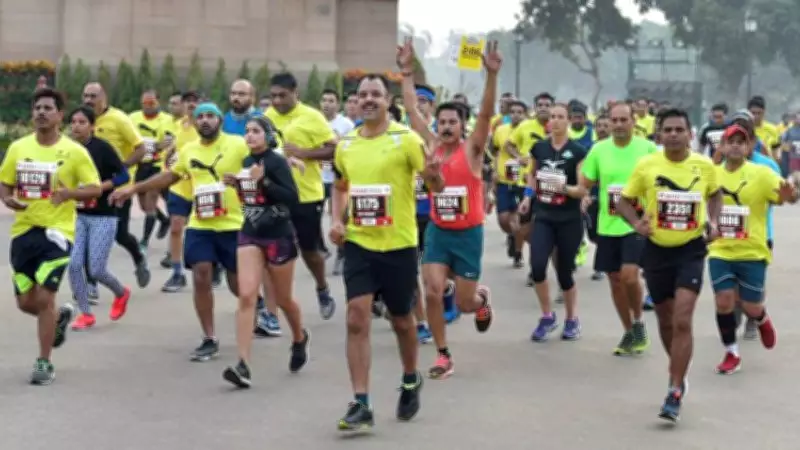
Running Through the Haze: India's Urban Marathon Phenomenon
Consider the atmospheric reality of New Delhi in mid-November. The Air Quality Index consistently registers between "Very Poor" and "Severe" levels, with PM 2.5 particulate matter creating a dense, grey haze that blankets everything from Lutyens' bungalows to the sprawling National Capital Region. Medical wisdom would dictate staying indoors with air purifiers, avoiding physical exertion. Yet, if you visit Lodhi Garden at dawn or Mumbai's Marine Drive around 5:15 AM, you'll witness a striking contradiction to basic self-preservation instincts.
Thousands of people—tech entrepreneurs, college students, weary mothers, ambitious singles—are lacing up their neon-colored running shoes and moving in rhythmic unison. They are running marathons and participating in run clubs, creating a social movement that defies environmental challenges.
The Transformation of Running Culture
Fifteen years ago, recreational runners on Indian streets were rare anomalies. If you spotted someone running in 2011, you might assume they were late for a bus or training for police academy exams. Today, India is experiencing a running revolution that has spread from metropolitan centers to small towns across Ladakh and Kerala. This cultural shift extends far beyond simple cardiovascular health concerns, driven by three powerful invisible forces that reveal much about contemporary Indian society.

The Digital Validation Engine
The first driving force lies in the pockets of every runner: smartphones. When mobile data costs crashed in the mid-2010s, sharing personal milestones migrated from living rooms to digital feeds. Running offers unique advantages in the social media economy by generating quantifiable data—trackable routes, elevation maps, and finish-line moments captured with medals around necks.
This digital validation has fundamentally transformed running from a private battle between legs and road into a public performance. Strava screenshots now serve as badges of discipline, signaling participation in communities that value grit and endurance. Sociological concepts like preferential attachment explain how these networks gain gravitational pull as more people join—what began as events like the Tata Mumbai Marathon have evolved into rituals where people participate because colleagues or college roommates did so previously.
Combating Urban Isolation
The second force addresses a profound sociological shift: urban India's loneliness epidemic. Traditional community structures have faded in major cities where joint families are disappearing and neighborhood gathering spots have vanished. Young professionals migrating to Bengaluru or Gurugram for work often find themselves adrift in seas of cubicles and traffic, lacking "third places" outside offices and apartments.
Run clubs have stepped into this vacuum, particularly evident in gatherings at places like Cubbon Park on Sunday mornings where demographics skew overwhelmingly young and single. These groups have inadvertently become India's most effective dating services, with running acting as a natural filter that ensures participants share schedules, discipline, and values. They function as social lubricants disguised as workouts, creating organic collisions between like-minded individuals.
Reclaiming Public Spaces
The third critical function addresses safety concerns, especially for women in Indian cities that can feel like hostile environments. Running alone at dawn in Delhi or Mumbai involves complex calculations about darkness, uneven pavements, and isolation. Run clubs transform this dynamic entirely, enabling women to occupy spaces previously considered off-limits through collective presence.
Beyond safety, these groups represent acts of urban adaptation. In polluted, isolating, and often unsafe cities, run clubs have evolved into social technologies for reclaiming public space, manufacturing community, and imposing meaning on chaotic urban lives. What appears as irrational behavior—running through smog at dawn—makes profound sense when the group itself becomes the reward.

The Deeper Meaning of Movement
Today's Indian runners aren't merely chasing personal bests but pursuing belonging, visibility, and brief moments of control. At 5:15 AM, before cities fully assert themselves, these communities temporarily take streets back, moving forward together rather than as isolated individuals. The running phenomenon reveals how urban Indians are creatively adapting to contemporary challenges, transforming fitness activities into powerful social movements that address deeper human needs for connection and community in increasingly fragmented urban landscapes.
This examination of India's running culture highlights how environmental challenges haven't deterred but perhaps intensified the human search for connection through shared physical activity.