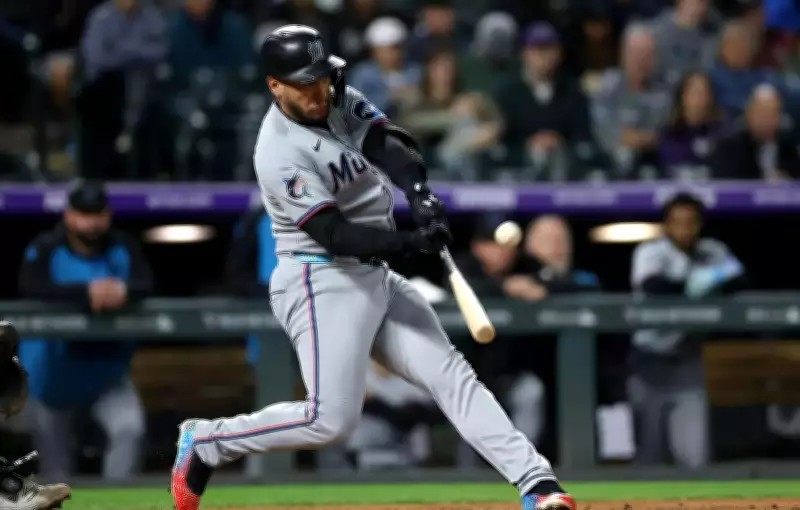
Miami Marlins Face Critical Catching Decision Ahead of 2026 Season
The Miami Marlins' catching depth chart presents a fascinating paradox as the team prepares for the 2026 campaign. On the surface, the organization appears well-positioned behind the plate with a clear starter, promising prospects, and adequate depth. However, a closer examination reveals significant questions about whether this configuration provides enough stability for a competitive season.
Current Catching Configuration and Projections
The Marlins' official depth chart lists Agustín Ramírez as the primary catcher, with Liam Hicks and Brian Navarreto providing backup support. Joe Mack, the organization's top catching prospect, completes the quartet after being added to the 40-man roster on November 18, 2025.
Multiple projection systems confirm this alignment. FanGraphs' 2026 forecast shows Ramírez as the starting catcher with Hicks as his primary backup. ESPN's depth chart mirrors this arrangement, while CBS Sports notes no third catcher beyond the projected starters. USA TODAY Sports identifies Hicks and Mack as the top two options, reflecting Miami's offseason strategy that focused on trades rather than external catching acquisitions.

This configuration stems directly from the Marlins' winter approach, highlighted by their January 20, 2026 trade that brought pitcher Bradley Blalock from Colorado in exchange for Jake Brooks. The organization has demonstrated clear faith in its young core while reshaping the roster through strategic transactions.
Joe Mack: The Future Arriving Sooner Than Expected?
Joe Mack represents both the present and future of Marlins catching. Drafted 31st overall in the 2021 MLB Draft from Williamsville East High School in New York, the left-handed hitter signed for $2.5 million and has steadily progressed through Miami's system.
Now 23 years old, Mack's defensive prowess sets him apart. MLB.com ranks him among the organization's top prospects, describing him as "one of the better defensive catching prospects in the game" in their January 12, 2026 analysis. Fish On First's 2026 prospect rankings place Mack at number two in the system, specifically citing his elite defensive capabilities and remarkable 1.75-second pop time.
Mack's development timeline has accelerated significantly. He moved from Beloit to Pensacola on April 21, 2024, received a spring training assignment with Miami on March 11, 2024, and now finds himself on the cusp of major league readiness. With the Marlins' lack of first-base additions and ongoing roster reconstruction, many analysts believe the organization's best competitive decision for 2026 would be giving Mack an opportunity to start the season in the majors.
The Veteran Void and Payroll Flexibility
Despite the apparent depth, a significant concern looms over the Marlins' catching situation: the complete absence of a proven veteran safety net. This becomes particularly relevant when considering available free agents like Elias Díaz, who became available on November 1, 2025 after the San Diego Padres declined his option.
Díaz's 2025 season with the Padres saw him appear in 106 games, batting .204 with nine home runs, 29 RBIs, and a .607 OPS over 255 at-bats. His advanced metrics included an 88.4 mph average exit velocity, 38.7 percent hard-hit rate, and 7.5 percent barrel rate. More importantly, Díaz brings valuable experience, including a 2023 All-Star season with Colorado where he hit .267 with 14 home runs and 72 RBIs while earning All-Star Game MVP honors.
The Marlins possess significant payroll flexibility to address this need. According to an October 2, 2025 report by Craig Mish of the Miami Herald to Barry Jackson, the organization planned to be "active participants" in free agency ahead of 2026. Current financial commitments remain minimal, with only Sandy Alcantara ($17.3 million) and retained salaries for Giancarlo Stanton ($10 million) and Avisaíl García ($5 million) on the books.

Strategic Crossroads for Miami's Front Office
The Marlins now face a critical strategic decision. They can proceed with their current catching alignment, banking on Ramírez's consistency and Mack's rapid development. Alternatively, they could leverage their payroll flexibility to add a veteran catcher like Díaz, Jonah Heim, Gary Sánchez, or Christian Vázquez from the available free-agent pool.
This decision carries significant implications for Miami's 2026 competitiveness. A veteran addition would provide stability, mentorship for younger catchers, and insurance against injuries or performance dips. However, it might also delay Mack's development or create roster congestion.
As spring training approaches, the Marlins' catching situation remains in flux. What appears stable on paper contains underlying uncertainty that one strategic move could completely transform. The organization's willingness to address this need before camp begins will reveal much about their competitive priorities for the coming season.