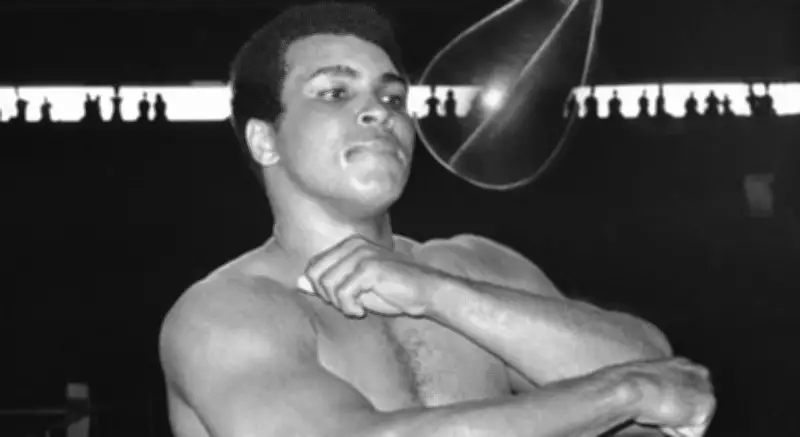
Muhammad Ali's Philosophy: Embracing Risk for Greatness
The iconic words, "He who is not courageous enough to take risks will accomplish nothing in life," spoken by Muhammad Ali, resonate deeply from a career built on defiance and daring. As one of history's greatest heavyweight boxers, Ali consistently chose challenging paths over safe ones, both inside and outside the ring. His life was a testament to placing himself in uncertain situations, from facing formidable opponents to making controversial decisions that cost him titles and years of his prime. This unwavering commitment to risk gives profound weight to his enduring message.
Early Beginnings: From Humble Origins to Olympic Glory
Born Cassius Marcellus Clay Jr. on January 17, 1942, in Louisville, Kentucky, Ali grew up in a segregated America. His father painted signs, his mother worked as a domestic, and nothing in his early life hinted at global fame. Boxing entered his life serendipitously at age 12 after his bicycle was stolen. Reporting the theft to local policeman and trainer Joe Martin, young Clay expressed a desire to "whup" the thief, leading Martin to teach him to fight. This sparked a rapid ascent through amateur ranks, culminating in a gold medal at the 1960 Rome Olympics in the light heavyweight division. While this victory seemed straightforward, it marked the first step into a career where failure was always a real possibility.
The First Major Gamble: Defying Odds Against Sonny Liston
In 1964, Ali faced his first defining risk against heavyweight champion Sonny Liston, a feared fighter of the era. Still known as Cassius Clay, he was viewed as too young, unproven, and outspoken. His unconventional style—low hands, constant movement, and reliance on speed—defied heavyweight norms. Before the fight, he boldly predicted victory through rhymes and public declarations, risking ridicule if he lost. Instead, Liston failed to answer the bell for the seventh round, crowning Clay as world champion. Shortly after, he announced his conversion to the Nation of Islam and changed his name to Muhammad Ali, a decision with far-reaching consequences that reshaped his public image in the United States.

The Ultimate Sacrifice: Refusing the Draft in 1967
The clearest embodiment of Ali's risk philosophy came in 1967 during the Vietnam War. At his career peak, he refused military draft induction, citing religious beliefs and opposition to the war. The immediate cost was severe: he was stripped of his heavyweight title, lost his boxing license, and was sidelined for over three years during his prime ages of 25 to 29. This was no symbolic gesture; it jeopardized his career, income, and reputation, drawing intense criticism nationwide. Yet, this choice later became central to his legacy, illustrating how risk can forge enduring impact beyond immediate setbacks.
Resilient Comeback: Legendary Fights and Redemption
Upon returning to boxing in 1970, Ali immediately plunged back into high-stakes matches. In 1971, he suffered his first professional loss to Joe Frazier in the "Fight of the Century," but persisted. In 1974, he faced George Foreman in Zaire for the "Rumble in the Jungle." Foreman, younger and stronger, was favored, but Ali employed the risky "rope-a-dope" strategy, absorbing punishment until Foreman tired, knocking him out in the eighth round to reclaim the title. A year later, the "Thrilla in Manila" against Frazier pushed both men to their limits, with Ali winning after 14 grueling rounds. These episodes highlight how calculated risks, even with potential for defeat, drove his success.
Later Years and Enduring Legacy
Ali retired with a record of 56 wins and 5 losses, including 37 knockouts, and made history as the first three-time heavyweight champion, last reclaiming the title in 1978 against Leon Spinks. Diagnosed with Parkinson's disease in the 1980s, his condition gradually affected his movement and speech, yet he remained publicly visible. A poignant moment came at the 1996 Atlanta Olympics, where he lit the flame with trembling hands, symbolizing resilience. Honored with the Presidential Medal of Freedom in 2005, he passed away on June 3, 2016, in Scottsdale, Arizona, at age 74, leaving a legacy defined by achievements, struggles, and unwavering presence.

Applying Ali's Risk Philosophy Beyond Sports
Ali's quote emphasizes not reckless chance-taking, but moments where moving forward matters more than comfort. In everyday life, this translates to accepting uncertainty as a catalyst for growth. Whether choosing an unconventional career path, launching a project with unknown outcomes, or defying expectations, such risks create opportunities for learning and improvement. This principle advocates for calculated audacity—accepting temporary discomfort or failure in pursuit of meaningful goals, as seen in entrepreneurship, artistic expression, or personal boundary-setting. Without direction, risk is unproductive, but with clear intent, it becomes necessary for progress.
Overcoming Fear: Risk as Intellectual Capital
A key barrier to risk-taking is fear of failure, but Ali reframes failure as "intellectual capital"—valuable data that informs future efforts. When risk is viewed as a series of experiments rather than a single high-stakes moment, each attempt contributes to growth, even without immediate success. Those who achieve the most are often those who persist through setbacks, while a risk-averse life can lead to stagnation. By embracing uncertainty, individuals can shift direction and build meaningful outcomes, mirroring natural adaptation where organisms must evolve or decline.
In summary, Muhammad Ali's life demonstrates that risk is the price of accomplishment, urging us to step beyond the familiar to unlock potential.