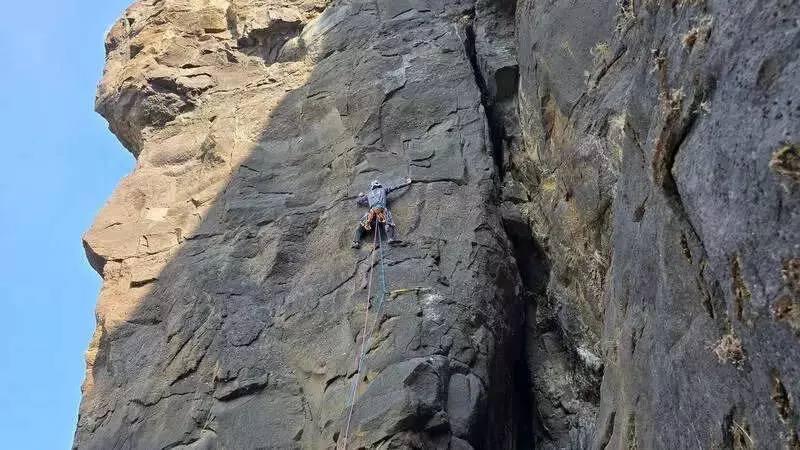
A dramatic rock face in the Sahyadri mountains near Pune has become the latest canvas for the region's climbing community. In a significant development for adventure sports in Maharashtra, a team of climbers from Pune has successfully established and mapped two new traditional climbing routes on a distinctive formation near the Telni waterfall in Inglun village, Maval taluka.
The Discovery and Naming of Gajmukh
The site of this new climbing venture is an east-facing wall near the Mahadevi temple in Kamshet. The rock formation itself, which rises strikingly against the classic Sahyadri landscape, bears a resemblance to the face of Lord Ganesha. This unique feature inspired the names for the newly opened routes: Gajmukh 1 and Gajmukh 2. "Both cracks are clearly visible from the temple. Vehicles can reach nearly the base, followed by a short 15-minute walk. Facing the rock, the left crack is Gajamukh 1, while the right is Gajamukh 2," explained Varun Bhagwat, the expedition leader.
The Expedition and Climbing Details
Bhagwat, a microbiologist who turned to full-time mountaineering a decade ago, emphasized that the routes were the result of careful planning. The team first explored the area in November, studying the potential of two prominent cracks on the rock face. They returned in late December with a clear strategy. The team established a base camp on December 29, with climbing commencing the next day.

Both routes ascend roughly 40 to 45 metres and were climbed in a traditional style. This method relies on placing removable protection into the rock's natural features rather than installing permanent bolts. Gajmukh 1, following a relatively straightforward crack system, was completed in a single pitch. Gajmukh 2, however, presented a formidable challenge. "That was the toughest part. The wall is above your head. Clearing the overhang took more than 24 hours of effort spread across two days, with around 8 hours of climbing each day," Bhagwat recounted.
Building a Climbing Ecosystem in the Sahyadris
The expedition involved seven individuals. Four members focused on the climbing and route mapping, while three others managed critical logistics like carrying equipment and cooking. Support for the permanent anchor points at key stations came from Giripremi, a Pune-based mountaineering institute.
For Bhagwat and his colleagues, this project is part of a broader mission to develop climbing infrastructure in the Sahyadris. Since 2019, they have worked on routes at locations like Jivdhan fort, Madan fort, Sinhagad, and the Fergusson College rock quarry. "Once routes are mapped and shared, others can come, practise on them, and get stronger. It helps build a climbing ecosystem rather than keeping routes limited to a few people," he stated. The team is already looking forward to exploring and opening more routes in the Lonavala region, inviting more climbers to experience the mountains.