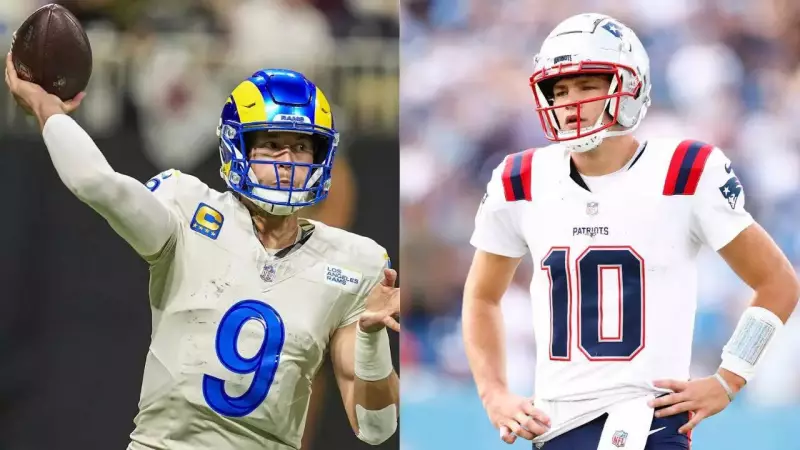
The conversation for the NFL's Most Valuable Player award has taken a dramatic and contentious turn. With just one week remaining in the regular season, the spotlight is no longer on a single frontrunner but on a fierce debate between the established brilliance of the Los Angeles Rams' Matthew Stafford and the meteoric rise of the New England Patriots' Drake Maye. This debate, fueled by statistics, team success, and now a compelling argument about context, refuses to die down quietly.
The Case for the New Kid: Drake Maye's Stellar Ascent
Drake Maye, the Patriots' second-year quarterback, has forcefully inserted himself into the MVP conversation with a season of remarkable poise and production. His rise has been defined not by flashy, reckless play but by clean execution, surgical control, and a notable lack of mistakes. He has systematically turned the New England Patriots into a weekly headache for opposing defences, stacking victories alongside impressive efficiency metrics.
This consistent, winning performance has shifted national attention. While Matthew Stafford continues to put up some of the most eye-popping passing numbers in the league, Maye's combination of team success and personal statistics has created a powerful narrative. The balance he has shown has pulled the MVP spotlight away from Stafford's individual brilliance, setting the stage for a clash that goes deeper than simple box-score comparisons.

Dan Orlovsky's Context-Driven Defence of Matthew Stafford
Amidst the growing momentum for Maye, one influential voice has stood firm against the tide. Former NFL quarterback and current ESPN analyst Dan Orlovsky, who was once Stafford's teammate, presented a detailed, context-heavy argument for why the Rams quarterback should still win the award.
Appearing on The Pat McAfee Show, Orlovsky began by praising Maye's exceptional season, comparing it to Joe Burrow's legendary second-year run that took Cincinnati to the Super Bowl. "If I was voting today, I would vote for Stafford," Orlovsky stated unequivocally. He then launched into his core thesis: that the context of how statistics are accumulated is just as important as the numbers themselves.
"For everybody that continues to point stats to me... you can't in one hand talk about the stats and in the other conversation, 'Well, who he did it against doesn't matter.' Yes, it does," Orlovsky argued. He used a vivid analogy to drive his point home, suggesting his own stats would be "ridiculous" against high school opponents but "awful" in the NFL, proving the quality of competition is paramount.
The Strength-of-Schedule Argument Takes Center Stage
Orlovsky further sharpened his argument when challenged by co-host Darius Butler. He asked analysts to consider a direct comparison: if one quarterback consistently played against a weaker defence like the Seattle Seahawks, and another faced a brutal unit like the New York Jets, the former would naturally have better statistics.
"How you acquire the stats and who you acquire those stats against has to be a part of the conversation," Orlovsky emphasised. His point underscores a critical element of the MVP debate—Stafford's numbers have come against a significantly tougher slate of defences throughout the season, while Maye has benefited from a more favourable schedule. Orlovsky insists this context shouldn't diminish Maye's achievements but must provide crucial perspective for voters.
As the regular season draws to a close, Drake Maye holds the tangible momentum and favourable betting odds, powered by his team's win column and his efficient play. Conversely, Matthew Stafford holds onto the support of analysts like Orlovsky and the weight of a résumé built against stiffer competition. This fundamental tension—between raw production and the context behind it—is what keeps this NFL MVP race fiercely alive and undecided, promising a dramatic conclusion to the voting process.