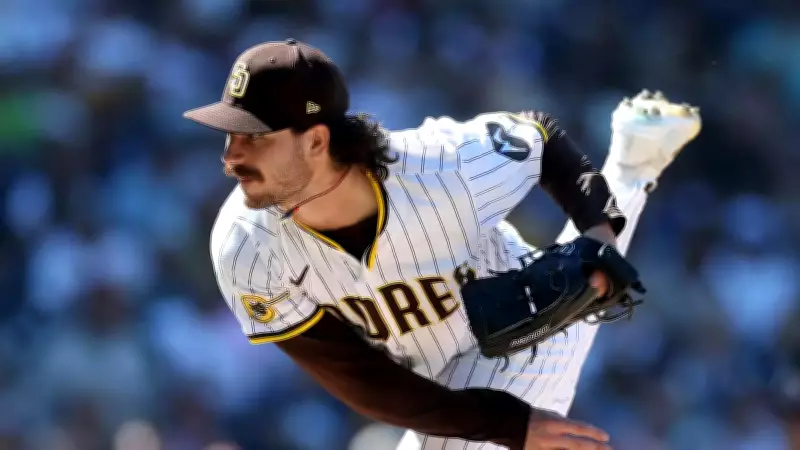
San Diego Padres Shift Focus to Justin Verlander After Missing on Framber Valdez
The San Diego Padres are actively seeking to strengthen their pitching staff ahead of the 2026 Major League Baseball season, but they are operating under significant financial constraints. This strategic pivot comes after the club failed to secure left-hander Framber Valdez, who instead inked a lucrative three-year, $115 million contract with the Detroit Tigers.
Verlander Emerges as Primary Target in Revised Strategy
With their top target off the board, the Padres have redirected their attention toward shorter-term, more cost-effective options. The most prominent name now in consideration is future Hall of Famer Justin Verlander. The 43-year-old right-handed pitcher, a three-time Cy Young Award winner, remains a free agent as spring training draws near.
Industry analysts suggest San Diego could propose a one-year contract laden with performance incentives. This structure would provide the Padres with a wealth of veteran experience and postseason pedigree without saddling the franchise with a long-term financial obligation.

It is crucial to clarify the nature of this potential acquisition: While some reports have loosely used the term "trade," Justin Verlander is not under contract with any organization. He is an unrestricted free agent. The Padres' interest simply reflects a deliberate change in spending philosophy after deciding not to match the substantial investment required to sign Valdez.
Projecting a Practical Contract and Role
A realistic agreement for Verlander could fall within the $7 million to $10 million range for the base salary, supplemented by bonuses tied to innings pitched and potential postseason appearances. For Verlander, this move would offer a chance to join a National League West contender expected to compete for a playoff berth, all while he continues his personal quest for 300 career victories. He currently sits approximately 30 to 35 wins away from that historic milestone.
Within the Padres' rotation, Verlander would likely slot in as the fifth starter. The team would prudently manage his workload, with a projected cap of around 140 to 150 innings for the season. This cautious approach would mirror his 2025 campaign with the San Francisco Giants, where he made 29 starts, posted a 3.85 ERA, and logged 152 innings of work.
Addressing a Clear Rotation Need
The Padres' pursuit of pitching help is driven by a tangible gap in their starting rotation. The current projected starting five includes Nick Pivetta, Michael King, and Joe Musgrove, with Randy Vasquez and JP Sears tentatively filling the final two spots. The departure of Dylan Cease via trade created a void in both innings pitched and strikeout production that the front office is eager to fill.
Framber Valdez represented a more robust solution due to his proven durability, stellar 3.24 career ERA, and consistent history of logging 200-inning seasons. However, once the Detroit Tigers formalized their offer, the Padres were effectively priced out of the bidding. Justin Verlander now stands as a lower-cost alternative who still brings invaluable postseason experience and a legendary track record to the table.
Statistical Comparison: Verlander vs. Valdez
A snapshot of their 2025 seasons highlights the different profiles:
- Justin Verlander: 3.85 ERA, 152 Innings Pitched, 29 Starts, 7.8 Strikeouts per Nine Innings (K/9), 1.23 WHIP. The 42-year-old veteran showed a remarkable bounce-back after early-season struggles.
- Framber Valdez: 3.10 ERA, 192 Innings Pitched, 33 Starts, 7.1 K/9, 1.15 WHIP. The left-hander solidified his reputation as a reliable workhorse, consistently pitching deep into games.
Verlander's 2025 season was a tale of two halves. He struggled immensely before the All-Star break, going 0–8 with a 4.99 ERA. After the break, however, he rediscovered his elite form, posting a stellar 2.60 ERA across 13 starts. He also delivered two impressive seven-inning outings in September, demonstrating that he retains the ability to work effectively deep into ballgames.

Mutual Benefits of a Potential Deal
For the San Diego Padres, the principal advantage would be injecting stability into the back end of their rotation without making a major, multi-year commitment to payroll. A one-year pact significantly limits long-term risk should Verlander's performance decline or injuries arise, freeing up financial resources to be allocated to other areas of need.
For Justin Verlander, this move would grant another opportunity to pitch for a competitive team while extending his illustrious career under a carefully managed workload. Although his former team, the San Francisco Giants, would not be directly impacted by the transaction, adding a veteran of his caliber to a division rival always carries competitive implications within the NL West.
While this potential signing may not satisfy fans or analysts hoping for a blockbuster acquisition, the favorable cost-to-potential-production ratio makes it a pragmatic and sensible option for a budget-conscious front office.
Overall Impact and Low-Risk Profile
If this move materializes, the San Diego Padres would add a seasoned veteran capable of eating valuable innings and providing mentorship to younger pitchers like Randy Vasquez. Verlander, in turn, would remain in a competitive environment conducive to his ongoing pursuit of 300 career wins.
Given the minimal financial risk associated with a short-term deal, the Padres would likely benefit from this arrangement even if Verlander performs at or near league-average levels, rather than recapturing his Cy Young-winning peak form. His career statistics—through the 2025 season—underscore his legendary status:
- Wins: 266
- Career ERA: 3.32
- Strikeouts: 3,390
- Innings Pitched: 3,136
- Cy Young Awards: 3
- World Series Titles: 2
Justin Verlander's Hall of Fame resume is already secure. If he signs with San Diego and maintains his health, the Padres could effectively address a clear rotation need without committing to a burdensome, long-term contract, making this a strategically sound move for both parties involved.