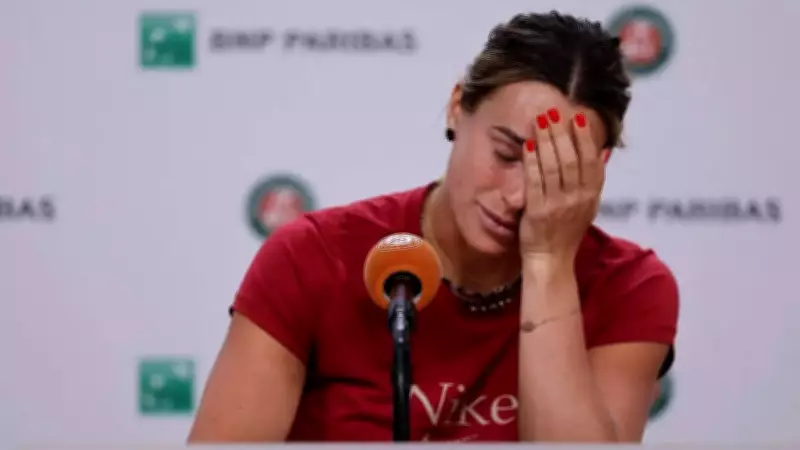
Aryna Sabalenka arrived at Roland Garros looking like the one player immune to the chaos that had swept through the 2026 French Open. While top contenders fell one after another, the world No. 1 moved through the draw without dropping a set and appeared firmly on course for a maiden Paris title. Yet in a dramatic quarter-final collapse on Court Philippe-Chatrier, Sabalenka watched a commanding position disappear before admitting afterwards that the defeat left her questioning everything. Diana Shnaider, playing in her first Grand Slam quarter-final, seized the opportunity and produced the biggest win of her career, advancing with a remarkable 3-6, 7-5, 6-0 victory.
Why Did Aryna Sabalenka's French Open Campaign Unravel So Dramatically?
For much of the match, Aryna Sabalenka looked in complete control. She led by a set and held a 4-1 advantage in the second. Even in the opening set, when a comfortable lead briefly began to wobble, she still found a way through. This time, however, the warning signs became impossible to ignore.
The windy conditions unsettled her throughout the afternoon. As errors crept into her game, frustration quickly followed. Shnaider, meanwhile, remained disciplined and stuck to a clear game plan. The Russian absorbed pressure, extended rallies when necessary and forced Sabalenka into increasingly risky decisions.

What followed was one of the most startling momentum swings of the tournament. Aryna Sabalenka won only one of the final 13 games and suffered her first 6-0 set defeat in more than two years. The collapse was as much mental as tactical.
After the match, the Belarusian offered a brutally honest assessment of her state of mind.
“No thoughts, no emotions,” Sabalenka said. “Just want to quit tennis right now, but we’ll see in a few days. Hopefully I’ll get back on track mentally.”
She later added: “I don’t know when was the last time that happened to me that I lose 10 games in a row. I guess mentally I go into a very deep, deep, dark hole over there, and I just couldn’t get mentally back on track.”
Those comments echoed previous painful defeats, including last year's French Open final loss. Once again, Sabalenka found herself battling not only an opponent across the net but also her own emotions.
What Does This Result Mean for Aryna Sabalenka and the French Open Field?
The defeat raises familiar questions about Sabalenka's ability to manage high-pressure moments despite her status as one of the sport's dominant players. This was her 14th consecutive Grand Slam quarter-final, a remarkable run that highlights her consistency. Yet some of her most painful defeats have followed a similar pattern, where emotions have overtaken execution at critical moments.
Sabalenka acknowledged that challenge directly.
“What doesn’t kill us makes us stronger, I guess,” she said. “At some point I will figure that little situation, and I will get back tougher. I [will] just figure how I can overcome it. You know those rooms where you just go in and you smash everything? Probably I will spend a whole day tomorrow over there destroying stuff. Maybe it will help; maybe not.”
For Shnaider, the victory marks a breakthrough moment. The 23rd-ranked Russian had never reached a Grand Slam quarter-final before this tournament but handled the occasion with impressive composure.
“Honestly I’m speechless, I’m super happy,” Shnaider said. “Obviously today was tough conditions with the wind and my first time playing Aryna [Sabalenka]. So definitely a lot of nerves.”
Her reward is a semi-final meeting with qualifier Maja Chwalinska, another surprise package in a tournament defined by unexpected results. Sabalenka's exit also guarantees a rare piece of Grand Slam history: for the first time since the 1977 French Open, none of the men's or women's semi-finalists have previously won a major title.