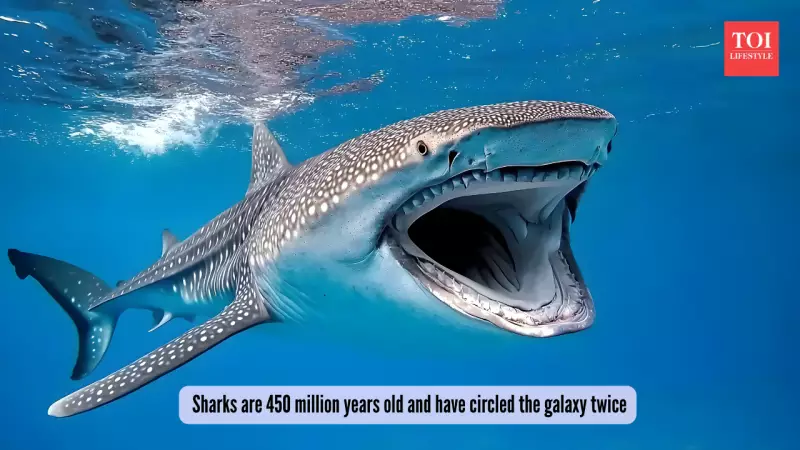
Sharks: Living Fossils That Predate Trees and Dinosaurs
Sharks glide through our oceans as living relics from a distant past. These ancient mariners appeared long before dinosaurs walked the Earth. They even predate the first trees that grew on land. Sharks have witnessed cosmic spins and survived massive earthly upheavals throughout their remarkable history.
An Ancient Lineage Dating Back 450 Million Years
Sharks first emerged approximately 450 million years ago during the Silurian period. The Natural History Museum confirms this astonishing timeline. Trees evolved much later, around 390 million years ago. Earth during the Silurian period lacked forests entirely. Vast water bodies hosted early shark ancestors like spiny Acanthodians.
Our planet has completed two full orbits around the galaxy since sharks first appeared. During this immense timespan, sharks have endured five catastrophic mass extinction events. These global disasters wiped out most life forms each time. Yet sharks persisted through every crisis.

The Secret to Their Survival: Remarkable Adaptability
What enabled sharks to sail through these mass extinctions? Their extraordinary adaptability proved crucial. Sharks demonstrate incredible habitat flexibility. They thrive in diverse environments from deep, dark oceans to shallow coastal seas. Some species even inhabit river systems.
Emma Bernard, the fossil fish curator at the Natural History Museum, explains their success. "Sharks can exploit different parts of the water column," she states. "They consume a wide variety of food sources including plankton, fish, crabs, seals, and whales. This dietary diversity helps sharks survive when ocean conditions change dramatically."
Extraordinary Examples of Shark Longevity
The Greenland shark represents one of Earth's longest-living animals. These remarkable creatures can survive up to 400 years. Sleeper sharks first appeared around 100 million years ago. By that time, sharks had already dominated marine ecosystems for ages.
Sharks have evolved into remarkably diverse forms throughout their history. The bizarre spiral-toothed Helicoprion represents one extreme adaptation. The warm-blooded megalodon, surprisingly slender rather than stocky, demonstrates another evolutionary path. Shark teeth fossils appear worldwide, including important discoveries like a manganese-encrusted megalodon specimen found at 3,090 meters depth.
While shark cartilage rarely fossilizes, these surviving marine marvels continue to astonish scientists. Their stories teach powerful lessons about resilience and adaptation. Sharks embody evolution's silent yet persistent endurance across geological epochs.