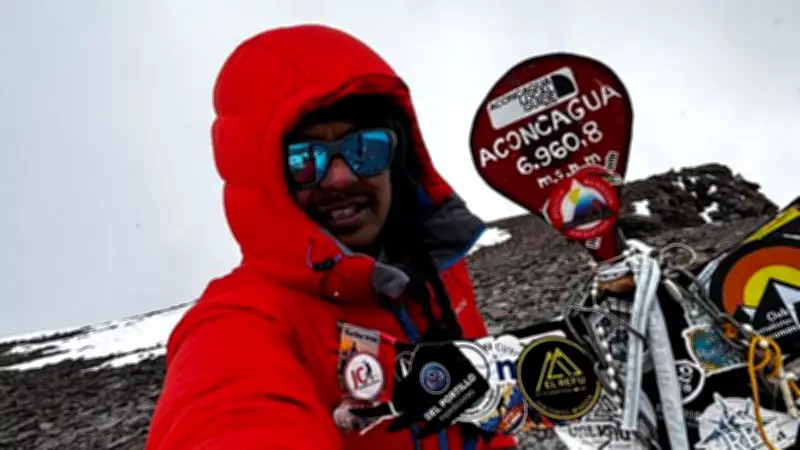
Tripura Engineer Conquers Mt. Aconcagua, Braving 100 Kmph Winds in Andes
In a remarkable feat of endurance and determination, Aritra Roy, an IT engineer originally from Tripura and working in Bengaluru, has successfully scaled Mt. Aconcagua in Argentina's Andes range. This achievement represents the fourth peak in his ambitious quest to conquer the Seven Summits, the highest mountains on each of the world's seven continents.
The Challenge of Mt. Aconcagua
Standing tall at 22,841 feet, Mt. Aconcagua is not only the highest peak in South America but also the tallest mountain outside of Asia. Despite being lower than Everest, it presents formidable challenges, especially during the harsh winter months. Temperatures frequently plunge below zero degrees Celsius, and wind speeds can exceed 100 kilometers per hour, creating perilous conditions for even the most experienced climbers. The mountain's success rate hovers around a mere 30 percent, underscoring the difficulty of this ascent.
For Roy, this climb was a natural progression in his mountaineering journey. Having already summited Mt. Everest in 2025, along with Mt. Kilimanjaro in Africa and Mt. Elbrus in Europe in 2023, he has systematically built his expertise and resilience in high-altitude environments.

From IT Professional to Mountaineer
An IT engineer by profession, Roy hails from a family with a strong athletic background. His father was a football coach, and Roy himself developed an early interest in sports. However, practical considerations led him to pursue a career in information technology, eventually landing a job with a multinational corporation in Bengaluru.
Despite being physically fit and engaged in adventure racing, Roy never seriously considered mountaineering as a professional pursuit—until the Covid-19 pandemic altered his perspective. "With everything shut during the Covid lockdown, I turned to freehand exercises, running, and cycling to stay fit," Roy recalls. These activities, combined with prior trekking experience, helped him build the endurance and confidence necessary to tackle the world's highest peaks.
Reflecting on his goals, Roy explains, "Climbing Mt. Everest isn't a one-off feat. There must be some context. I had the option of climbing the seven highest peaks in the world, the seven highest volcanic peaks, or the 14 highest peaks. From a financial and practical point of view, I chose the first." In many ways, he credits the pandemic with providing clarity and focus for his mountaineering ambitions.
Formal Training and Preparation
After undertaking smaller expeditions, Roy scaled Mt. Kilimanjaro and Mt. Elbrus in 2023. Recognizing the need for formal training, he enrolled at the Himalayan Mountaineering Institute in Darjeeling in 2024, completing both basic and advanced mountaineering courses over the course of the year. This rigorous training equipped him with the skills required for more challenging climbs.
The Financial and Logistical Hurdles
High-altitude expeditions are not only physically demanding but also financially taxing. Personal gear alone—including down suits, boots, oxygen systems, masks, crampons, ice axes, helmets, layered clothing, and sleeping bags—can cost up to $15,000. Overall, expeditions to peaks like Mt. Everest or Mt. Aconcagua can range from $40,000 to $100,000, making sponsorship essential.
While Roy received support from the Assam Rifles, the BSF, and various private companies during his previous climbs, his Aconcagua expedition was sponsored by Hindustan Aeronautics Limited (HAL). This backing highlights the growing recognition of Indian mountaineers and their endeavors.
The Grueling Ascent
After obtaining the necessary permits, Roy began his trek on December 29, 2025, traveling by bus from Mendoza to Puente del Inca. The journey involved:

- An eight-kilometer hike to Confluencia at 3,340 meters on the first day, with a rucksack weighing nearly 30 kilograms.
- An acclimatization day on December 30 to adapt to decreasing air pressure and oxygen levels.
- A seven-hour, 18-kilometer trek to the base camp, Plaza de Mulas, at 4,350 meters on December 31.
The new year commenced with rotation cycles, a critical practice where mountaineers ferry supplies to higher camps and return to lower altitudes to aid acclimatization. On January 1, 2026, Roy completed his first rotation to Camp 1 at 5,050 meters, followed by a permanent move to Camp 1 the next day. "Finding water became an issue as there was very little snow to melt," he notes, "but that is what mountaineering is all about—it teaches us to become self-reliant and keep calm in adverse situations."
By January 6, the weather began to deteriorate significantly, with winds reaching 100 kmph. Faced with a narrow summit window, Roy decided on a direct summit push from Camp 2—a daunting 1,300-meter climb—instead of moving to Camp 3 at 6,000 meters. "It was doable as I had done similar treks in the past," he asserts. Setting out at 3:30 AM local time on January 7, he finally reached the summit at 2 PM (10:30 PM IST), triumphing over the extreme conditions.
Future Aspirations and National Pride
Roy views his achievement not merely as a personal success but as a testament to the spirit of Atmanirbhar Bharat. It demonstrates that Indians and Indian institutions can excel on the global stage, overcoming any challenge with resilience and determination. Looking ahead, the techie-turned-mountaineer plans to explore a different kind of adventure in Antarctica, continuing his pursuit of the Seven Summits and inspiring others to push their limits.
This story of perseverance, from the tech hubs of Bengaluru to the icy slopes of the Andes, serves as a powerful reminder that with passion and preparation, even the most daunting goals are within reach.