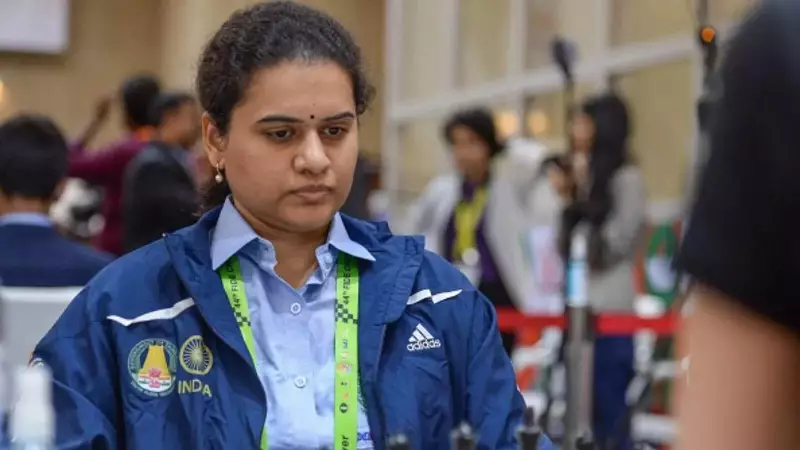
The recent World Rapid Chess Championships in Doha, Qatar, concluded under a cloud of controversy, with inconsistent regulations potentially costing India a gold medal. The focus of the dispute lies in differing tie-break rules between the Open (men's) and Women's sections, which directly impacted veteran Indian Grandmaster Koneru Humpy's title chances.
The Rule Discrepancy That Changed The Game
While the tournament regulations allowed all finishers on the highest points in the Open section to proceed to tiebreak games, a different standard was applied in the Women's section. There, only the top two ranked players among those tied for the lead were granted a playoff opportunity. This discrepancy did not affect the Open event, where Magnus Carlsen secured a clear victory. However, in the Women's section, three players—China's Zhu Jiner, Russia's Aleksandra Goryachkina, and India's K. Humpy—all finished tied at the top with 8.5 points each.
Due to her lower ranking compared to Zhu and Goryachkina, Humpy was denied a spot in the playoff, which ultimately decided the gold and silver medals. This denied the Indian star a shot at a second successive World Rapid gold medal, a heartbreaking outcome after a stellar performance.

FIDE's Explanation and a History of Inconsistency
Following murmurs of discontent over the lopsided regulations, FIDE CEO Emil Sutovsky took to social media platform X (formerly Twitter) to clarify the issue. He stated that until 2022, neither section had extensive tie-breaks, with only the top two players eligible. Sutovsky claimed the current systems reflect the preferences of a majority of players in each section, based on a poll conducted among top competitors. "The tie-break systems used now reflect preferences of a majority of players in respective sections — hence Open has a different tie-break format from Women," he posted.
However, this explanation has been met with skepticism. Critics point to FIDE's slow history in standardizing rules across genders. For instance, women were given uniform four-board teams at the Chess Olympiad only in 2006, ending an era of three-board teams with colour inequality. The Women's Candidates tournament adopted the same eight-player double round-robin format as the Open section only as recently as 2019. The contrast is sharp when compared to swift action on issues like the dress code, which was amended last year after Magnus Carlsen's protest.
A Twist of Fate: Humpy's Past Experience with the Rule
Ironically, Humpy has been on both sides of this contentious rule. In the 2019 World Rapid Championship in Moscow, she benefited from it. Then, Iran's Ekaterina Atalik was tied on points with Humpy and China's Lei Tingjie. However, only Humpy and Lei, due to their superior rankings, advanced to the playoff, with Atalik being excluded—a mirror image of the 2024 scenario, but with Humpy as the beneficiary.
This recurrence highlights the ongoing debate about fairness and equality in chess governance. The central question remains: should elite tournaments maintain different competitive rules for Open and Women's categories, or should uniformity be the standard to ensure equal opportunity for all competitors at the pinnacle of the sport?