Uzbek Chess Revolution Challenges Indian Supremacy
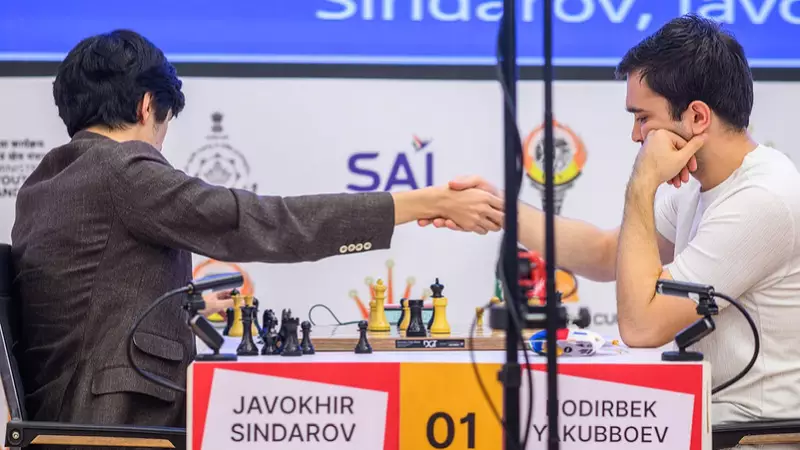
The 2025 FIDE Chess World Cup has witnessed a dramatic power shift in global chess, with Uzbekistan emerging as the new formidable force challenging India's young prodigies. The semifinal clash between Uzbek players Javokhir Sindarov and Nodirbek Yakubboev on Sunday marked a historic moment for Central Asian chess, showcasing their growing dominance in the sport.
Sindarov's Historic Breakthrough
In a tense semifinal encounter that began with warm smiles but ended with barely any eye contact, 19-year-old Javokhir Sindarov defeated his compatriot Nodirbek Yakubboev 1.5-0.5 in the tiebreaks. The victory was particularly poignant as Sindarov repeatedly offered consoling gestures to his defeated countryman after securing his place in the final and, more importantly, a spot in the prestigious 2026 Candidates Tournament.
Sindarov's achievement is monumental for Uzbek chess. He becomes the first-ever Uzbek player to qualify for the Candidates Tournament, achieving what even their biggest hope Nodirbek Abdusattorov couldn't accomplish. The flamboyant teenager has now earned his place alongside chess elites including Fabiano Caruana, Anish Giri, Matthias Bluebaum, and Wei Yi at the Cyprus event.

Statistical Dominance Exposes Indian Struggles
The numbers tell a compelling story of Uzbek ascendancy and Indian disappointment. While Uzbekistan sent only five players to the 2025 FIDE Chess World Cup, two of them reached the semifinals. In stark contrast, India's initial contingent of 24 players failed to produce even a single semifinalist.
Arjun Erigaisi made the deepest run among Indians, reaching the quarterfinals before being eliminated by China's Wei Yi. This performance gap highlights the growing challenge that Uzbek players pose to India's chess prodigies in international competitions.
Historical Context: Uzbekistan's Chess Evolution
For over two decades, Uzbek chess was dominated by the legendary Rustam Kasimdzhanov, a former FIDE World Champion and Asian Champion. The transformation began in 2021 when the world got its first glimpse of Uzbekistan's new generation at the FIDE World Rapid and Blitz Championship in Warsaw.
Then 17-year-old Nodirbek Abdusattorov created history by becoming the youngest-ever World Rapid Champion, finishing ahead of chess giants Magnus Carlsen and Ian Nepomniachtchi. With a world ranking of No. 4 and peak rating of 2765, Abdusattorov seemed destined to carry Kasimdzhanov's legacy forward.
However, destiny had different plans. After Abdusattorov narrowly missed qualifying for the 2024 Candidates, Sindarov seized the opportunity, mastering the challenging knockout format to confirm his own qualification for the Candidates Tournament.
Rising Threat to Indian Chess Prodigies
The success of Uzbek players isn't new to Indian chess enthusiasts. In 2022, a team led by Abdusattorov toppled an Indian 'B' team featuring D. Gukesh, R. Praggnanandhaa, Nihal Sarin, and Raunak Sadhwani, denying the host nation glory at the Olympiad gold in Mahabalipuram.
Now, with Sindarov's qualification and Yakubboev still in contention for the third Candidates spot through the third-place playoff against Russia's Andrey Esipenko, Uzbekistan could potentially have multiple representatives at the Candidates Tournament.
The scenario becomes even more concerning for Indian chess fans. There's a possibility that three Uzbek players could qualify for the Candidates if Yakubboev beats Esipenko, and if Abdusattorov wins both the 2025 London Chess Classic and the 2025 World Rapid and Blitz Championship.
Implications for Indian Chess Future
The rise of Uzbek chess poses significant challenges for India's young talents. After three Indians - Gukesh, Praggnanandhaa, and Vidit Gujrathi - featured in the previous Candidates tournament, there's a real possibility that none might qualify for the Cyprus event.
Sindarov's remarkable improvement over the past year demonstrates Uzbekistan's systematic approach to chess development. Since October 2024, his Elo rating has jumped from 2668 to 2725, with impressive performances in the Freestyle event and Esports World Cup 2025 indicating his growing prowess.

As the chess world watches Sindarov prepare to challenge China's Wei Yi in the final, attempting to become the first Uzbek World Cup winner, Indian chess authorities must take note of the emerging pattern. The Central Asian nation has clearly established itself as the biggest roadblock for Indian prodigies in the coming years, demanding strategic responses to maintain India's position in global chess.