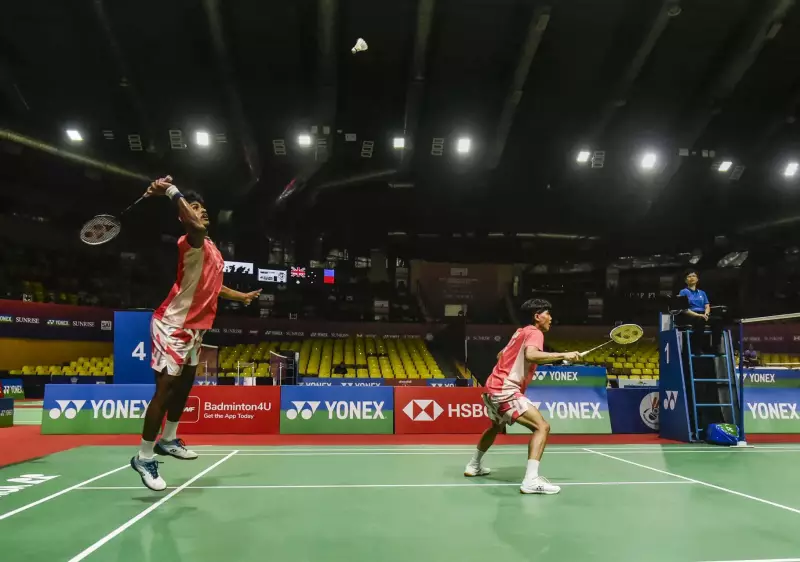
The Badminton World Federation will launch a trial of its new 25-second time clock at the Indonesia Masters next week. This initiative aims to reduce tactical delays during matches and create a more standardized flow of play. The federation plans to continue testing this system at select World Tour tournaments throughout the season.
How the Time Clock System Works
Under the new system, the clock starts immediately after the umpire updates the score. Both the server and receiver must be ready to play before the 25 seconds expire. Players can towel off, drink water, or apply cold spray without seeking permission as long as they complete these actions within the allotted time.
Umpires retain the discretion to allow longer breaks in exceptional circumstances. These include medical interventions or extensive court mopping that requires additional time.

Player Reactions: Support and Skepticism
Reactions from the badminton community have been mixed. China's world number two Wang Zi Yi welcomed the move, stating that players would adapt if the rule was enforced uniformly.
"If the rule is going to apply, players will adjust to it," Wang told PTI. "It will address the issue of delay by players."
Tokyo Olympic champion Chen Yu Fei expressed some concern about recovery time after demanding rallies. "I think when we finish long rallies, I feel 20-25 seconds is not enough but we can try," she said after reaching the semifinals of a recent tournament.
Denmark's Mathias Christiansen voiced skepticism about whether the clock would solve the underlying problem. "I must say I'm a little bit sceptical about it. If the umpires are taking good care of the match and make it smooth, I don't think there is any problem," he commented. "I don't think it will address tactical delays."
Coaches Offer Varied Perspectives
Korean singles coach Hyunil Lee believes the allotted time might actually be excessive. "Twenty-five seconds is very long. It should be enough, maybe even less," he remarked.
Former India doubles player and current coach B Sumeeth Reddy acknowledged the need for standardization but cautioned about practical considerations. "In general, standardising the norms is always better so that a set rule is in place," said Reddy, who works closely with former world number one Satwiksairaj Rankireddy and Chirag Shetty.
Reddy highlighted how varying match paces affect spectators. "Some matches finish fast because players don't take breaks, while some last forever because of repeated pauses. From a spectator's point of view, that becomes boring."
He also noted that tactical delays and subjective umpiring have long existed in the sport. "I give credit to players who are able to take that extra break and convince the umpire. That's an art in itself," he said, adding that the time clock could help cut undue delays.
However, Reddy warned against rigid enforcement after physically draining rallies. "After a 100 or 150-shot rally, you cannot expect a player to be ready in 20 to 25 seconds. That buffer has to be there. I think 25 seconds is a decent amount of time, especially in doubles where rallies are shorter, but sensibility has to come into play."
BWF's Data-Driven Decision
The Badminton World Federation based its decision on extensive match analysis. The federation studied hundreds of Major Championship and World Tour matches. Their research revealed that in rallies without interruptions, the average time between points was 22 seconds. This compared to just nine seconds of actual rally time.
This data led the federation to conclude that 25 seconds strikes the right balance between player recovery and maintaining match flow.
Support for Standardization
Former India player Arvind Bhat strongly supported the move toward a time clock system. He pointed out that the current lack of clarity around time between rallies has allowed gamesmanship to persist.
"Right now it's very haphazard. It depends on your relationship with the umpire," said Bhat, the 2014 German Open champion. "With a time clock, that is ruled out. It becomes fair for both players."

Implementation Timeline and Future Plans
The BWF Council approved these rules at its meeting on August 29 last year. The regulations first came into effect at the Australia Open Super 500 from November 18 to 23. This forms part of the federation's broader initiative to improve sport presentation and ensure continuous play.
The BWF has already conducted preliminary system tests without enforcement. The federation plans further trials in the coming months alongside consultations with member associations, coaches, and players. Only after these consultations will the BWF decide on permanent adoption of the system.