India Open Badminton Tournament Descends into Farce with Bird Nest Debris Incident
The India Open Super 750 badminton tournament has lost its reputation as a celebration of world-class sport. Instead, it has transformed into a daily showcase of administrative incompetence. Every single day of this prestigious BWF World Tour event at the Indira Gandhi Indoor Stadium has brought fresh controversy.
Semifinal Halted by Falling Nest Debris
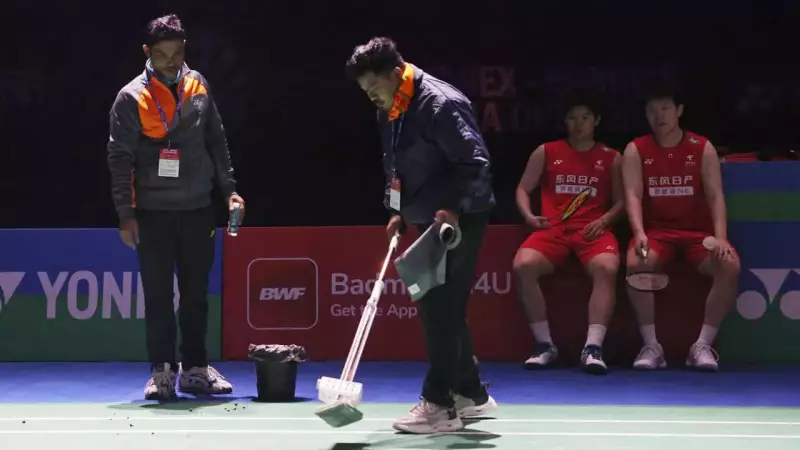
On Saturday, the tournament reached a new low point. A women's doubles semifinal match had to be stopped abruptly. Particles and twigs from a bird's nest fell directly onto the court between points. This bizarre episode perfectly captured the avoidable and embarrassing problems that have defined this year's competition.
The incident occurred on Court No. 1 during the semifinal between top-seeded Chinese pair Liu Shengshu and Tan Ning and the sixth-seeded South Korean duo of Baek Ha Na and Lee So Hee. Liu was preparing to serve at 6-3 in the opening game when debris suddenly rained down from above.

Liu broke into laughter and pointed toward the chair umpire, showing more disbelief than amusement. The Chinese players walked to their chairs, looking visibly perplexed and concerned. Lee also glanced up at the roof in bewilderment, struggling to comprehend how a Super 750 tournament could descend into such farce.
The chair umpire immediately summoned sweepers to clear the court. The cleaning operation took several precious minutes. Tournament officials later confirmed that the particles indeed came from a bird's nest. Workers picked up the debris and disposed of it before play could eventually resume.
Pattern of Neglect and Criticism
"That a semifinal at a premier BWF event could be interrupted by falling nest debris would be comical if it were not so damning," a former Indian shuttler told reporters. "More troubling is that this was not an isolated mishap. As people have witnessed over the past few days, it forms part of a recurring pattern."
Just two days earlier, another match faced similar disruptions. The pre-quarterfinal between HS Prannoy and Loh Kean Yew had to be halted twice after bird droppings fell on the court. That incident triggered widespread criticism of playing conditions and raised serious questions about the venue's basic readiness.
Warning signs appeared even before the tournament gathered momentum. Danish shuttler Mia Blichfeldt complained about "dirty" and "unhygienic" conditions inside the arena. She later posted a photograph on Instagram, pointedly questioning whether the venue was fit to host the World Championships later this year.
Another Danish player, world No. 3 Anders Antonsen, joined the criticism. He questioned pollution levels in the city and whether staging a Super 750 tournament under such conditions made sense.
Systemic Maintenance Failures Exposed
"Bird-related disruptions are particularly indefensible," an ex-India player emphasized. "Indoor badminton arenas are supposed to be controlled environments. The presence of nests inside the stadium is not an act of nature beyond human control. It provides clear evidence of neglected infrastructure and lax maintenance."
The former player added, "Such issues do not materialize overnight. They result from months, if not years, of oversight failure. Proper maintenance protocols could have prevented these embarrassing incidents."
The tournament's problems extend beyond the bird nest incident. Players have reported multiple issues with court conditions, air quality, and overall facility management. These recurring problems have overshadowed the actual badminton matches and player performances.
Spectators and badminton enthusiasts have expressed disappointment with the tournament organization. Many expected better standards from a Super 750 event, especially one hosted in India's capital city. The repeated disruptions have damaged the tournament's prestige and raised concerns about future international events at the venue.
Tournament organizers now face mounting pressure to address these systemic issues. The badminton community awaits explanations and assurances that such problems will not recur in future editions of the India Open or other international tournaments scheduled for the stadium.