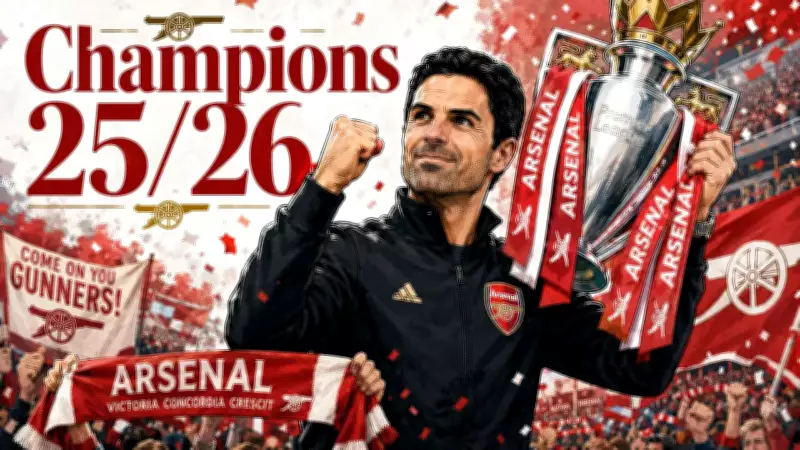
For a very long time, Arsenal was what many called a "banter club." The term was popularized by Football Twitter, where fans reveled in the Gunners' inability to win trophies despite playing attractive football. Ian Holloway once famously described them as a team that "played some of the best football… and yet couldn’t have scored in a brothel with two grand in their pockets." This politically incorrect commentary captured the essence of Arsenal's frustrating years since their last Premier League title in 2004. Now, after two decades, Arsenal have finally won the Premier League again.
Why Arsenal's Win Matters
To understand the significance of this triumph, one must revisit the role of European football in India. For millennials and Gen Z, supporting clubs like Arsenal or Manchester United became a rite of passage, a way to connect with the global economy. The Premier League, with its favorable TV timings and growing audiences, found a massive footprint in India. Many fans' coming-of-age coincided with the rise of the league, and for some, that meant aligning with Manchester United's Class of '92 or Arsenal's Invincibles under Arsene Wenger.
The rivalry between Arsenal and Manchester United defined an era. Memorable moments like Ryan Giggs' slaloming run in the 1999 FA Cup semi-final, the 8-2 thrashing at Old Trafford, and Robin van Persie's controversial move to United fueled the fire. For fans, a "pizza party" referred to the infamous incident where a slice was thrown at Sir Alex Ferguson, and "see you out there" was a call to arms in the tunnel.

The Banter Club Era
After 2004, Arsenal's decline was slow and artistic, making them the ultimate banter club. They produced technically gifted players like Cesc Fabregas, Tomas Rosicky, and Jack Wilshere, who treated the ball like a Fabergé egg, yet they would concede from long throws against physical teams. They were accused of trying to walk the ball into the net, and rival fans watched their stumbles with schadenfreude.
Meanwhile, Manchester United's decline after Sir Alex Ferguson's retirement was immediate and chaotic. Arsenal's was more refined: beautiful while losing. This season, however, Arsenal transformed under Mikel Arteta.
Arteta's Transformation
Arteta, a former Guardiola assistant, adopted a pragmatic approach reminiscent of Jose Mourinho. He created a siege mentality, banning football channels and filling training screens with music. The team embraced its dark side, becoming masters of set pieces. Set-piece coach Nicolas Jover became a cult figure, with a contract clause tied to goals from dead-ball situations. Arsenal scored 24 goals from set pieces, including 18 corners, often grinding out 1-0 wins.
This style was a departure from Wenger's beautiful football, but it delivered results. After finishing second in three consecutive seasons, Arsenal finally crossed the line. Gabriel Jesus admitted the internal contradiction: "Beautiful football can be annoying when goals come from set pieces, but titles are often decided that way."
The Final Push
Arsenal's season was not always convincing, but they dragged themselves over the line while rivals waited for the familiar collapse. As one social media post noted, this was the first time Arsenal fans could post about winning the Premier League, as their last title came before the advent of social media. For years, the club was like Mohun Bagan in Kolkata, often "defeated after playing well." Now, their football may not be beautiful, but life certainly is after winning the league.