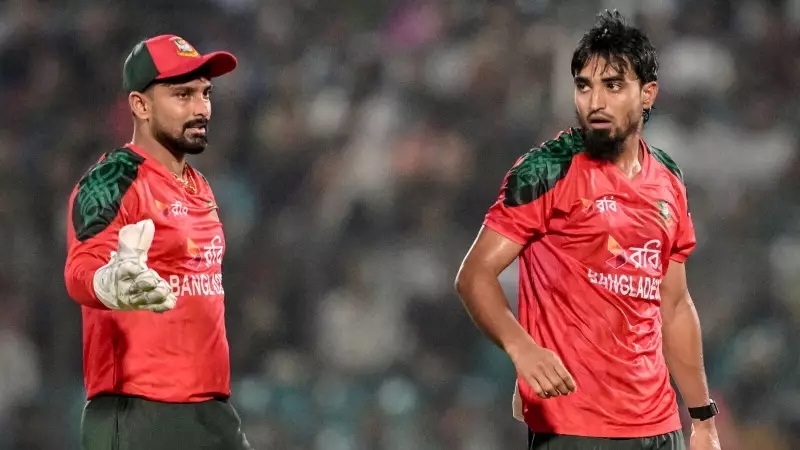
The International Cricket Council (ICC) faces a major diplomatic and logistical crisis just a month before the T20 World Cup 2026. The Bangladesh Cricket Board (BCB) has formally refused to send its team to India for the tournament, citing player security concerns. This dramatic move comes as a direct response to the controversial removal of Bangladesh pacer Mustafizur Rahman from the Indian Premier League (IPL).
The Root of the Conflict: Mustafizur's IPL Ouster
The flashpoint for this standoff occurred last week. The Board of Control for Cricket in India (BCCI) directed the Kolkata Knight Riders (KKR) franchise to release Mustafizur Rahman from their squad. This directive was reportedly issued "due to recent developments going across" between the two nations, alluding to the ongoing political tensions. KKR had secured the left-arm fast bowler for a hefty sum of ₹9.20 crores during the auction just a month prior.
Angered by this action, the BCB has taken a firm stance. The board has written to the ICC, the event's governing authority, requesting the relocation of all of Bangladesh's scheduled matches to a venue outside India. In the original fixture, Bangladesh, placed in Group C, was set to play three matches at Kolkata's Eden Gardens and one at Mumbai's Wankhede Stadium.

ICC's Logistical Nightmare and Limited Options
The ICC now finds itself in an extremely difficult position with the mega-event set to begin in February 2026. Revising the schedule at this late stage presents a colossal logistical challenge. It involves rearranging flights, hotels, and security for not just the Bangladesh contingent but also for their opposing teams—England, West Indies, Nepal, and Italy.
Bangladesh's proposed solution is to move their games to co-host Sri Lanka, where Pakistan is already scheduled to play all its matches. However, integrating a new team into the Sri Lankan leg of the tournament with such short notice is a complex undertaking. The situation is further complicated by the fact that the ICC is currently headed by former BCCI secretary Jay Shah, adding a layer of political sensitivity to the decision-making process.
Potential Scenarios: What Happens Next?
If the ICC rejects Bangladesh's request and the BCB remains firm on its boycott, cricket's world body has limited and historic precedents to follow.
Scenario 1: Bangladesh Withdraws, Walkovers Granted
This would mark the first time Bangladesh misses a T20 World Cup. The tournament would proceed with only 19 teams. In Group C, England, West Indies, Nepal, and Italy would each receive a walkover win against Bangladesh. This has happened before: in the 1996 ODI World Cup, Australia and West Indies refused to play in Sri Lanka, and in 2003, England and New Zealand skipped matches in Kenya and Zimbabwe, all resulting in walkovers.
Scenario 2: ICC Replaces Bangladesh with Another Team
The ICC could invite another nation to replace Bangladesh, as it has done in past tournaments. In the 2009 T20 World Cup, Scotland replaced Zimbabwe after their withdrawal. Similarly, in the 2016 U-19 World Cup, Ireland stepped in for Australia, which pulled out just 22 days before the event in Bangladesh.
The ball is firmly in the ICC's court. Its decision will not only affect the T20 World Cup 2026 schedule but also set a significant precedent for handling political and security disputes in international cricket. The coming weeks will be critical in determining whether a compromise can be reached or if the tournament will proceed without one of its prominent Asian teams.