Bangladesh Escalates T20 World Cup Venue Dispute to ICC's Legal Committee
In a significant escalation of the ongoing standoff, the Bangladesh Cricket Board (BCB) has formally requested the International Cricket Council (ICC) to refer their demand for relocating T20 World Cup matches to the global body's independent Dispute Resolution Committee. This development comes just hours after Bangladesh reiterated its firm stance on moving their tournament fixtures from India to Sri Lanka.
The Legal Pathway: ICC's Dispute Resolution Committee
The ICC Dispute Resolution Committee represents a formal legal mechanism within international cricket governance. This independent arbitration body, comprised of legal experts and operating under English law with proceedings seated in London, serves as the final arbiter for disputes involving the ICC, member boards, players, officials, and related parties.
The committee functions through confidential arbitration panels that assess the lawfulness and interpretation of ICC decisions, regulations, and contractual matters. Importantly, the DRC does not serve as an appeal forum but rather examines whether ICC actions comply with established rules and agreements. Once all internal remedies have been exhausted, parties can approach this committee, whose rulings are final and binding with extremely limited grounds for procedural appeal.

Bangladesh's Unwavering Security Stance
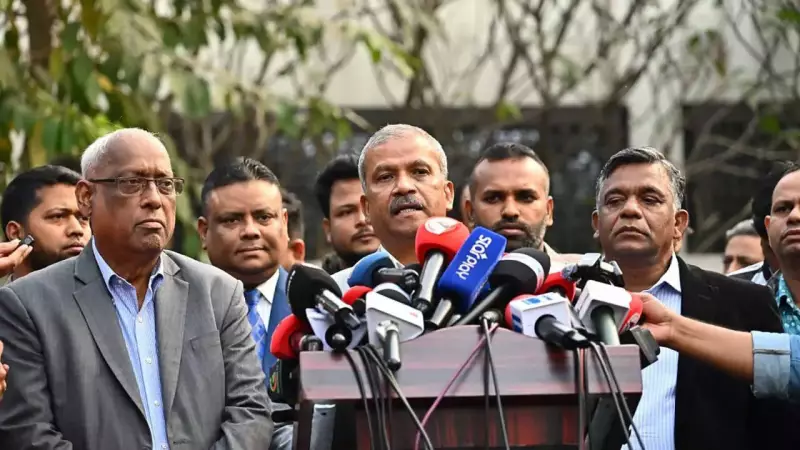
Bangladesh officials have consistently maintained that their refusal to play the upcoming T20 World Cup in India stems exclusively from legitimate security concerns, characterizing this as a sovereign decision. Sports Adviser Asif Nazrul emphasized on Thursday that there exists no possibility for Bangladesh to reconsider their position regarding travel to India for the tournament.
"As the ICC has also not accepted Bangladesh's request to change the venue, it now effectively means that Bangladesh will not be taking part in this year's T20 World Cup," Nazrul stated during a press briefing in Dhaka following meetings with senior national cricketers.
The official further criticized the ICC for what he described as a failure to ensure justice by disregarding Bangladesh's venue change request. "Our security risk in playing in India has not changed at all," Nazrul asserted. "This concern did not arise from any imaginary analysis or assumption. It arose from a real incident, where one of the best players of our country was forced to bow his head before extremists, and the Indian cricket board removed him from India, plainly speaking, asked him to leave."
ICC's Firm Position on Tournament Venues
The International Cricket Council has maintained a consistent position regarding tournament scheduling and venue decisions. Earlier this week, the global governing body formally rejected Bangladesh's relocation request following a board meeting, deciding to keep the T20 World Cup schedule unchanged.
In their official statement, the ICC explained: "The ICC's venue and scheduling decisions are guided by objective threat assessments, host guarantees and the tournament's agreed terms of participation, which apply uniformly to all 20 competing nations."
The council further elaborated: "In the absence of any independent security findings that materially compromise the safety of the Bangladesh team, the ICC is unable to relocate fixtures. Doing so would carry significant logistical and scheduling consequences for other teams and fans worldwide, and would also create precedent-related challenges that risk undermining the neutrality, fairness and integrity of ICC governance."
Following their decision, the ICC provided Bangladesh with a one-day deadline to consult their government and confirm whether their team would participate in the tournament as scheduled.
The Triggering Incident: Mustafizur Rahman's IPL Removal
BCB president Aminul Islam Bulbul has identified a specific incident as the catalyst for Bangladesh's hardened stance against traveling to India for the World Cup. According to Bulbul, the removal of pace bowler Mustafizur Rahman from an Indian Premier League team due to security concerns raised serious red flags for Bangladesh cricket authorities.

Bulbul clarified that Mustafizur was neither injured nor had voluntarily withdrawn from the IPL, and the BCB had not revoked his No Objection Certificate. "He was dropped due to security reasons," the BCB president revealed, describing this development as a pivotal moment that fundamentally altered Bangladesh's risk assessment.
Once the BCB learned of Mustafizur's removal, they immediately contacted the ICC on January 4. "We informed them of the situation and asked them to take it seriously," Bulbul explained. "If a player can be removed from a league due to security concerns, how can we ignore those same concerns for a World Cup?"
The BCB president emphasized that his board had proposed solutions rather than confrontation, citing previous instances where neutral venues or hybrid models were implemented during ICC tournaments due to security considerations. "We asked the ICC to follow that logic," he stated. "Let us play the World Cup, but at a neutral venue like Sri Lanka or elsewhere."
Tournament Implications and Scheduling Details
Bangladesh finds itself placed in Group C alongside England, Italy, West Indies, and Nepal for the upcoming T20 World Cup. According to the current schedule, the team is slated to play their first three matches in Kolkata before traveling to Mumbai for their final group stage encounter.
The tournament opens on February 7 with Bangladesh scheduled to face West Indies on the inaugural day. The escalating dispute now places this fixture and Bangladesh's entire tournament participation in serious jeopardy as the BCB pursues formal legal channels through the ICC's dispute resolution mechanism.