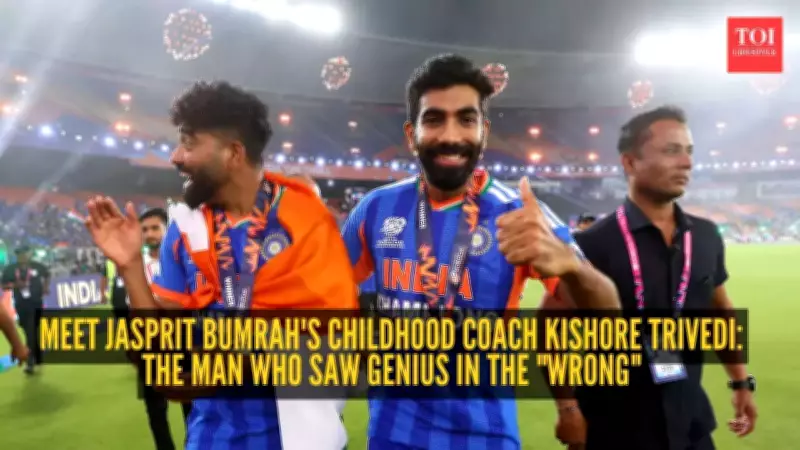
The Unlikely Guru Who Saw Genius in Flaws
Picture a lanky, introverted 16-year-old boy arriving at the cricket nets, delivering balls with an unorthodox arm action that seemed to defy every coaching manual. His elbow locked straight, his body rigid, and his wrist cocked aggressively as if targeting the leg stump. Most cricket instructors would have immediately flagged this as a technical violation, rushing to "correct" the anomalies into textbook conformity. But not Kishore Trivedi.
Spotting Diamond in the Rough
At his humble Royal Cricket Academy in Ahmedabad, the 79-year-old coach perceived something extraordinary where others only noticed errors. That teenager was Jasprit Bumrah, who would later captivate global audiences and claim crucial wickets during India's triumphant T20 World Cup 2026 final campaign. Trivedi's revolutionary choice to preserve Bumrah's so-called "flaws" rather than eliminate them ultimately cultivated a cricketing icon. This is the remarkable narrative of the mentor who abandoned conventional playbooks to sculpt one of India's most exceptional fast bowlers.
The Reluctant Prodigy
Initially, Bumrah hardly resembled academy material. A student at Nirman High School, located merely fifteen minutes away by auto-rickshaw, he approached cricket practice with casual indifference. Coach Kishore Trivedi reminisced about their first encounter, stating, "He enrolled at sixteen after playing sporadic school cricket without serious dedication. After observing him briefly, I emphasized that achieving professional excellence demanded consistent commitment—practicing one day and vanishing for three wouldn't suffice. I recognized his innate talent and assured him that with discipline, he could reach the sport's pinnacle."

Embracing the Abnormal
Bumrah responded positively, attending sessions regularly and astonishingly clocking speeds of 140 kph even during his teenage years. Fellow players dreaded confronting his deliveries, which seemed to hiss from behind his shoulder due to an unusually forward release point enabled by hyperextension. Mocked as a "chucker" by peers, Trivedi firmly defended him, declaring, "His action is legal, distinctive, and ours." Rather than imposing adjustments, the coach fostered unwavering confidence in Bumrah's natural technique.
Rejecting Conventional Dogma
Traditional fast bowling principles advocate a relaxed run-up, bent elbow, fluid body rotation, and versatile wrist movements. Bumrah, however, exhibited a brief jog, stiff posture, predominantly in-swinging deliveries, and an open-chested follow-through—attributes that coaching manuals would label as fundamentally incorrect. Typical instructors might have transformed hundreds of similar bowlers into mediocre professionals through rigid corrections. Trivedi discarded this script entirely.
After meticulously studying Bumrah for a week, Trivedi opted to refine perfection within imperfection. Instead of fixing perceived faults, he sharpened the youngster's inherent skills. This approach propelled Bumrah to represent Gujarat in the Syed Mushtaq Ali Trophy, where scout John Wright identified his potential. Subsequently, the Mumbai Indians recruited him, launching his celebrated IPL career and global stardom.
Legacy of a Modest Academy
Trivedi's Royal Academy has nurtured multiple professional cricketers, including his son Siddharth Trivedi, a former Rajasthan Royals IPL participant. Reflecting on Bumrah's ascent, Trivedi expressed profound pride, noting, "Envision producing the world's finest bowler from such a modest coaching center. That achievement brings me immense joy." His dedication to honing Bumrah's talent stands as a tribute to India's enduring guru-shishya tradition, emphasizing mentorship over mechanical instruction.
From Casual Teen to World Champion
Bumrah's journey from an indifferent schoolboy to a pivotal member of India's T20 World Cup 2026 championship squad is genuinely awe-inspiring and extraordinary. It underscores how visionary coaching that values individuality can unlock unparalleled greatness, challenging entrenched norms and redefining sporting excellence.