The early 1980s were the grainy days of black and white television. For an Indian audience, getting used to the trickling taste of live coverage of the World Cup, Michael Platini, probably the world's most well-known footballer then alongside Zico and Socrates, you could argue was still an unknown quantity. It wouldn't take too long though for the maestro to become a bit of a favourite with his silken touches, overall elegance and cerebral playmaking, somewhat of a footballing equivalent of GR Viswanath or John McEnroe (with one's humility and calm and without the other's temper tantrums).
For a budding fan of the global footballer then, it did hurt when Platini's France let go of a 3-1 lead in extra-time of the 1982 World Cup semifinal and eventually lose to West Germany in the tie-breaker. History remembers it as the 'Night of Seville'.
Spain's Long Journey
If that was France, often flattering to deceive, Spain presented an even more exasperating reality. Always present among the elite, perennial dark horses, they seldom rose above their billing. Hard to imagine that today they are the defining idea in the game, having carried the underachiever's mantle for decades.

Such was their abject underachievement back then, that the 1980s famous 'vulture squadron' of Real Madrid was reduced to at best being a quiz question. After their dismal show as hosts in the 1982 World Cup, there was a glimmer of promise four years later with an Emiliano Butragueno four-goal haul — then a record for a single World Cup game tally — in the Round of 16 that sent Denmark packing. But then the familiar implosion happened against Belgium, an affair that was decided in the shootout.
Spain reintroduced themselves more convincingly through club football. Barcelona's Cruyff-coached Dream Team of the early 1990s, with Romario and Stoichkov in it, gave us the true taste of Spain. Still, those were not days of yearlong European football beamed in India. And come the World Cup, chatter around potential favourites used to hover around Brazil, Argentina, Germany and Italy.
The Turning Point
But all that began to change. First with France. In 1998 with Zinedine Zidane breaking the hearts of millions across the world with two piercing headers against Brazil in the Paris final. That broke their World Cup jinx. Just Fontaine, the top scorer in 1958 with 13 goals, and Platini earned their redemption.
Spain had to wait. The two giants — Real Madrid and Barcelona — who made them such a force in club football were largely responsible for their numerous downfalls on the international stage. Their famed historical rivalry — a product of social, cultural and political differences — spilled over to the national teams over generations.
After the 1964 European championship, it took Spain 44 years, under the wily Atletico Madrid great Luis Aragones — the Wise Man of Hortaleza — to win another Euro in 2008. That, though, was the start of a revolution, and by 2010, it became a storm that reshaped world football. The 2010 team, comprising chiefly the golden generation of Pep Guardiola's Barcelona and coached by Real Madrid legend Vicente Del Bosque, won their first World Cup.
A 2010 Feeling
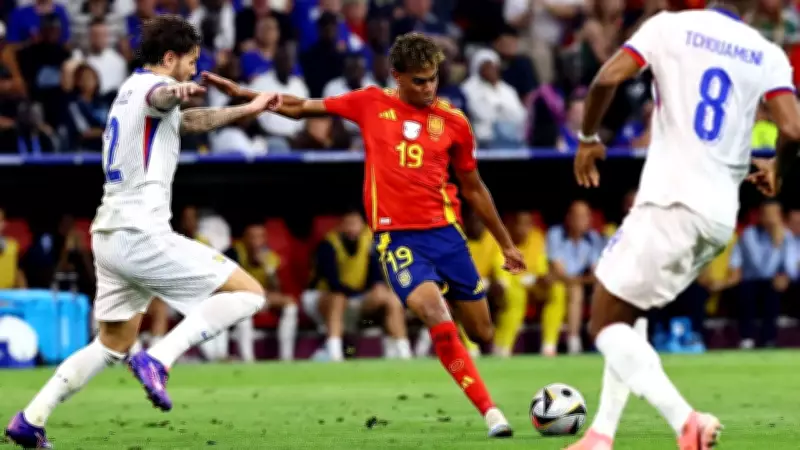
This time around, there's a 2010 vibe to La Roja who will be travelling to the US as bookies' favourites to win. Under coach Luis de la Fuente, the reigning European champions are dominated by a talented Barca crop — eight of them could make the first XI with Lamine Yamal and Pedri leading the line. De la Fuente hasn't picked a single Real Madrid player for the first time in Spain's World Cup history. The 19-year-old Yamal is the closest Europe can come to matching Leo Messi. Many believe that Pedri is on a par with Spain's greatest World Cup player — Iniesta, the man who scored Spain's World Cup-winning goal in 2010. A terrific group of Basque-origin players — Unai Simon, Mikel Merino, Mikel Oyarzabal, Martin Zubimendi and Nico Williams — will complement the Barcelona superstars this time.

Nothing to Match French Attacking Line
The one Real Madrid player, though, who has dribbled past his team's slump to score 42 goals in 44 games this season is not a Spaniard. French captain Kylian Mbappe is the two-time champion's biggest star, but the team is not only about him. Ousmane Dembele, the current Ballon D'Or holder and a member of the all-conquering Paris St Germain side, will shuffle positions with Mbappe — making it incredibly difficult for the opposition defence.
And then, there's a third front — Michael Olise. The Bayern Munich right-winger has the ability to dribble past strong defenders, and there are French experts who believe he can also be a perfect No. 10, filling the void of the supremely-versatile now-retired Antoine Griezmann — the unheralded architect of their triumph in 2018.
Such is France's might, that PSG's two super-talented wingers Desire Doue and Bradley Barcola are not even discussed. The beauty of France is that outgoing coach Didier Deschamps has two world-class players for virtually every position. The coach has managed egos of the superstars brilliantly over his 14-year reign making them a supremely consistent unit, and come July 19, they will love to give their manager a winning farewell.