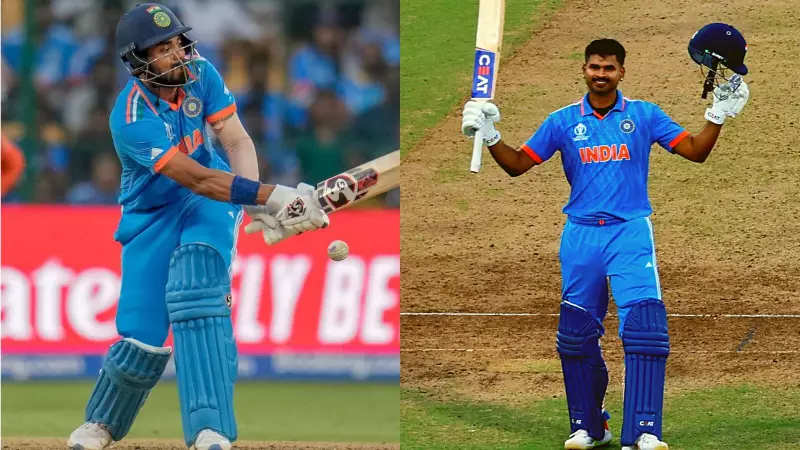
In Indian cricket, the spotlight has historically shone brightest on the top three batsmen. Yet, the engine room of every major title triumph has been a firing middle order. From the Yashpal Sharma-Sandeep Patil combo in Kapil Dev's 1983 World Cup win to the versatile line-ups of MS Dhoni's champion era, a robust core has been non-negotiable. Now, after years of experimentation, India appears to have found its ideal fourth and fifth gear in the distinctly different but perfectly complementary pairing of KL Rahul and Shreyas Iyer.
A Partnership Forged in Fire: Post-2019 Rebuilding
Their alliance began in the critical rebuilding phase after the 2019 World Cup, where a fragile middle order was a glaring weakness. Since then, the duo has been nothing short of phenomenal. In 14 partnerships, they have amassed 823 runs at a staggering average of 64. Remarkably, one in every three of their stands has crossed the 100-run mark. This consistency has provided the Indian batting lineup with unprecedented stability and firepower through the middle overs.
A Study in Contrasts: Attitude, Temperament, and Technique
What makes this pair so potent is their fascinating divergence in approach. Shreyas Iyer is the aggressor, the calculated risk-taker. He is known to shift between three different batting stances in a single game, adapting to conditions and bowlers with proactive intent. In a crisis, he counter-punches, aiming to demoralize the attack. He is arguably the world's most ruthless destroyer of spin bowling, using his footwork and powerful wrists to dismantle lengths. His wicket was the most coveted by Australia in the 2023 World Cup final, a testament to his big-match temperament.

Former head coach Rahul Dravid highlighted this clutch ability, noting, "You just look at some of his knocks under pressure, how he's able to actually bring the best out of himself under those pressure situations."
In contrast, KL Rahul is the classicist, a compelling watch of textbook elegance. While possessing a rich array of attacking strokes, he often deploys them with more traditional flair. Their handling of the short ball encapsulates their difference: Iyer slashes or pulls, often in front of square; Rahul prefers the finer, more controlled cut behind point. Rahul approaches a collapse with an old-school mindset, preferring to weather the storm before accelerating. His adaptability allows him to be the aggressor, accumulator, or enforcer as the situation demands. Since 2020, no one averages higher than his 61.72 at the No. 5 position (min. 20 innings).
Complementary Forces Confounding Opponents
Together, they create a puzzle for opposing captains and bowlers. Their strengths are so varied that field settings and bowling plans must be constantly revised. A short ball that might test Iyer could be dispatched to the fence by Rahul. Both are exceptional leg-side players and masterful manipulators of the field, adept at rotating strike and accumulating runs.
This contrast grants the Indian team immense flexibility. If early wickets fall, Rahul can anchor while Iyer rebuilds momentum. If the top order provides a flier, Iyer can press the accelerator with Rahul stabilizing from the other end. While Iyer has a slightly higher strike rate (99.07 between positions 4-7 compared to Rahul's 94.72), they are not miles apart, ensuring the scoreboard never stagnates.
Their 136-run partnership off just 101 balls in Hamilton in 2020 is a prime example. Joining at 156/3 in the 29th over, they seamlessly accelerated, laying the foundation for India's massive 347/4. They followed it with another century stand in the same series, warning New Zealand and the world of their destructive potential.
The Foundation for Future Glory
Behind the aggressive template set by Rohit Sharma and company at the top lies the guaranteed solidity of Rahul and Iyer. They have been the center holding the innings together through top-order wobbles. With the eventual return of Hardik Pandya, India's top six transforms into an intimidating proposition, one capable of clinching the World Cup that slipped away at home in 2023.

They may not always be the poster boys, but as history shows, tournaments are won on the muscle, momentum, and control furnished by such middle-order pillars. KL Rahul and Shreyas Iyer, through their beautiful contrast, have become precisely that for modern Indian cricket.