India Creates History with T20 World Cup 2026 Triumph
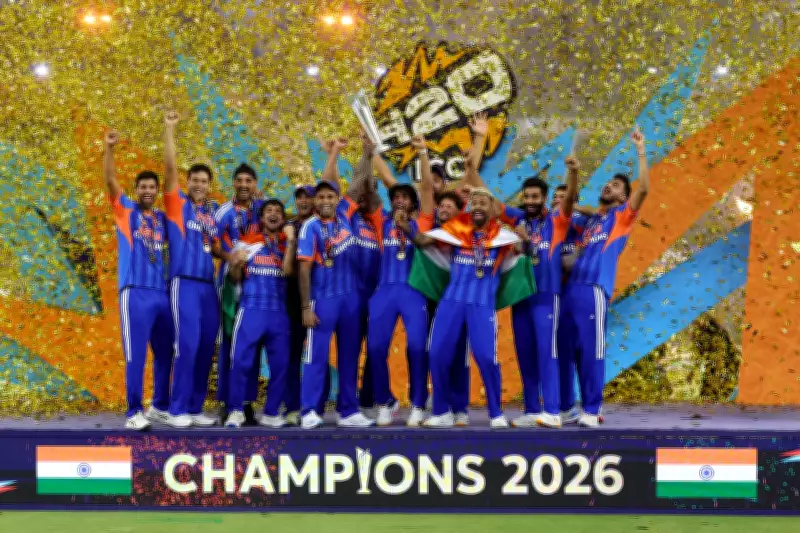
Entering the ICC Men's T20 World Cup 2026 as overwhelming favorites, India faced a turbulent journey but ultimately emerged victorious, defending their title in a historic campaign on home soil. The team, which had been on a stunning run since winning the 2024 edition, encountered unexpected challenges despite familiar conditions and most players being in form.
A Rocky Path to Glory
While reaching the Super Eights was never in doubt given the expanded 20-team tournament format, India's real test began there. They were hammered by South Africa in their first Super 8 match, creating a must-win situation that intensified pressure. The final Super 8 clash against West Indies became particularly crucial, requiring superb individual performances to advance.
Even in the semi-final against England, India were not completely in control despite posting a record 253/7, eventually winning by just seven runs. The summit clash, however, saw a dominant display as they thrashed New Zealand by a record 96 runs to secure the championship.

Historic Achievements
With this victory, India rewrote T20 World Cup history in multiple ways:
- First team to successfully defend the T20 World Cup title
- First team to win the tournament on home soil
- First team to win the T20 World Cup three times (adding to 2007 and 2024 triumphs)
Despite what could be described as a not-so-perfect campaign, Indian players managed to scrape through, winning their third consecutive ICC title following the T20 World Cup 2024 and Champions Trophy 2025.
Player Performances: The Heroes of India's Campaign
Batting Standouts
Sanju Samson (9/10) emerged as one of the undisputed heroes. After initially losing his starting position to Ishan Kishan, Samson made a spectacular comeback in the Super 8s. His stunning unbeaten 97 off 50 balls against West Indies in the virtual quarter-final was followed by identical scores of 89 in both the semi-final and final. He finished as India's second-highest run-getter with 321 runs and hit the most sixes in the tournament (24) across just five innings.
Ishan Kishan (8/10) crafted one of the best comeback stories, initially nudging Samson out of the opening slot. When opening partner Abhishek Sharma struggled, Kishan kept the scoreboard moving with crucial knocks including 61 against Namibia and 77 against Pakistan. Even after being moved to No.3, he continued contributing significantly, finishing as India's second-highest run-getter with 317 runs.
Suryakumar Yadav (6.5/10) had a topsy-turvy campaign as captain but kept his composure when it mattered most. He started with an unbeaten 84 against USA when the team was struggling at 77/6, but had limited success in subsequent matches. Still, he finished with 242 runs at an average of 30.25 and guided the team to victory in the final.
All-Round Contributions
Hardik Pandya (7/10) once again proved his value as India's X-factor. Batting at No.5 or lower, he scored two fifties and contributed 217 runs while providing timely breakthroughs with nine wickets. His all-round performance against Namibia earned him Player of the Match honors.
Shivam Dube (7/10) effectively played the middle-overs enforcer role, consistently scoring quick runs to give India strong finishes. His 66 off 31 balls against Netherlands, along with figures of 2/35, helped maintain India's unbeaten group stage record.
Axar Patel (6.5/10) served as a livewire in the field, with his catching proving particularly crucial in the semi-final against England. He also picked up important wickets, including three in the final, finishing with 11 wickets across seven matches.
Bowling Excellence
Jasprit Bumrah (9/10) demonstrated why he remains head and shoulders above other bowlers. He picked wickets in almost every match, with his defining performance coming in the final against New Zealand where he produced sensational figures of 4/15 - the best by a pacer in a T20 World Cup final. He finished as joint-highest wicket-taker with 14 wickets while maintaining an exceptional economy rate of 6.21.

Varun Chakaravarthy (5/10) had a contrasting campaign. He began strongly with nine wickets in the group stage but struggled in the Super 8s, particularly in the semi-final where he conceded a record 64 runs in four overs. Despite this, his early exploits helped him finish as joint-highest wicket-taker with 14 wickets.
Mixed Performances
Abhishek Sharma (4/10) endured a difficult tournament, starting with a hat-trick of ducks. Though he showed glimpses of form with a 55 against Zimbabwe and a quick-fire 52 in the final, he struggled consistently throughout the campaign.
Tilak Varma (6/10) had a below-par outing initially, struggling to get going at No.3. However, once moved down the order after Samson's promotion, he found better rhythm with crucial contributions in the latter stages.
Arshdeep Singh (6/10) had a decent campaign with nine wickets from eight innings, though he was somewhat overshadowed by Bumrah's brilliance.
Limited Opportunities
Several players had restricted game time. Kuldeep Yadav (7/10) featured in just one match against Pakistan, returning figures of 1/14 in three overs. Mohammed Siraj (7/10) also played only one match - the tournament opener against USA - where he took 3/29.
Meanwhile, Rinku Singh (2/10) had a disappointing campaign as the designated finisher, managing just 24 runs from five innings before losing his place. Washington Sundar (3/10) played just two matches without taking any wickets.
A Triumph of Resilience
India's T20 World Cup 2026 victory represents more than just another championship. It showcases a team's ability to overcome adversity, adapt to changing circumstances, and deliver when it matters most. Despite facing unexpected challenges and requiring lineup adjustments throughout the tournament, the players demonstrated remarkable resilience to secure their place in cricket history.
The campaign highlighted both individual brilliance and collective determination, with different players stepping up at crucial moments. From Samson's batting heroics to Bumrah's bowling masterclass, each contribution played a vital role in this historic achievement that cements India's status as a T20 cricket powerhouse.