India's Explosive Start in T20 World Cup Final Against New Zealand at Narendra Modi Stadium
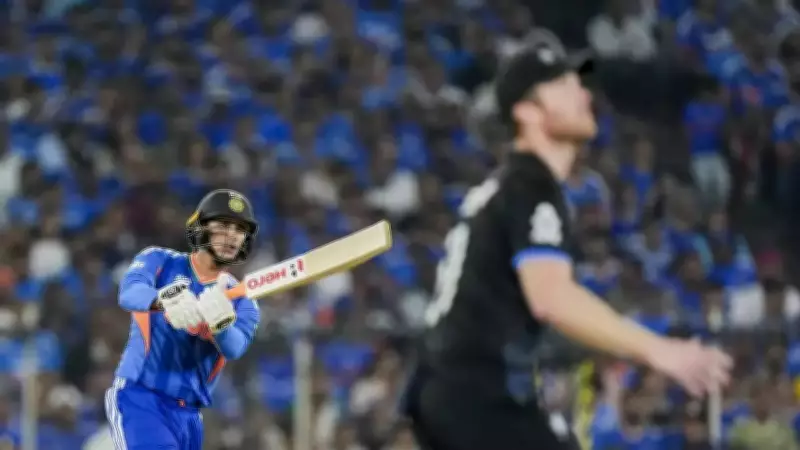
In a thrilling display of batting prowess, Abhishek Sharma and Sanju Samson provided India with an explosive start in the final of the ICC Men's T20 World Cup against New Zealand at the Narendra Modi Stadium on Sunday. The dynamic opening duo added a formidable 98 runs for the first wicket, establishing the first 50-plus opening partnership in the history of men's T20 World Cup finals.
Record-Breaking Opening Stand and Powerplay Dominance
The previous highest opening stand in a T20 World Cup final was a modest 48 runs, scored by Kamran Akmal and Shahzaib Hasan for Pakistan against Sri Lanka at Lord's Cricket Ground back in 2009. Abhishek Sharma, who had struggled to accumulate significant runs earlier in the tournament, rose to the occasion in the final, while Sanju Samson continued his impressive run of form seamlessly.
Both openers combined to score an astonishing 92 runs during the powerplay, setting a new record for the highest powerplay score in any T20 World Cup match. Abhishek Sharma reached his half-century in just 18 balls, showcasing his aggressive intent, and was eventually dismissed after scoring 52 runs. This performance underscored India's batting depth and strategic approach in high-pressure situations.

Historical Context and Milestones at Stake
Before the match commenced, iconic figures MS Dhoni and Rohit Sharma brought the T20 World Cup trophy onto the field, eliciting a thunderous response from the enthusiastic crowd. Dhoni famously led India to their first T20 World Cup title in 2007, while Rohit Sharma captained the side to their second championship in the 2024 edition.
India entered this final with several historic milestones within reach. The team aimed to become the first host nation to win the T20 World Cup, the first team to successfully defend the title, and the first team to secure three T20 World Cup victories. This was India's fourth appearance in a T20 World Cup final, the most by any team, highlighting their consistent performance on the global stage.
Pre-Match Build-Up and Team Strategies
New Zealand captain Mitchell Santner won the toss and opted to field first, a decision influenced by the pitch conditions and the team's strategy to restrict India to a manageable total. In response, India captain Suryakumar Yadav expressed confidence in batting first, citing the team's strong performance with this approach and the advantage of setting a target in a high-stakes match like a final.
India fielded an unchanged playing XI, while New Zealand made adjustments by including Jacob Duffy in place of McConchie. The teams lined up as follows: India featured Abhishek Sharma, Sanju Samson (wk), Ishan Kishan, Suryakumar Yadav (c), Tilak Varma, Hardik Pandya, Shivam Dube, Axar Patel, Varun Chakravarthy, Arshdeep Singh, and Jasprit Bumrah. New Zealand comprised Tim Seifert (wk), Finn Allen, Rachin Ravindra, Glenn Phillips, Mark Chapman, Daryl Mitchell, James Neesham, Mitchell Santner (c), Matt Henry, Lockie Ferguson, and Jacob Duffy.
Statistical Insights and Tournament Journey
In T20 World Cup encounters between India and New Zealand, New Zealand held a slight edge with victories in 2007, 2016, and 2021. However, India secured their place in this final with a hard-fought seven-run win over England in Mumbai, while New Zealand advanced by defeating South Africa in the semifinal.
Out of the nine previous T20 World Cup finals, six were won by the team chasing, but India had defied this trend by winning two of the three finals decided in the final over, in 2007 and 2024. This historical context added an extra layer of intrigue to the match, as both teams vied for supremacy under the bright lights of Ahmedabad.
The stage was set for a monumental clash, with India's batting firepower and New Zealand's bowling resilience promising an unforgettable contest in the quest for T20 World Cup glory.