Football Creates Rare Unity in Manipur's Conflict-Torn Foothills
In villages scattered across the western foothills of Imphal, young men have maintained a relentless vigil for nearly three years. Night after night, they stand at the edges of their settlements armed with sticks and torches, a duty that became unavoidable after community elders declared constant vigilance essential for survival.
Night Patrols Give Way to Football Competition
In Kuki villages, these nocturnal patrols began almost immediately after violent clashes erupted on May 3, 2023. In Naga-majority settlements, the practice intensified just this week following renewed tensions in Litan. Remarkably, some of these same young sentries found themselves transported to the Assam Rifles' New Keithelmanbi Garrison earlier this week, not for security duty but for football.
From Monday to Thursday, thirteen teams representing eight Naga, three Meitei, and two Kuki communities gathered at the garrison's uneven, dusty football ground. They participated in the Assam Rifles' Foothills Football Tournament, organized under Operation Sadbhavana, a military initiative aimed at fostering goodwill.

A Geographic and Social Divide
Keithelmanbi occupies a critical position along the seam where the Imphal Valley rises into the surrounding hills. This geography has hardened into clearly defined buffer zones and heavily guarded perimeters during the ongoing conflict. While teams were simply named after nearby villages, distances as short as four kilometers carried profound significance in this divided landscape.
The Kuki teams, including Haibung FC which reached Thursday's final, crossed the buffer zone for the first time since May 2023. They traveled in Assam Rifles buses under armed escort, highlighting both the tournament's importance and the persistent tensions.
Football's Historical Role in Divided Societies
Football has frequently mirrored deeper societal fractures throughout history. The 1990 clash between Dinamo Zagreb and Red Star Belgrade came to symbolize Yugoslavia's unraveling. The so-called "Football War" between El Salvador and Honduras in 1969 demonstrated how athletic competition could ignite terrain already primed for conflict. In these instances, football didn't create grievances but amplified existing tensions.
In Keithelmanbi, however, football was tasked with a different mission: restraint and reconciliation. Organizers approached the tournament with extreme caution. Senior Assam Rifles officers addressed all teams before kickoff, establishing clear ground rules: play in the true spirit of the sport; any deliberate attempt to injure an opponent would result in an immediate red card; particularly severe offenses would lead to disqualification of the entire team.
"Refereeing decisions are always contentious," one officer explained. "Therefore, we deliberately used soldiers from outside the northeast region to ensure impartiality." Security personnel lined the entire perimeter of the playing field, maintaining constant vigilance.
Tournament Structure and Community Tensions
The tournament's structure reflected the region's complex demographics. The first semifinal at 8 AM on Wednesday featured two exclusively Meitei teams: New Keithelmanbi Team B and KTYWA Keinou. The second semifinal carried heavier historical baggage as Khonglong Naga Youth Club faced Haibung FC.
This matchup occurred just days after violence flared between Kukis and Nagas approximately 100 kilometers away in Litan, within Ukhrul district. Although Khonglong's village hadn't suffered direct damage, anxiety spread rapidly through the community. Naga youngsters joined their Kuki counterparts in initiating night patrols, and families hesitated before allowing their team to travel to the tournament.
"People were naturally worried," admitted one Khonglong player. "But if we completely stop meeting and interacting, that creates no pathway toward a better future."
Haibung FC's Remarkable Journey
On the pitch, tensions didn't spill over into the game. Haibung dominated their semifinal in a largely one-sided contest. When the match concluded, players exchanged steady, unforced handshakes. This victory set up a final that few had predicted: the first Kuki-Meitei football match since May 3, 2023.

Haibung's story explains why reaching the final carried significance far beyond sports. The squad's average age is just nineteen years old. Instead of focusing on football training, many players found themselves standing night sentry duty. "For our own safety and our community's protection," one player explained. "That doesn't mean we want to fight another community. We just want to live peacefully."
Another player added quietly, "We don't sleep properly on those nights when we're on patrol. But it has become our responsibility to protect our homes." For the tournament's duration, players were temporarily excused from these security duties.
Personal Stories Behind the Players
Haibung coach Ngamgoulen, thirty years old, had returned from Delhi on April 28, 2023, where he had been preparing for Manipur's civil services examinations. Within weeks, his village suffered five separate attacks. His cousin Nilson Kuki's house burned completely to the ground. Movement became severely restricted, with routes to Imphal airport blocked by buffer zones. While other residents traveled via Aizawl or Dimapur to reach airports, Ngamgoulen remained in his village.
"As the younger brother of the village chief," he explained, "it was my duty to stay and support my people during this crisis." His belongings remain in Delhi, a testament to his interrupted life.
The players' personal stories reveal the conflict's human cost:
- Seiminthang Haokip (20), Haibung defender, now lives in a relief camp after his village was burned down twice and still awaits the next stage of his Territorial Army application.
- Thangkhopao Singsit (21), fullback, had been preparing for CDS examinations when his village was attacked in July 2023, leaving three villagers dead and one still missing.
- Chongouman Kipgen (21), goalkeeper, ran a private school with his father that employed teachers from Meitei, Kuki, Naga, and smaller tribal communities before the conflict made such coexistence impossible.
- Thangminsei Kipgen (19), midfielder, now teaches at the only functioning community-run school in the area after most qualified teachers left the state.
The Historic Final Match
By the time the final began, the stands were completely full. Villagers had been transported in Army vehicles under armed escort, joining local elders and residents. Senior Assam Rifles officers observed from the sidelines.
The first half proved intensely competitive, with New Keithelmanbi establishing control. By halftime, the Meitei side had built a commanding 3-0 lead. During the break, Haibung regrouped strategically and scored two quick goals shortly after play resumed.
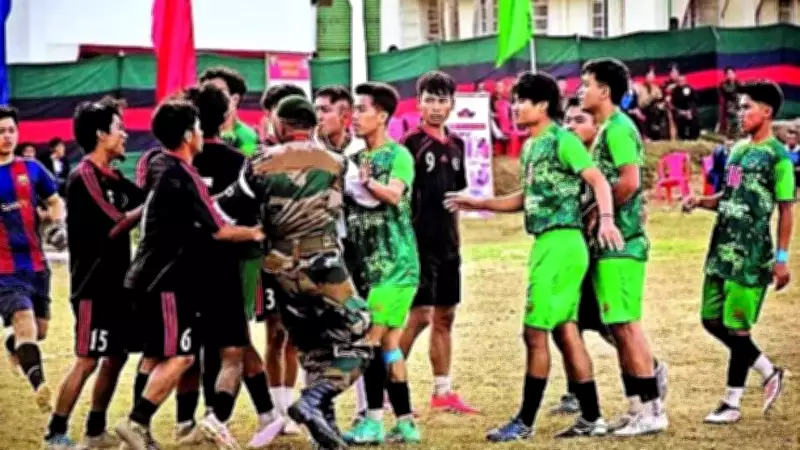
Midway through the second half, a particularly hard tackle triggered protests and brief shoving before Assam Rifles personnel swiftly intervened. The commentator's familiar reminder echoed across the field: "Khel ki sadbhavana banaye rakhein. Referee ke nirnay ka paalan karein." Maintain the game's spirit. The referee's decision is final.
The game concluded with a 5-2 victory for New Keithelmanbi, featuring five yellow cards throughout the match. When the final whistle blew, players from both teams formed a line and exchanged handshakes without hesitation. The interaction was brief but routine.
"We just played football," one participant remarked afterward. Security personnel remained stationed until all teams had completely dispersed. The Meitei side returned toward the valley, while Haibung FC boarded Assam Rifles buses for their journey back across the buffer zone under armed escort—returning to villages where night patrols would resume immediately.