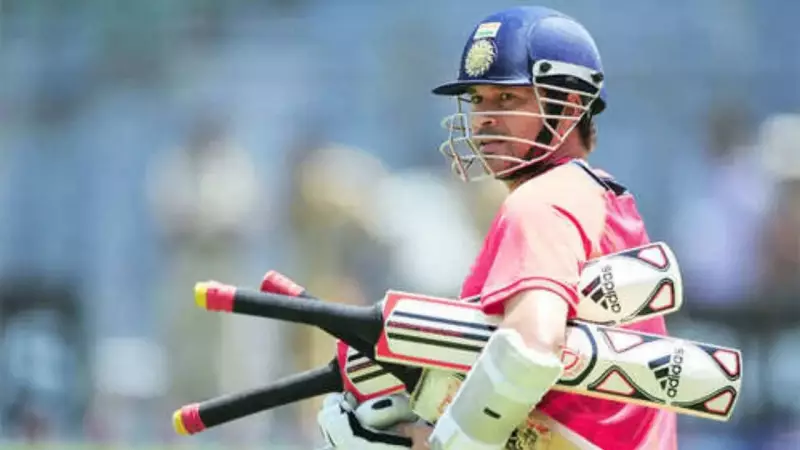
Exactly thirty-six years ago, on December 18, 1989, a piece of cricket history unfolded in Gujranwala, Pakistan, that seemed utterly unremarkable at the time. In a rain-curtailed ODI against arch-rivals Pakistan, a 16-year-old boy walked out to bat for India, wearing the national colours in limited-overs cricket for the very first time. That teenager was Sachin Tendulkar, whose journey in one-day internationals began with a two-ball duck. Little did anyone know that this inauspicious start would blossom into the most prolific ODI career the world has ever witnessed.
The Humble Beginning in Gujranwala
The match was the second ODI of a four-match series, following a Test series that ended 0-0. The first ODI had been abandoned without a ball bowled. India's captain Kris Srikkanth won the toss and elected to field first at the Municipal Stadium. The visitors handed ODI debuts to three players: Sachin Tendulkar, Salil Ankola, and Vivek Razdan.
Pakistan's innings, reduced to 16 overs per side due to rain, crumbled to 87 for 9. Spinner Maninder Singh (2/17) and debutant Ankola (2/26) were among the wicket-takers, while four Pakistani batters were run out. Only Saeed Anwar, with an unbeaten 32-ball 42, offered resistance.

Chasing a modest 88, India found themselves in trouble at 34 for 3. It was at this moment that the young Tendulkar, batting at number five, made his entrance into ODI cricket. Facing the fiery Waqar Younis, who, like Sachin, had also made his Test debut just a month earlier, the teenager was caught by Wasim Akram after facing just two deliveries. He was out for a duck, and India slumped to 36/4.
India's innings never recovered, and they were restricted to 80 for 9 in their 16 overs, losing the low-scoring thriller by just 7 runs. Mohammad Azharuddin top-scored with 21. Pakistan took a 1-0 lead in the series, which they eventually won 2-0.
From a Duck to Record-Shattering Heights
That debut match was, incidentally, the only ODI Tendulkar played in that series. It stood in stark contrast to his Test debut in Karachi a month prior, where he had shown promise with scores of 15 and 59 in his first two innings. He finished that Pakistan Test series with 215 runs at an average of 35.83, including two fifties.
However, the ODI format is where Sachin Tendulkar would eventually build an unmatched legacy. From that initial failure, he amassed a mountain of records over a career spanning 22 years and 91 days. He retired having played 463 ODIs, scoring a world-record 18,426 runs with 49 centuries and 96 half-centuries.
His ODI career featured numerous milestones, including most runs in the format at the time of his retirement, most hundreds (later surpassed by Virat Kohli), most fifty-plus scores (145), most runs in a calendar year (1894 in 1998), and being the fastest to reach every 1000-run milestone from 15,000 to 18,000 runs.
A Fun Fact About the Era
The ODIs in that 1989 series were originally scheduled as 40-overs-a-side contests, though Tendulkar's debut game was cut to 16 overs. This highlights an interesting quirk of cricket history: the 50-over format was not yet standardized. In the late 1980s, ODIs were played over 40, 50, 55, or even 60 overs. It was the 1987 World Cup, hosted by India and Pakistan, that first formally adopted the 50-overs-a-side format, which gradually became the global norm by the mid-1990s.
Thus, December 18, 1989, marks not just the humble beginning of a singular cricketing genius but also serves as a snapshot of a bygone era in the sport's evolution. The day a future legend scored a duck, setting the stage for two decades of unprecedented dominance.