Sanju Samson's Heroics Propel India to T20 World Cup Semifinals
In a moment of pure cricketing drama at Kolkata's Eden Gardens, Sanju Samson dropped to his knees, looking skyward in gratitude and relief. His career-defining unbeaten 97 off just 50 balls had just steered India to a thrilling five-wicket victory over West Indies, securing their place in the T20 World Cup semifinals in what was essentially a virtual quarter-final for both teams.
India captain Suryakumar Yadav doffed his cap in honor of Samson's match-winning innings on Sunday. However, while Samson's magnificent 97 in Kolkata will be remembered for years to come, it was his brief but pivotal 15-ball 24 against Zimbabwe just three days earlier that truly resurrected India's faltering T20 World Cup campaign.
India's Batting Struggles Before Samson's Return
In the five matches preceding Samson's return to the playing XI against Zimbabwe, India had managed to win four games, but concerning cracks were appearing in their batting lineup. The statistics revealed a troubling pattern: India played without Samson in four of those five matches, and their highest opening partnership during that stretch was a mere 8 runs.

In the solitary match where Samson did feature—against Namibia when regular opener Abhishek Sharma was sidelined due to illness—Samson and Ishan Kishan managed an opening stand of 25 runs in just 12 balls, offering a glimpse of what was possible.
Beyond the opening woes, India's entire top order, including Suryakumar Yadav and Tilak Varma, was grappling with strike-rate issues during the tournament's initial phase. The combination of openers failing to provide solid starts and the middle order struggling to accelerate created a double jeopardy for the defending champions.
The Off-Spin Conundrum
The root of India's batting troubles was their pronounced vulnerability against off-spin bowling. With six left-handers in their top eight batting positions, India had inadvertently made themselves susceptible to opposition off-spinners, and teams were quick to exploit this weakness.
During the group stage, India faced more deliveries from off-spinners than any other team—102 balls in total. Among the 13 teams that encountered at least six overs of off-spin bowling, only Nepal and Oman scored at slower rates than India's 6.23 runs per over.
Namibia's Gerhard Erasmus first exposed this chink in India's armor, claiming four wickets—three of them left-handers—in their group-stage encounter. Pakistan followed suit, with part-time off-spinner Salman Ali Agha taking the new ball and dismissing Abhishek Sharma for a duck. The trend continued against the Netherlands, where off-spinner Aryan Dutt opened the bowling and removed both Indian openers cheaply.
While Abhishek Sharma had not previously shown particular vulnerability against off-spin—boasting a career strike rate of 171.1 against off-spinners in powerplay overs in T20Is—the slower tournament pitches seemed to unsettle him. His opening partner Ishan Kishan, however, has historically struggled against off-spin, managing just a 76.9 strike rate against them in powerplay overs across all T20Is.
The Turning Point: Samson's Return Against Zimbabwe
By the conclusion of the group stage, it was evident that India's left-handed opening combination presented a problematic match-up against off-spin. This realization became painfully clear when South Africa captain Aiden Markram took the new ball himself and dismissed Ishan Kishan for a duck in their Super 8 clash, contributing to India's 76-run defeat that left them in a do-or-die situation.
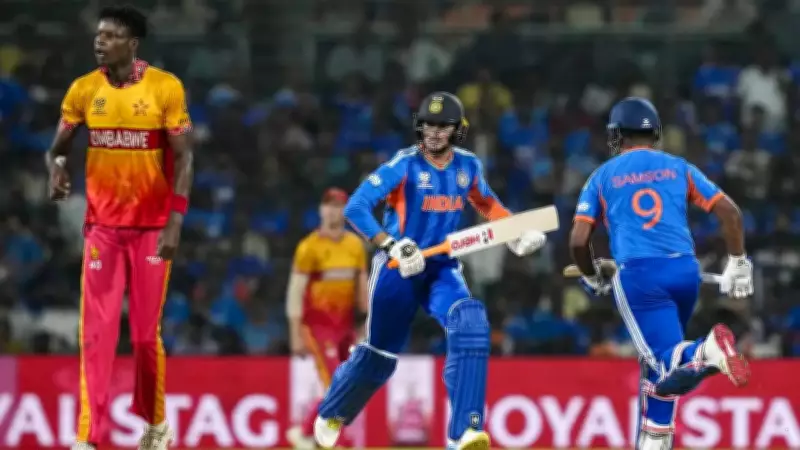
India's fortunes changed dramatically in their next Super 8 match against Zimbabwe in Chennai, where Sanju Samson returned to the playing XI. Opening alongside Abhishek Sharma, Samson provided India with a brisk 48-run opening stand. Crucially, his presence as a right-handed opener prevented opposition off-spinners from exploiting the new ball against left-handed batsmen.
Though Samson was dismissed after scoring 24 runs off just 15 balls, he had accomplished his mission perfectly. His brief innings had a transformative effect: Abhishek Sharma, who had managed only 15 runs with three ducks in the tournament until that point, found his form and scored a half-century. India posted 256 runs in their innings and crushed Zimbabwe by 72 runs.

This convincing victory provided the momentum India's campaign desperately needed, and much of the credit belonged to Samson's 15-ball cameo that had turned their fortunes around.
Historic Chase Against West Indies
Against West Indies on Sunday, India chased down their highest-ever target in Men's T20 World Cup history—196 runs—surpassing their previous record of 173 against South Africa in 2014. Samson's magnificent 97 in this chase now stands as the second-highest score for India in T20 World Cup history, behind only Suresh Raina's 101 against South Africa in 2010.
More significantly, it represents the highest score by an Indian batsman in a T20 World Cup chase, surpassing Virat Kohli's unbeaten 82 against Australia in 2016 and Pakistan in 2022. Captain Suryakumar Yadav, who had previously questioned which player Samson should replace in the lineup, bowed in appreciation of the match-winning innings.
While Samson's 97 in Kolkata will rightly be celebrated for securing India's semifinal berth and ranking among the nation's finest T20 World Cup performances, it was his 15-ball 24 against Zimbabwe that breathed life into India's campaign. That innings transformed India from a struggling side into the formidable team that now advances confidently to the semifinals, looking every bit the championship contender they were always meant to be.