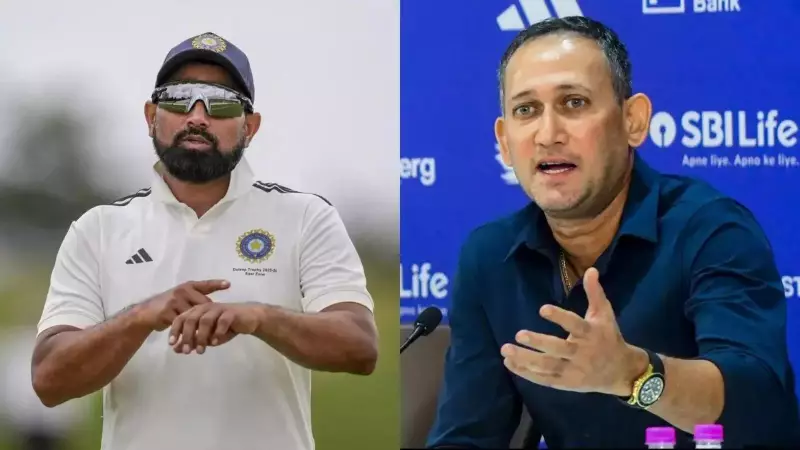
The persistent omission of veteran pacer Mohammed Shami from the Indian cricket team is set to become a central point of discussion once again. This comes as the national selection committee, chaired by Ajit Agarkar, prepares to pick the squad for the upcoming One Day International series against New Zealand in early January. The core of the debate hinges on Shami's current form and fitness, demonstrated through a heavy workload in domestic cricket, which appears to contradict the selectors' stated reasons for his continued exclusion.
A Season of Toil and Wickets for Bengal
In the ongoing domestic season, Mohammed Shami has been a workhorse for Bengal, sending down over 200 overs across formats. His campaign includes participation in the Ranji Trophy, the Syed Mushtaq Ali Trophy (SMAT), and the currently ongoing Vijay Hazare Trophy (VHT). The breakdown of his bowling load is significant: 145.2 overs in the Ranji Trophy, 26.5 overs in SMAT, and 34.2 overs in the VHT so far.
Despite being away from the national setup, the 35-year-old seamer has consistently performed his primary role: taking wickets. His recent List A outings have been particularly impressive, with eight wickets in four Vijay Hazare Trophy matches, giving a clear account of both his rhythm and fitness.

The Selector's Stance vs. On-Field Evidence
The chief selector, Ajit Agarkar, has repeatedly cited fitness and the "need to play some cricket" as reasons for Shami's absence. This justification now faces intense scrutiny given the bowler's substantial domestic involvement. If the current volume of cricket does not qualify as "some cricket," the definition itself seems unclear to many observers.
Agarkar had previously stated, "If he is fit, why wouldn’t we have a bowler like Shami? I have had multiple chats with him. Over the last six to eight months, what we have found out is that he wasn’t fit." However, the present scenario paints a different picture. Shami is fit. Shami is in top rhythm. Shami is picking wickets. The ball is now effectively in the court of Agarkar and his fellow selectors.
Experience vs. Age: The World Cup 2027 Calculus
One argument against his recall could be his age, with an eye on the 2027 ODI World Cup in South Africa. However, global examples provide a compelling counterpoint. Australia continues to successfully manage and deploy fast bowlers like Mitchell Starc (35), Scott Boland (36), and Michael Neser (35). This demonstrates that with careful management, experienced pacers can remain potent assets in multi-nation events.
Shami's pedigree is unquestionable. His last appearance for India was in the Champions Trophy, where he was the lone specialist seamer shouldering the burden on turning tracks, finishing with 9 wickets from five games. His impact during the 2023 ODI World Cup is also fresh in memory; once included in the playing XI, he proved to be the genuine wicket-taker India had missed, capable of running through batting line-ups single-handedly.
Beyond his own skill, his presence would offer invaluable experience to support and guide younger bowlers like Harshit Rana and Prasidh Krishna in the squad. As the selectors meet in the first week of January to finalize the team for the three ODIs against New Zealand starting January 11, ignoring Shami's compelling domestic form and proven match-winning ability will be a difficult decision to justify.