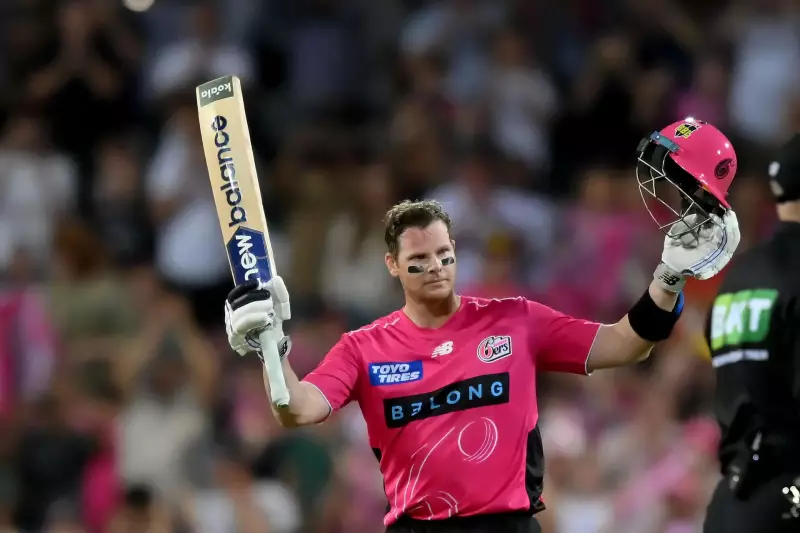
A thrilling century partnership between Steve Smith and Babar Azam took an unexpected turn during Friday's Big Bash League clash at the SCG. The Sydney Sixers faced their cross-town rivals, the Sydney Thunder, in a high-stakes encounter. The match's pivotal moment arrived during the crucial power surge overs, sparking drama between the two batting stars.
The Controversial Decision
Steve Smith made a bold tactical move that visibly upset his batting partner. In the 11th over of the innings, with Babar Azam sitting comfortably on 47 runs from 38 deliveries, the Pakistani batsman sought a single after three consecutive dot balls from Thunder bowler Chris Green. Smith firmly declined the run, choosing instead to retain the strike for the upcoming power surge period.
The BBL's unique 'floating' powerplay allows teams to select any two-over window between overs 11 and 20 for maximum scoring potential. Smith wanted to exploit this opportunity personally. Television cameras captured Babar's clear frustration during a brief mid-pitch conversation at the over's conclusion. The tension was palpable as the two international stars exchanged words.

Smith's Power Surge Masterclass
What followed justified Smith's controversial decision in spectacular fashion. When the power surge commenced, Smith unleashed an astonishing assault on Thunder bowler Ryan Hadley. The Australian batsman smashed four consecutive sixes in the over's first four deliveries, creating BBL history. That over became the most expensive in the tournament's record books, yielding 32 precious runs for the Sixers.
Smith finally took a single off the over's last ball, handing the strike to Babar for the 13th over. The momentum shift proved too abrupt for the Pakistani batsman, who fell to Nathan McAndrew's very first delivery. Babar left the field showing obvious disappointment, his innings cut short at 47 runs.
Post-Match Reflections
Steve Smith later explained his thinking to Channel 7 broadcasters. "We discussed strategy at the ten-over mark," Smith revealed. "The captain and coach wanted to take the power surge immediately. I suggested waiting one over because I preferred hitting toward the shorter boundary. I didn't want to waste the first over of our power surge. My target was 30 runs from that over, and we actually managed 32, so the result worked perfectly."
The Australian star acknowledged his partner's reaction with a touch of humor. "I'm not certain Babar felt too pleased when I refused that single," Smith added with a smile. Interestingly, Babar was not visible on the field following the match's conclusion, though his exact whereabouts remained unclear.
Strategic Context and Reactions
Mitchell Starc, making his first BBL appearance in eleven years, offered perspective on the incident. The veteran fast bowler admitted he hadn't witnessed the specific moment but explained that such tactical considerations are common in modern T20 cricket. "Similar to bowlers who prefer certain match-ups," Starc noted, "batters also develop specific preferences about when and against whom they want to face deliveries."
Despite the brief on-field tension, Smith's calculated gamble delivered exactly what the Sixers needed. The Australian went on to complete a magnificent 41-ball century, steering his team to a five-wicket victory over their crosstown rivals. His innings demonstrated why he remains one of cricket's most innovative and effective T20 batsmen.
The match highlighted how modern T20 cricket increasingly revolves around strategic gambles and power-hitting windows. While partnerships remain crucial, individual match-ups and specific over targeting can sometimes override traditional batting cooperation. Smith's decision, though momentarily controversial, ultimately proved the difference between victory and defeat for the Sydney Sixers.