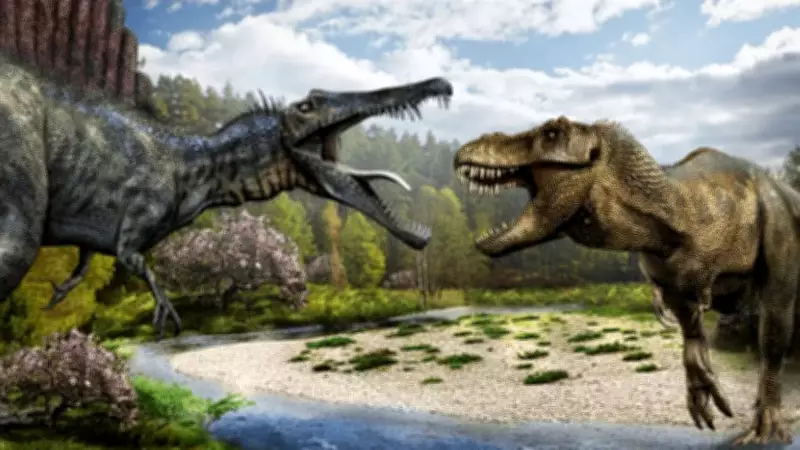
T. Rex vs Spinosaurus: Who Was the True King of the Dinosaurs?
One question that has captivated dinosaur enthusiasts for decades is what would happen if Tyrannosaurus rex and Spinosaurus ever clashed in combat. While Hollywood films and video games often depict these two giants fighting, science provides a far more intriguing conclusion. Both were among the largest and most formidable carnivores to ever exist, yet they differed significantly in size, anatomy, and habitat.
Tyrannosaurus rex, commonly known as T. rex, roamed North America approximately 68 to 66 million years ago. It is widely regarded as one of the most fearsome land predators in history, capable of growing up to 40 feet in length and weighing an astonishing 9 tons. Its most iconic feature was its massive skull equipped with bone-crushing jaws.
Meet the Giants
Tyrannosaurus rex lived in North America during the late Cretaceous period, from 68 to 66 million years ago. It is considered one of the strongest terrestrial predators ever, with an estimated length of up to 40 feet and a weight of nearly 9 tons. In contrast, Spinosaurus inhabited North Africa during the Cretaceous period, specifically from 99 to 93 million years ago. It could reach about 50 feet in length and was distinguished by its large dorsal sail and crocodilian snout.

Bite Force
When it comes to bite force, T. rex is the clear winner. Its bite was among the most powerful of any terrestrial animal, capable of crushing bones with ease. Spinosaurus, on the other hand, had a narrower jaw filled with conical teeth, ideal for grasping slippery prey like fish. While it possessed a strong bite, it was not designed for bone crushing. In a direct confrontation, a single bite from T. rex could prove decisive.
Movement and Speed
T. rex was built for land locomotion, with powerful leg muscles and a heavy tail that provided excellent balance. Although not extremely fast, it was certainly more agile and balanced on land than Spinosaurus. Modern research suggests that Spinosaurus spent considerable time hunting in rivers, making it less efficient on land. Thus, in terrestrial movement, T. rex held a clear advantage.
Intelligence and Sensory Abilities
Most scientists agree that T. rex had sharp sensory abilities, including excellent eyesight and a highly developed sense of smell. It was likely both a hunter and a scavenger. Spinosaurus, however, was uniquely adapted to hunt like an oversized crocodile, waiting by the water to catch fish and other aquatic creatures. These two species rarely, if ever, engaged in battles due to their specialized lifestyles.
Size Comparison
In terms of sheer size, Spinosaurus was actually larger than T. rex. However, being larger does not necessarily equate to greater strength. T. rex possessed powerful, massive muscles designed to take down large prey. Spinosaurus appeared intimidating due to its sails and elongated body, but its build was more suited for aquatic environments.
The general consensus is that on land, T. rex would likely emerge victorious due to its superior bite force, heavy mass, and greater mobility. In underwater or swampy environments, Spinosaurus might have the edge thanks to its swimming abilities. Still, in a direct one-on-one battle on land, T. rex remains the more deadly hunter. Nevertheless, Spinosaurus stands as one of the most peculiar and fascinating dinosaurs ever discovered.