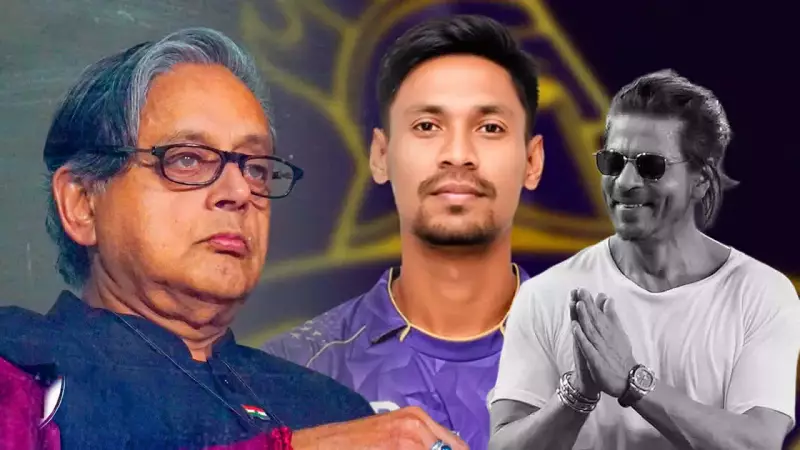
Senior Congress leader and Member of Parliament Shashi Tharoor has strongly criticized the Board of Control for Cricket in India (BCCI) for its recent intervention concerning Bangladeshi cricketer Mustafizur Rahman. Tharoor asserted that sports must remain separate from political disputes, labeling the board's move as both unfortunate and ill-timed.
Tharoor's Firm Stance in Wayanad
Speaking to the media in Wayanad, Kerala, on January 4, 2026, the parliamentarian expressed his disappointment. He argued that the game of cricket should not be leveraged as a tool to address broader diplomatic or political challenges between nations. Tharoor emphasized that India and Bangladesh maintain active diplomatic and political channels, which are the appropriate forums for resolving bilateral issues.
"Using cricket to compensate for other problems is not the right approach," Tharoor stated. He pointed to recent high-level meetings between the two countries as evidence that official dialogue is ongoing. The MP also acknowledged serious concerns regarding violence against minorities in Bangladesh, clarifying that Indian authorities are already engaging with the government in Dhaka on these matters through proper channels.

Concern Over Social Media Pressure
A significant part of Tharoor's critique focused on the role of public and online sentiment in influencing policy decisions. He voiced concern over social media pressure shaping actions that should be based on careful, strategic judgment.
"Policy matters require nuanced thinking and should not be decided by waves of public outrage," Tharoor remarked. He warned against allowing transient online trends to dictate foreign policy or sports administration, advocating for a more measured and principled approach.
The Core of the Controversy
The row began when the BCCI requested the Kolkata Knight Riders (KKR) franchise in the Indian Premier League to release Bangladeshi pace bowler Mustafizur Rahman. While the exact reasons behind the BCCI's request were not officially detailed, it was widely perceived in political and cricketing circles as a reaction to the ongoing diplomatic tensions and the situation in Bangladesh.
Tharoor's comments bring to the forefront the perennial debate about the intersection of sports and geopolitics. His argument reinforces the principle that athletes should not be used as pawns in political disagreements, especially when formal diplomatic mechanisms exist and are functioning.
As the story develops, the focus remains on whether sporting bodies will uphold the separation Tharoor advocates or if global cricket will see further instances of political influence affecting team compositions and player participation.