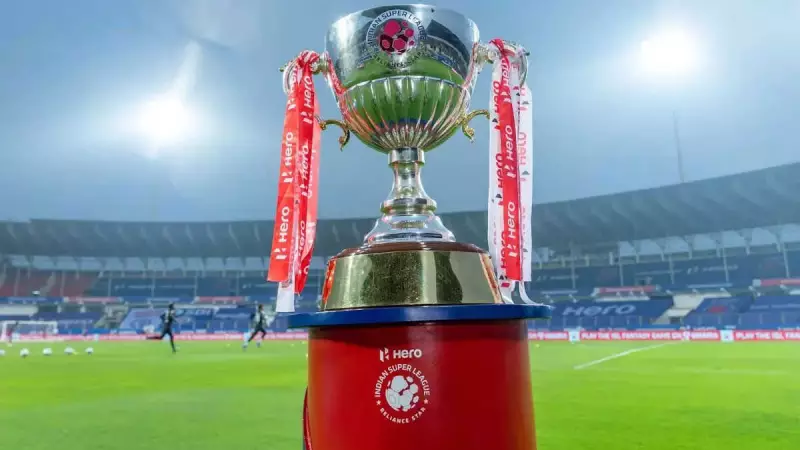
All 14 ISL Clubs Confirm Participation for 2025-26 Season Amid Financial Concerns
All fourteen first division clubs have officially confirmed their intention to play the much-delayed 2025-26 season of the Indian Super League. The confirmation came on Monday as the deadline for confirming home venues passed. This decision follows months of uncertainty and negotiations with the All India Football Federation.
Financial Clarity Remains a Key Issue
While all clubs have agreed to participate, many have expressed concerns about financial aspects. Several clubs have sought clearer commitments from AIFF regarding funding and reduced costs. A club official explained their position clearly to TimesofIndia.com.
"We are standing our ground saying, 'Yes we will participate as we committed to the government. But we need more clarity from you, from the AIFF,'" said the official. "Easier way to say it is that our participation is confirmed in the ISL, if certain conditions are met."

The clubs specifically want a complete waiver of the Rs 1 crore participation fee. They have also requested government support to help reduce costs associated with hosting games. These financial concerns have been central to discussions throughout the planning process.
Odisha FC's Deliberation and Decision
Odisha FC was among the clubs that needed extra time to make their decision. The club had suspended first team operations back in August 2025 and pulled out of both the Durand Cup and Super Cup competitions. They sought a long-term financial roadmap before committing to the ISL season.
Despite these concerns, Odisha FC ultimately confirmed their participation along with the other thirteen clubs. Their decision marks a significant step forward for the league's revival after months of uncertainty.
Budget Breakdown and Financial Realities
The 2025-26 season comes with a total budget of Rs 24.26 crore. Under the current arrangement, each club will contribute Rs 1 crore as participation fee. AIFF will provide Rs 9.77 crore toward the season's expenses. The remaining costs will come from the federation's resources on an ongoing basis.
Clubs will bear additional expenses including logistics, venue costs, and player wages. Broadcast revenue, which previously amounted to Rs 275 crore per season, will be substantially lower this time. This reduction in income has prompted clubs to question the participation fee structure.
"Which is why we've all questioned the participation fee and said that ideally it should be lesser if not charged at all," reasoned an ISL club official. "But I think it's also a new model that everyone's trying to work out and experiment, right?"
Player Wages and Contract Considerations
One significant area of expenditure for ISL clubs has always been player salaries. With reduced revenues expected this season, some clubs have approached players about potential pay cuts. However, this approach comes with legal complexities.
A player agent confirmed that clubs cannot force pay reductions on players who are under existing contracts. If clubs attempt to impose cuts unilaterally, players could pursue legal action. Any wage reductions would require mutual agreement and new contracts.
Not every club is considering player wage reductions as their first option for cost-cutting. With a shortened season, logistical costs will naturally decrease. Clubs plan to utilize resources differently when preparing home venues.
Focus on Football Above All Else
Despite financial challenges, many club officials emphasize the importance of simply getting football started again. Prithijit Das, President of newly promoted Inter Kashi, expressed this sentiment clearly.
"I think the most important part is that in our country, since the last 6 months, football had come to a stop," said Das. "Now, football is going to start. And there will be football. Let us focus on the football."
Inter Kashi has agreed to play all their games away from home since their Varanasi stadium won't be operational until around Diwali. Das emphasized that having a season at all represents progress.

"What is the production cost, who is the sponsor, what difference does it make? If you play a game, that game is starting, that is the biggest thing," he added. "At the end of the season, we can have a discussion on what was bad, what was good. But first, there should be a season. We were thinking there won't be a season at all."
Season Structure and Immediate Next Steps
The 2025-26 ISL season will feature 91 games played in a single-leg home and away format. The league is scheduled to begin on February 14 and conclude before May 31. This represents a shortened calendar compared to previous seasons.
AIFF now faces several immediate tasks. They must finalize the shortened calendar, secure exemptions from AFC regarding ACL 2 slot allocations, and find commercial and broadcast partners for the season. These steps are crucial for the league's successful implementation.
Club officials acknowledge that this season represents a different approach to resource management. One official who wished to remain anonymous explained the changes.
"There were certain standards which were set by the ISL. There were certain norms that we used to follow," said the official. "It could be a difference of almost 20 to 30 percent in cost, resource management type, resource utilization now. So that would obviously... we'll try to see where we can curtail without compromising on any kind of safety or any of those things. But yeah, maybe the glamour quotient will come down."
The primary goal for clubs remains getting football back on track in India. As one club chief summarized, "Our biggest goal was that football should happen. We were anyway not making profits and this was not going to make you profitable anyway. If there is a gap year, Indian football will go to the dogs! All the effort that you've put in so far, would have gone for a toss. Today it is more about being alive than sustainability in time to come."