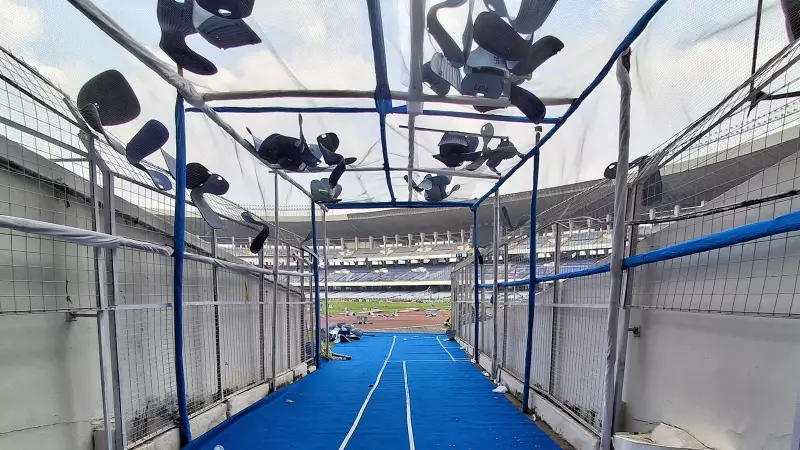
The iconic Vivekananda Yuba Bharati Krirangan (VYBK), popularly known as the Salt Lake Stadium in Kolkata, stands as a grim testament to fan fury and administrative failure. The stadium, once celebrated as Indian football's hallowed ground, was left in shambles after thousands of angry supporters ransacked it on December 13, 2025, following a deeply disappointing event featuring Argentine superstar Lionel Messi.
From Celebration to Destruction: A Night of Chaos
A week after the incident, the scale of the devastation remained starkly visible. The catalyst was the failure of fans, many of whom had paid between Rs 5,000 to Rs 10,000 for tickets, to catch even a glimpse of their idol, Lionel Messi. Their frustration boiled over, transforming into violent chaos.
Rows of modern blue bucket seats, a key feature of the stadium's FIFA-standard renovation done between 2015 and 2017 at a cost of ₹100-126 crore, were ripped out and hurled onto the prized Riviera Bermuda natural grass turf. Water bottles rained down, and fans tore down banners, hurled chairs, and ransacked the ground. High-end technical equipment, including LED screens and speakers, was also vandalised.

Uttam Saha, founder secretary of the Argentina Fan Club, called it an "administrative failure." He alleged that while fans were reaching a breaking point, security personnel were distracted. "In Western countries, police watch the audience. Here, IPS officers were busy taking selfies," Saha lamented.
The Heavy Price: Financial and Emotional Loss
Officials from the Bidhannagar Police Commissionerate stated that the preliminary estimated financial loss stands at approximately Rs 2.5 crore. The damage extends beyond broken chairs to include the synthetic running track, iron fences, gates, and the expensive technical gear.
However, as noted by a former football player speaking on condition of anonymity, the deeper cost is the damage to Kolkata's reputation as a world-class sporting host. "Money can renovate the stadium again, but what will never come back is the emotional trust of the fans who left without seeing their God," Saha echoed, highlighting the profound emotional betrayal felt by the supporters.
The much-hyped unveiling of a 70-foot statue of Messi also fizzled out, with the star inaugurating it virtually from his hotel amidst the chaotic scenes on the ground.
A History Marred by Controversy and Tragedy
This is not the first such incident to scar West Bengal's sporting history. The Salt Lake Stadium, inaugurated in 1984 by then-Chief Minister Jyoti Basu, was once one of the world's largest, holding 1,20,000 spectators. Its past is checkered with tragic and violent episodes.
In 1980, a stampede during a Mohun Bagan vs East Bengal match at Eden Gardens claimed 16 lives. In 1996, India's collapse against Sri Lanka in the Cricket World Cup at Eden Gardens sparked a riot, forcing match referee Clive Lloyd to award the match to Sri Lanka. Violence also marred the 2007 IFA Shield final, leading the Brazilian team Palmeiras to walk off the pitch.
Three decades after the 1980 tragedy, a match was cancelled after Mohun Bagan fans hurled stones, injuring their own player Syed Rahim Nabi and 40 others.
As dust settles on the uprooted chairs of the Salt Lake Stadium, the immediate focus is on a costly repair bill funded by public money. The challenge for a city that breathes football is not just to fix the fixtures, but to restore faith and ensure such a heartbreaking collapse of management and security never recurs.