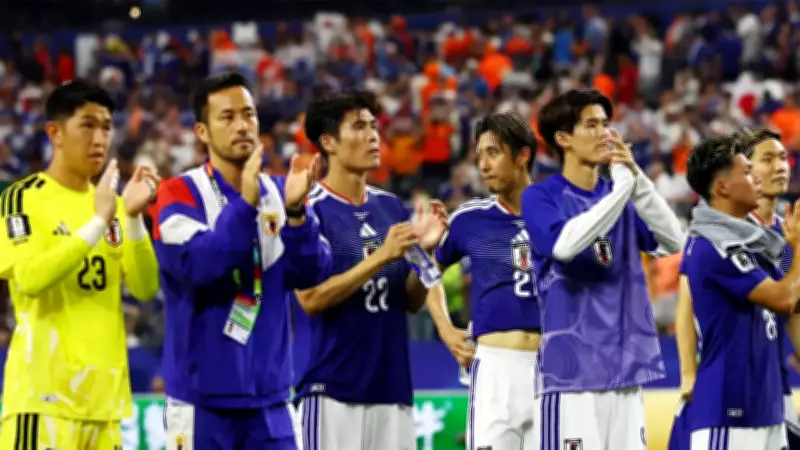
Japan refused to let the night slip from their grasp. As the clock ticked toward defeat and the Netherlands edged closer to victory at the Dallas Stadium, the Samurai Blue summoned one final surge of belief.
A corner in the 89th minute was met with a towering header from substitute Koki Ogawa, only to ricochet off the unsuspecting head of Daichi Kamada and loop gloriously beyond the diving Dutch goalkeeper Bart Verbruggen. In an instant, despair turned to delirium as Japan’s fans erupted in celebration, their team snatching a pulsating late equaliser.
The goal perfectly encapsulated the never-say-die spirit of Japan’s football — securing a thrilling 2-2 draw against the Netherlands in one of the most dazzling spectacles of the 2026 World Cup so far.

Over 6,500 miles away from Dallas, images coming in from Tokyo’s iconic Shibuya crossing showed thousands of jubilant Japanese fans transforming an overcast early morning into a sea of colour replete with blue and white jerseys. Twirling beneath the cloudy skies, it created a dazzling mosaic of frenzy as they waved the country’s flags in delight to celebrate this rousing comeback.
Bulk of the credit for Japan’s dramatic late goal should also go to head coach Hajime Moriyasu and his inventive touchline management. His quiet influence is also the reason many have tipped Asia’s best team to go far in this World Cup.
As the match entered the closing stages, Moriyasu and his coaching staff held up a series of boards displaying the countdown numbers, starting at three and working down to one, to show the players the tactical switches. This coded method kept the instructions hidden, while bewildering opponents.
“The Netherlands were strong, we were trailing behind a difficult opponent. The players were united, tenacious, they fought to the end and did not cease to persevere. Of course, we’re not completely satisfied with just the one point for the draw,” Moriyasu said at the press conference later.
The Netherlands held possession for large stretches, but struggled to penetrate Japan's obdurate backline.
Japan were without their captain Wataru Endo, who retired after failing to recover in time for the World Cup from a foot injury. Consequently, Moriyasu tweaked his midfield, deploying Ao Tanaka and Kamada to play the pressing game, with Keito Nakamura providing the burst of energy as the wing-back.
Japan’s ability to innovate and compete are a product of how successfully its football culture has embraced the world. Today, a Japanese team is shaped as much in Dusseldorf, Brighton and Liverpool, as it is in Tokyo, Osaka and Yokohama.
Takefusa Kubo, dubbed as the “Japanese Messi”, crisscrossed borders before adulthood. Trained in Spain and shaped by their football, Kubo embodies the new generation comfortably operating between cultures. The most symbolic figure is Kamada. The attacking midfielder honed his skills in Japan’s youth system, before joining Lazio on a two-year contract. In 2024, he joined Premier League team Crystal Palace, helping them win the FA Cup in his first season.
Japanese footballers are the posterboys of globalisation in sport, but they are yet to progress beyond the last 16 of a World Cup. They quelled heavyweights Spain and Germany, before bowing out to Croatia in the 2022 edition.
Moriyasu, Japan’s coach since 2018, terms it a “mental block.” The Samurai Blue would do well to build on this stirring comeback against the Netherlands to break into the final four. Back home, over 122 million will be rooting for them.