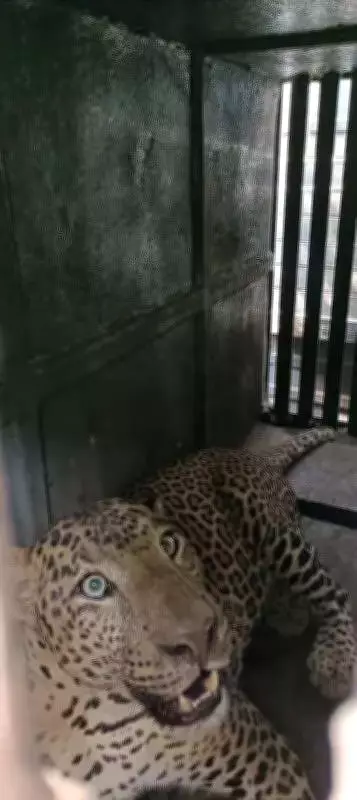
The state forest department has announced plans to establish leopard safari projects at Trimbakeshwar and Yeola in Nashik district. The initiative aims to boost wildlife tourism while mitigating human-leopard conflicts in the region.
Proposal Discussed in Review Meeting
The proposal was deliberated during a review meeting held in Nashik on Wednesday. Forest Minister Ganesh Naik directed officials to prepare a detailed project report (DPR) for government approval. The safari zones are envisioned to be developed within large, fenced forest areas, providing a semi-natural habitat for leopards.
Controlled Wildlife Experience
According to forest officials, the project will offer a controlled wildlife experience. Visitors will be taken on guided tours in designated safari vehicles operated by the forest department. The enclosures will feature double-layer fencing in sensitive zones to ensure animal containment and safety.

Range Forest Officer of Nashik West division, Sumit Nirmal, stated that the exact land parcels are yet to be finalized. "We are planning leopard safaris at Yeola and Trimbakeshwar. The area could be around 25 acres or more, but it will be finalized only after detailed site surveys," he said. He added that the DPR will soon be submitted to the state government.
Rehabilitation of Captive Leopards
Officials revealed that leopards currently in captivity or rescued during conflict situations—such as straying into human settlements—will be rehabilitated in these safari zones. This move is expected to reduce the burden on rescue centers while minimizing incidents of human-wildlife conflict in the region.
Unlike traditional zoos, the safari will provide a more natural setting within a secured environment. Visitors will travel in forest department vehicles accompanied by trained staff or guides who will offer insights into leopard behavior and enforce safety norms. While sightings cannot be guaranteed due to the semi-natural conditions, officials believe the chances of spotting leopards will be higher compared to open forests.
Safety Measures and Infrastructure
Emergency response teams and strict no-entry zones will be integral to the safari infrastructure to ensure both visitor and animal safety. Officials described the project as a model that falls between a traditional zoo and a natural forest experience.