From Village Mud Pits to Professional Arenas: The Evolution of Kabaddi
Evening walks through Indian neighborhoods reveal cricket in countless forms. Young boys use broken bats and taped balls while academy trainees play with proper equipment and coaching. Cricket has become deeply vernacularized across India. Kabaddi, however, followed a completely different path to recognition.
The Many Names of a Single Game
People played this breath-holding game across the subcontinent under various names. Maharashtra called it hu-tu-tu while Madras and Mysore knew it as chedu-gudu. Punjab had jabarjang and Bengal played hu-du-du. Newly independent India rapidly standardized these regional variations.
In 1953, the All India Kabaddi Federation made a crucial ruling. The committee declared that players could only chant "kabaddi" during matches. No other words were permitted. This standardization helped kabaddi emerge as a national sport. Simultaneously, it stripped away much of the game's vernacular and rural character.

Breath, Bodies, and Ancient Origins
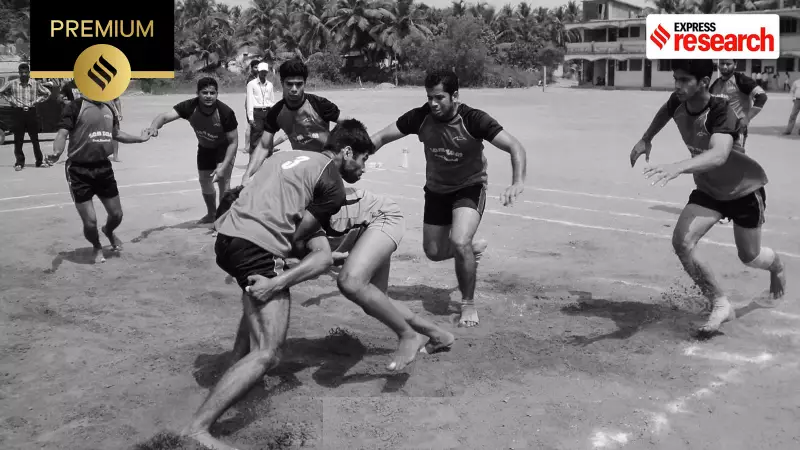
Kabaddi requires an open area with teams separated by a center line. Each side sends a raider across this line to tag opponents called anti-raiders. The raider must complete this action in a single breath while continuously chanting "kabaddi." To score, the raider must touch an opponent and return safely before running out of breath. Anti-raiders try to capture the raider before this happens.
The game's origins remain somewhat mysterious. Some believe it developed as training for hunting or self-defense. Others suggest it functioned as preparation for warfare. Anthropologist Joseph Alter cites an interesting theory. Saints practicing pranayama might have transformed breath-holding exercises into a sport. Many accounts indicate people have played kabaddi since prehistoric times.
Kabaddi's etymology proves equally uncertain. One explanation breaks the word into two parts: ka and baddi. Since ka represents the alphabet's first letter, it may signify "beginning." Baddi derives from barbarana meaning roar. This associates it with animation or coming to life. Thus, kabaddi fundamentally means "to begin living."
Standardization and National Identity
Kabaddi's modern history begins in early twentieth-century India. The sport first appeared at the 1911 Badshahi Mela in Delhi. Around the same time, middle-class enthusiasts organized competitions in Maharashtra's Satara district and Pune. This period coincided with peak nationalist fervor. As Gandhi's Swadeshi movement urged Indians to reject Western influences, kabaddi became associated with patriotic spirit.
Standardization remained elusive for decades. From the late 1920s to 1950, competitions followed different rules under various organizations. The first all-India kabaddi competition occurred in Baroda during 1923. Different groups attempted to standardize rules throughout this period. Kabaddi finally entered the program of All-India Olympic Championships after more than a decade.
The 1936 Berlin Olympics presented kabaddi as India's signature sport. This demonstration occurred during the controversial Nazi Olympics. A private club from Maharashtra showcased kabaddi on this international stage. Sports commentator Charu Sharma calls this episode significant for the sport's history.
Post-Independence Developments
The All-India Kabaddi Federation formed in 1950. National competitions began occurring annually with participation from state and institutional teams. Kabaddi appeared as a demonstration sport in the 1951 Asian Games in Delhi. Sharma emphasizes this inclusion's importance since Asian Games represent the second-largest international multi-sport event after Olympics.
Another significant development occurred in 1955 with establishment of women's national competition. Alter notes that standardization made this possible. A fairly violent masculine game became ungendered while developing into a national sport. India formed the Asian Amateur Kabaddi Federation in 1978.

Kabaddi appeared again as demonstration sport in the 1982 Delhi Asian Games. This paved way for its inclusion in the official program of the 1990 Asiad. Standardization and internationalization helped this essentially rural sport acquire semi-official status as national sport.
Popularity Questions and Cultural Portrayals
Questions about kabaddi's popularity persist despite its national status. In the 1990s, former kabaddi player Shriram Bhavsar claimed Mumbai alone had one thousand kabaddi clubs. He believed kabaddi surpassed cricket and football in popularity. While kabaddi remains popular particularly in rural India, evidence doesn't support claims of it overtaking cricket.
Indian cinema's portrayal of kabaddi reveals interesting cultural attitudes. The 2001 blockbuster Lagaan featured kabaddi briefly. These scenes established it as indigenous, rough game tied to peasant bodies. This contrasted sharply with colonial cricket. The 2004 Tamil movie Ghilli highlighted strength and honor associated with kabaddi. The hero, a kabaddi player, rescues a woman from a local gang leader.
Another film centered on the sport is 2014's Badlapur Boys. Young Vijay plays kabaddi to draw government attention to his village's water crisis. Despite these portrayals, Indian cinema seldom sheds kabaddi's rural, rough-hewn image.
The Professional Transformation
Kabaddi underwent dramatic transformation in 2014 with Pro Kabaddi League and World Kabaddi League launches. The PKL, promoted by Mahindra Group, achieved unexpected success. Its inaugural year attracted 435 million television viewers compared to 560 million for 2014 IPL.
Charu Sharma reflects on his journey as PKL Director. He pushed for kabaddi to gain stronger profile and earn its place among India's premier sports. This effort contributed significantly to Pro Kabaddi League's creation. The league transformed India's kabaddi landscape completely. It presented new, international, competitive, and sophisticated avatar of the sport.
Some opportunities were missed however. India never launched women's pro league despite Indian women remaining among world's best alongside Iran. Meanwhile in Punjab, World Kabaddi Cups featuring ring kabaddi have further popularized the sport. Alter notes that in Punjab, well-built people traditionally played kabaddi. The rich often offered money tied to a pole for the winning side. This entanglement of power and money has sometimes led to violence on kabaddi field.
The Kabaddi Paradox
Alter discovered during 1990s fieldwork why kabaddi continues thriving across regions. The game remains highly accessible. It doesn't require large fields or expensive equipment. Players need only small plot of land and chalk to draw lines. If chalk is unavailable, they use clothes and shoes to demarcate boundaries.
Here lies kabaddi's central irony. Standardization and internationalization forces that drove its popularity may have also contributed to its decline in some forms. The game transformed from diverse regional traditions into unified national sport. This process preserved kabaddi while simultaneously altering its fundamental character.
Kabaddi's journey reflects larger tensions in modern India. Traditional practices encounter modernization pressures. Local identities negotiate with national narratives. Rural roots interact with urban professionalization. Through all these transformations, kabaddi retains its distinctive essence as game of breath, bodies, and boundless energy.