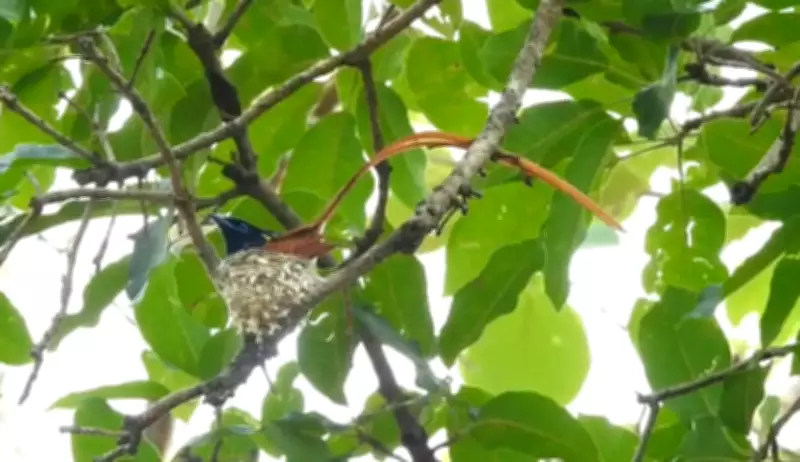
Deep inside the green canopy of Chhattisgarh's Udanti Sitanadi Tiger Reserve (USTR), over a narrow forest trail, a pair of Indian Paradise Flycatchers has been captured in a video perched on a tree branch, building a nest. The clip, shot under the natural shade and saintly silence of the reserve, shows the birds weaving together grass fibres and spider webs with astonishing precision, sparking the curiosity of nature lovers and wildlife enthusiasts while reinforcing the ecological import of the sacred green habitat.
Nesting Activity Observed in Detail
The elegant birds, locally known as 'Doodhraj', were filmed repeatedly flying in and out of a dense woodland patch inside the tiger reserve, carrying nesting material in their beaks before carefully shaping a tiny cup-like nest on a slender tree branch. Forest staff and bird enthusiasts said the sighting is particularly significant because nesting activity reflects not just the presence of the species, but also a habitat secure enough for breeding and raising chicks.
Expert Insights on the Species
Varun Jain, deputy director of USTR, told TOI, “The Indian Paradise Flycatcher (Terpsiphone paradisi), also the state bird of Madhya Pradesh, is regarded as one of India's most spectacular birds. Adult males are instantly recognisable by their silky white plumage, glossy black head and dramatic ribbon-like tail streamers that appear to float through the air during flight. Females and juvenile birds, however, display a striking rufous-brown colour.” He added that the pair was spotted in a moist forest patch near a water source — ideal habitat for the insect-eating fowl species that thrives in dense canopy cover, bamboo patches and riverine vegetation.

Coordinated Nest Building Excites Officials
What has especially excited forest officials is the coordinated behaviour of the pair while setting up the nest. The birds were seen making repeated aerial runs to collect fibres, dry grass, bark strands and cobwebs before delicately stitching them together into a compact nest suspended on a thin branch. A forest official remarked, “The nesting behaviour of the Indian Paradise Flycatcher is a very positive ecological indicator. It shows that the habitat is healthy, undisturbed and rich in food sources required for breeding.”
Ecological Significance of the Flycatcher
Known for its lightning-fast aerial hunting skills, the flycatcher spends hours perched silently on branches before suddenly darting into the air to snatch insects mid-flight. Jain said the species is highly sensitive to habitat disturbance, acting, therefore, as a bio-indicator of forest health. The sighting of the ongoing nesting has added another layer of ecological significance and intrigue to the reserve, which is increasingly emerging not just as a refuge for large animals such as tigers and leopards, but also as a safe sanctuary for birds and lesser-known wildlife species across central India.
For wildlife enthusiasts, however, the highlight remains the surreal image of the long-tailed white male gliding silently through filtered forest light, returning again and again to a tiny nest slowly taking shape in the wilderness.