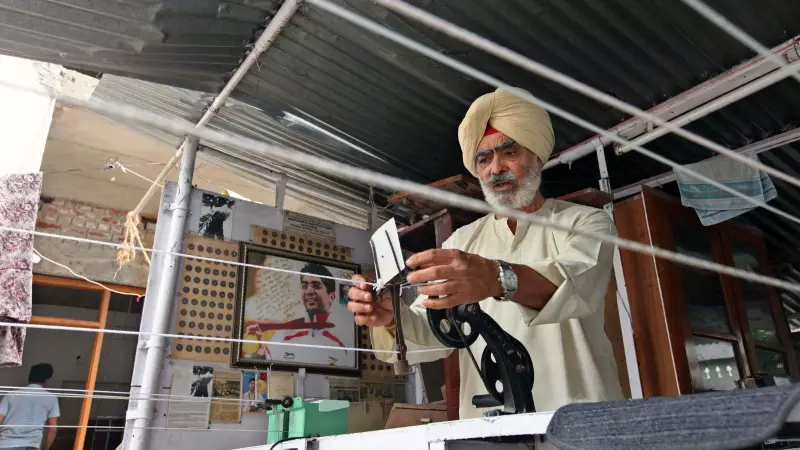
The Indian sporting community mourned the loss of a legendary figure as Colonel Jagir Singh Dhillon, the esteemed coach who guided Abhinav Bindra to India's first individual Olympic gold medal, was cremated with full military honours in Chandigarh on Wednesday afternoon. The 91-year-old veteran, who passed away on December 13, was remembered as a disciplinarian and a patient mentor who shaped the careers of countless shooters.
A Bond Forged in Discipline and Dedication
Beijing 2008 Olympic champion Abhinav Bindra, currently abroad, expressed his grief, calling it a "personal loss." The bond between the shooter and his coach began on July 13, 1995, when a young Bindra first approached Colonel Dhillon for training. Recounting those formative years, Colonel Gulpreet Singh Dhillon, the coach's eldest son, shared intimate details of their rigorous training sessions.
"Abhinav would spend hours training under my father at the shooting range built at our home, house number 316 in Sector 35," he said. The coach's philosophy was clear: discipline was non-negotiable, but it had to be paired with immense patience for young talents. The results were swift and spectacular. Within six months, Bindra clinched gold at the Ropar District Shooting Championships. By August 1996, he had shot a perfect score of 600 out of 600 in a Chandigarh competition, signaling the arrival of a prodigy.

From Army Cadet to Architect of Olympic History
Born in 1934 in Sur Singh village near Khemkaran, Punjab, Jagir Singh Dhillon's own journey was one of remarkable achievement. He joined the Indian Army's Corps of EME in 1953 in Secunderabad and soon discovered his talent for shooting. His competitive career spanned over five decades, from 1953 to 2004, during which he won more than 200 medals in national air rifle and rifle events. He also represented India at the 1970 and 1978 Asian Games and a Commonwealth Shooting Championships.
Interestingly, during his early army days, he was a roommate of the legendary sprinter Milkha Singh. Colonel Dhillon transitioned to coaching in 1989, setting up a range at his Chandigarh residence. His association with Bindra, which started with a letter from the aspiring shooter, lasted for three decades. In a 2016 interview, Dhillon had recalled, "He has trained more than 37,000 hours with me since he first came to me."
The Pinnacle: Beijing Gold and a Lasting Legacy
The defining moment for both coach and protégé came on August 11, 2008. As Abhinav Bindra stood atop the podium at the Beijing Olympics, winning gold in the men's 10m air rifle, his coach celebrated an emotional victory with Bindra's parents, Apjit Singh Bindra and Babli Bindra, at their Zirakpur residence. "When Abhinav won the Olympic gold, my father was elated about his trainee creating history," shared Gulpreet Singh Dhillon.
Colonel Dhillon's coaching genius lay in his ability to nurture without holding back. Once Bindra matured into a national-level shooter, his coach wisely advised him to seek international training to hone his skills further. His influence extended far beyond his most famous student. Paris Olympics fourth-place finisher and ISSF World Cup medallist Arjun Babuta began his shooting journey under Dhillon in 2011.
Babuta remembered the coach as a transformative figure. "The first lesson J S Dhillon sir taught me was discipline... He would show me Abhinav Bindra Sir's score sheets," Babuta said. After one of Babuta's early victories, Dhillon gifted him a jacket of Bindra's, telling him, "You are the next Abhinav." These words, Babuta noted, continue to inspire him daily.
The final rites in Chandigarh marked the end of an era for Indian shooting. Colonel Jagir Singh Dhillon leaves behind a legacy built on military discipline, unwavering patience, and a profound belief in his students' potential—a legacy that literally shot for the stars and brought home Olympic glory.